

Maybe You Are Not ADHD; Maybe You Are Nonlinear
and— you are not confused!

Are you ever seen as a square peg in a round hole?

Do you ever feel that you are the odd person out at a social gathering?

Have people ever called you a Jack [or Jill] of all trades, master of none?

Have you ever been told that you have the components of ADD or ADHD?[And that you should probably take some medication?]

Do you feel [or know] that your brain goes off in 10 different directions at the same time?
Did you say yes to a few questions?
Did you say yes to many questions?
Are you starting to think that maybe something is wrong with you?

I have a surprise for you and am letting the cat out of the bag!
There is nothing wrong with you, your brain, your learning, your competence, or your social skills….
Please stop thinking about yourself in the negative terms you have been told describe you…….
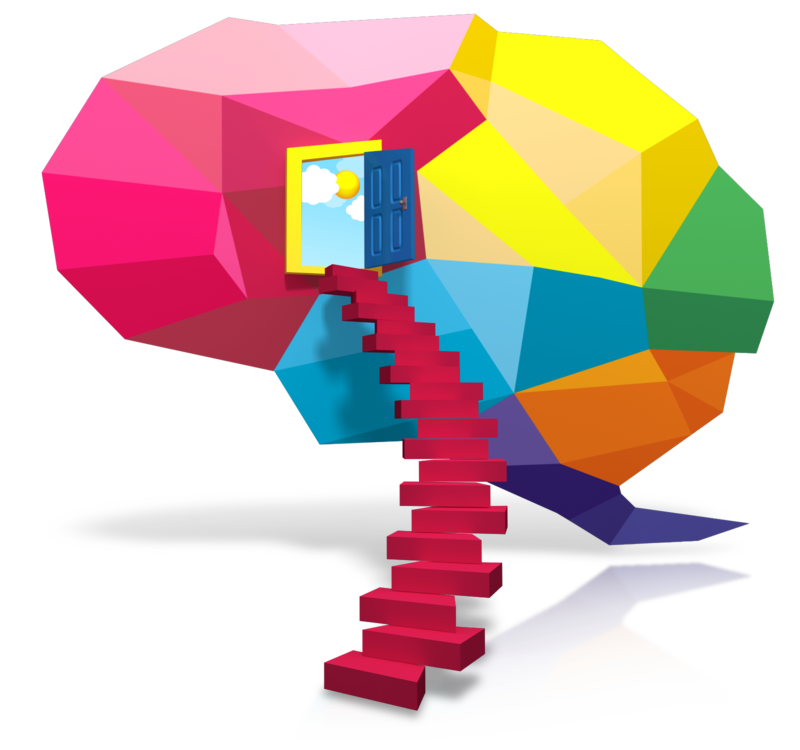
you probably have a nonlinear brain or a nonlinear mind
[By the way, I have no idea what a non-linear brain looks like but to me, it feels like this colorful open brain with an entry path for everything. I see myself as having a brain like this — it loves images and does a lot of its learning via visual cues. Hence all my articles, posts, books, and courses have lots of images.]
If at this point you find yourself asking “what the heck is a nonlinear brain” you are probably in that supermajority of people who have a linear brain — and you probably didn’t answer yes to many of the above questions.
If this is you, the linear one, and you are still reading this — you may not really understand what I will be writing about because many linears find it difficult to imagine what it is like to think like a nonlinear thinker, or have brains like ours — and to accept it all as “there is not a thing wrong with us.”
And worse, you might be saying to yourself right now — “it’s all a crock of b.s. anyone can multitask and concentrate— yes even in the midst of many other things impinging on your attention.”
But that small percentage of us who are nonlinear — we get it. We also understand that the linear minded among us don’t get it — we can see both sides of the picture. And we know that some are unable to do so.
One reason for my writing this is to let nonlinears know that they are not alone — that what goes on in their brain does not really mean anything is wrong with them and that they’re in good company. Another reason is to [hopefully] explain to the linear minded what it’s like to be one of the nonlinears.
If you are that skeptic and are still thinking ‘what the heck,’ you might try suspending that skepticism for a just a bit and read on…
We are real, our brains our real, and we can’t always turn them off to make them or us fit into your world — the linear world that most people inhabit. And yes, I am a strong nonlinear! So when I say we, I am including myself.
What is a nonlinear mind?
Caveat: all this information comes from my [nonlinear] head. It is not scientific as it’s based on my own personal experience and experiences of nonlinear friends of mine.
A nonlinear mind is a mind that’s constantly in motion — scanning, thinking, creating, and jumping from point A to point H without seeming to pass through points B to G.

What this feels or sounds like to a linear mind. “You went from A to H. That’s not right!”

The nonlinear person actually had a path in their mind and that path included points B, C, D, E, F, and G but it went from A through B, C, D, E, F, and G all the way to H in nanoseconds and without saying anything aloud. So all you heard was A and H.
The nonlinear person actually had a path in their mind and that path included points B, C, D, E, F, and G but it went from A through B, C, D, E, F, and G all the way to H in nanoseconds and without saying anything aloud. So all you heard was A and H.
We could, at some later time, [maybe] fill you in on the B to G parts. We just didn’t see a need to include all that in the conversation right now.
We are aware that this “thought jumping” is very frustrating to some [most? many?] of the people we are speaking with, but there are times we really cannot stop and fill in all those parts because our brain literally has gone so far ahead.
Our brains are moving so quickly that our words are unable to keep up with the thoughts as they are formed; so yes — we leave out lots of those words and thoughts. They are often left unspoken. Our nonlinear friends “get” those steps that others might, or do, see as “missing.”
Conversations between two or more nonlinear people probably sounds bizarre to the linear minded. The conversations may seem confused, disconnected, and/or on several topics at the same time — with many or all of the people speaking simultaneously.
Yet the nonlinear people having those conversations understand each other very well. We understand all the concurrent conversations going on and correctly fill in the blanks between the “thought jumps.”
[I was once at an amazing dinner party with other nonlinears where the flowing conversation was happening in four different languages. No one was translating any of the languages into any of the others but we all understood what everybody else was saying. That included me, and the only language I fully understood and spoke fluently was English. But I knew enough words in the other languages that I could enter into the conversation [speaking and replying only in English] but replying to a person who might just have raised a point in French, Flemish, or Hebrew. It still boggles my mind that we all knew what everyone was saying and we all enjoyed the evening.]

Additionally, we nonlinears tend to finish your sentences for you and we guess ahead as to the conclusion that you are trying to reach because our mind got there faster than you were able to say it and we of course have to say it aloud. It can be very annoying or at least frustrating for a linear minded person to try to have a conversation with a nonlinear person.
This can get worse if the nonlinear person is a bit stressed by your annoyance and frustration or was perhaps stressed or emotional, to begin with. Emotions seem to play great havoc with the nonlinear brain — creating more paths that open and more places to go — but in other directions.
This is not a slight to you. We are not trying to dominate the conversation, and we are not purposely trying to step on your words and thoughts, it is just that sometimes we cannot control what our brain is doing, especially if we get excited or stressed. Then our words come spilling out without much control.
Try to understand us — please…
Ok, I say — above is what we do.
Okay, you say back. But why are you like that? and how can we have a conversation?
It’s not clear to me why some of us nonlinear while many are not.
It probably is genetic and it also might be influenced by one’s development, much like all of development. It seems you either are linear or nonlinear and it makes a major difference in your life, your education, your careers, in your friendships, and in your socializing. But we are not ADHD! We may share some characteristics, but I repeat — we are not ADHD! [And my take on ADHD is yet another soapbox for yet another article.]
There is nothing you can do to get our nonlinear minds to stop being nonlinear. We are what we are!
The best you can do is to gently convince us to stop talking, take a deep breath, and somehow focus on what you are saying.
BUT
You have to do this gently and with compassion

When we are rudely asked to keep quiet or are yelled and told to shut up —we get more frazzled, and talk more, not less. And we then also talk faster!
If approached gently, we can realize that we have been running off at the mouth and that people are getting annoyed with us. We can take our own time out and be quiet.
It’s sometimes easier if we leave the conversation and come back later or just go quiet and stop talking for a while…We are capable of quietly listening but I admit, at least for me while I am continuing to listen to the ongoing conversation or just what you are saying my mind is still racing around all over the place. I may remember later to reply to you but I may not.
It takes some nonlinear people extra mental effort to stick on one conversation topic — but it can be done.
We, like anyone else, can also stick to a task and get it done. But like some racehorses, we almost have to put blinders on and become very compulsive about finishing that particular task.
So if a nonlinear person is working on something — they may basically seclude themselves until the project is finished because they understand how easy it is for them to get sidetracked.
Depending on the project, nonlinear people may not completely finish because once they have figured out the part that was of interest to them, they are all too able to put it aside and go on to another project.
This does not mean that the nonlinear person is a procrastinator or a non-completer kind of person or that they have anything “wrong” with them.
When working with nonlinear people, it is good to remember this — especially if it is a project that you know really needs to get completed in a timely fashion.
But as I mentioned above [with blinders on and staying away from distractions,] the nonlinear person can actually finish tasks and do them very well. Many nonlinear people get PhDs, JDs, MBAs, and MDs — or a few of these per person!
And nonlinears do become attorneys, physicians, executives, etc. who have very tight deadlines to deal with and a flurry of paperwork that has to be finished, organized, and sent out to the correct recipients. They are the dreamers who can see all the connections — but they also learned how to manage the smaller parts or learned to delegate them.
More about us
There is almost no conversation, book, or whatever that the nonlinear person can’t look at and think “I interested in this” — because nonlinear people are very interested in most anything and everything.
The Internet is a boon to the nonlinear mind. It’s also somewhat of a trap in that the nonlinear person can go from topic to topic to topic clicking on all those links because everything is so fascinating.
There was a saying going around online — do you know what my mind is like — it’s like having 100’s of tabs open on your browser at the same time. It was a great description of a nonlinear mind.
Nonlinears are people with brains just like everyone, but those brains work differently. They are open, curious, and often unable to contain their thoughts.
The world is changing, and because of the Internet we are meeting many different types of people, and we can interact with them on a daily basis through social media. We all need to learn how to interact with and encourage everyone — because we are all of value.
This is especially true for the nonlinears, because we are the ones that are too often seen as having something wrong. And that same Internet has led us to find each other — and that itself is a GREAT thing! We are not alone!!

We should be encouraging these thinking differences and celebrating them — all types of thinking are needed for this current state of the world.
To the friends, teachers, parents, and coworkers of we nonlinears:
Please try to understand us….

This is an edited version of part of a book I wrote, and more of it will be appearing here on Medium.