
May 1995: Deborah Curtis’s Book on Ian Curtis and Joy Division
When Touching From A Distance was published 15 years after Ian’s death, I spoke to Deborah for City Life magazine.
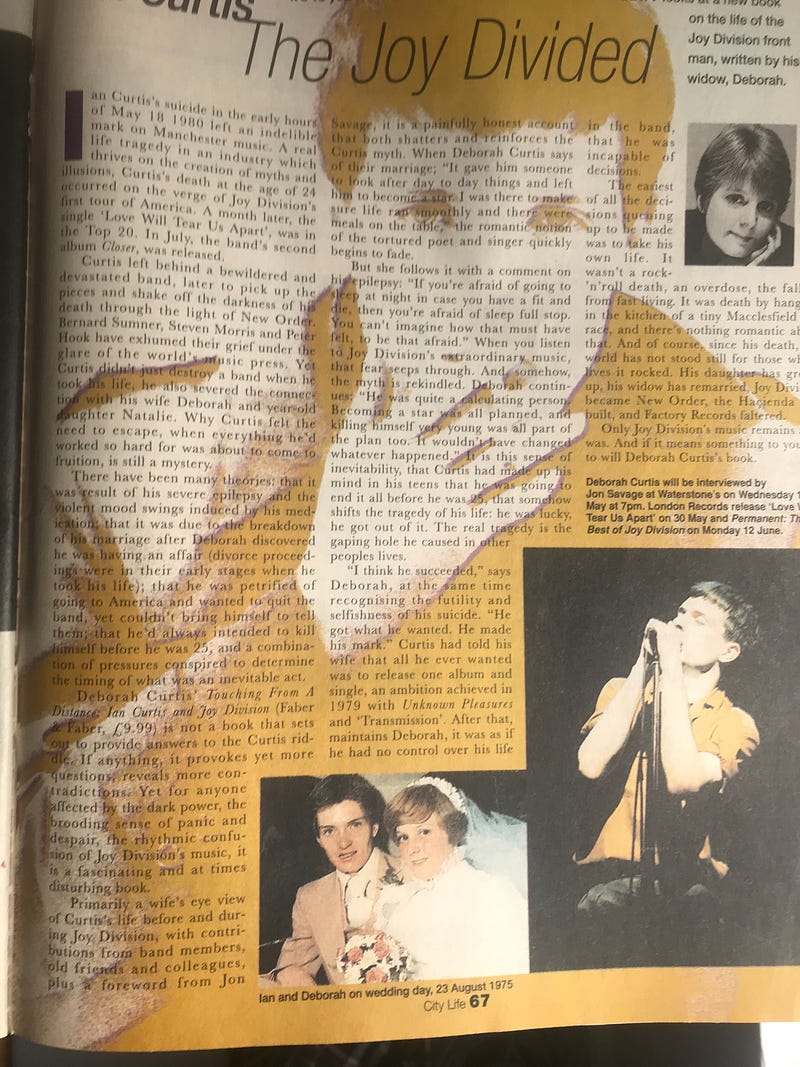
When Deborah Curtis published her book Touching From A Distance: Ian Curtis and Joy Division, I was lucky enough to interview her for Manchester’s City Life magazine.
Deborah lived in the countryside on the outskirts of Macclesfield, a relatively short drive from where I was living in South Manchester.
Unlike many interviews at the time, which were either done over the phone or in a bar or pub, I was invited round to her place for a chat.
I was a little nervous about meeting her and perhaps inevitably I got slightly lost on the way. I remember having to stop to consult my road map a couple of times, although I don’t think I got there late in the end.
Goodness knows what Deborah thought when I pulled up in front of the house in my battered white Austin Maestro van. It was a practical vehicle, but pretty low on the hip quotient — more suited to a plumber or decorator than a freelance journalist.
Still, Deborah didn’t come across as someone overly bothered by hipness. She seemed grounded, straightforward, practical and caring — the yin to Ian’s yang, perhaps?
We did the interview in the front room of the family home, which I seem to remember was cottage-like and painted white. Deborah made tea and I think there were biscuits, too.
It was a strange feeling to be in such a cosy, domestic setting as Deborah discussed her late husband and her reasons for finally telling her side of the story 15 years after his death.
To me, Ian Curtis was a post-punk icon, a tragic figure whose aura of existential angst and darkly poetic lyrics made him a truly great frontman.
Obviously Deborah saw him from a very different perspective.
The piece I ended up writing for City Life was part book review, part interview. It was squeezed into the back of the magazine rather than in the main front feature section — my editor at the time had needed some persuasion to run an interview rather than just a review, so I guess this was some kind of compromise.
Re-reading the piece today (thanks are due to Dave Haslam for digging it out for me), it seems strange that I didn’t write about meeting Deborah and how she came across. Perhaps that wasn’t my brief…
The book — which really is a great read— became the basis for the 2007 film, Control, directed by Anton Corbijn. The screenplay was by Matt Greenhalgh, who incidentally was also a City Life writer at the time I interviewed Deborah. He did a fantastic job with the film.
And here’s the piece I wrote way back then…
Deborah Curtis: “Ian was quite a calculating person. Becoming a star was all planned, and killing himself very young was all part of the plan too.”
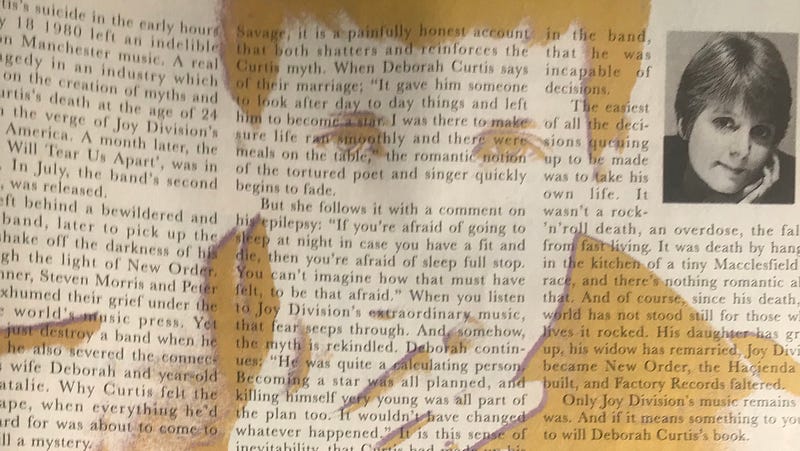
Ian Curtis’s suicide in the early hours of May 18 1980 left an indelible mark on Manchester music. A real-life tragedy in an industry which thrives on the creation of myths and illusions, Curtis’s death at the age of 23 occurred on the verge of Joy Division’s first tour of America. A month later, the single ‘Love Will Tear Us Apart’ was in the Top 20. In July, the band’s second album, Closer, was released.
Curtis left behind a bewildered and devastated band, later to pick up the pieces and shake off the darkness of his death through the light of New Order. Bernard Sumner, Stephen Morris and Peter Hook have exhumed their grief under the glare of the world’s music press. Yet Curtis didn’t just destroy a band when he took his life, he also severed the connection with his wife Deborah and year-old daughter Natalie.
Why Curtis felt the need to escape when everything he’d worked so hard for was about to come to fruition is still a mystery. There have been many theories: that it was a result of his severe epilepsy and the violent mood swings induced by his medication; that it was due to the breakdown of his marriage after Deborah discovered he was having an affair (divorce proceedings were in their early stages when he took his life); that he was petrified of going to America and wanted to quit the band, yet couldn’t bring himself to tell them; that he’d always intended to kill himself before he was 25, and a combination of pressures conspired to determine the timing of what was an inevitable act.
Deborah Curtis’s Touching From A Distance: Ian Curtis and Joy Division is not a book that sets out to provide answers to the Ian Curtis riddle. If anything it provokes yet more questions, reveals more contradictions. Yet for anyone affected by the dark power, the brooding sense of panic and despair, the rhythmic confusion of Joy Division’s music, it is a fascinating and sometimes disturbing book.
Primarily a wife’s-eye view of Curtis’s life before and during Joy Division, with contributions from band members, old friends and colleagues plus a foreword from Jon Savage, it is a painfully honest account that both shatters and reinforces the Ian Curtis myth.
When Deborah says of their marriage, “It gave him someone to look after day-to-day things and left him to become a star. I was there to make sure life ran smoothly and there were meals on the table,” the romantic notion of the tortured poet and singer quickly begins to fade.
But she follows it with a comment on his epilepsy: “If you’re afraid of going to sleep at night in case you have a fit and die, then you’re afraid of sleep full stop. You can’t imagine how that must have felt, to be that afraid.” When you listen to Joy Division’s extraordinary music, that fear seeps through, and somehow the myth is rekindled.
Deborah continues: “He was quite a calculating person. Becoming a star was all planned, and killing himself very young was all part of the plan too. It wouldn’t have changed, whatever happened.” It is this sense of inevitability, that Curtis had made up his mind in his teens that he was going to end it all before he was 25, that somehow shifts the tragedy of his life: he was lucky, he got out of it. The real tragedy is the gaping hole he caused in other people’s lives.
“I think he succeeded,” says Deborah, at the same time recognising the futility and selfishness of his suicide. “He got what he wanted. He made his mark.” Curtis had told his wife that all he ever wanted was to release one album and single, an ambition achieved in 1979 with Unknown Pleasures and ‘Transmission’. After that, maintains Deborah, it was as if he had no control over his life in the band, that he was incapable of decisions.
The easiest of all the decisions queuing up to be made was to take his own life. It wasn’t a rock’n’roll death, the fall-out from fast living. It was death by hanging in the kitchen of a tiny Macclesfield terrace, and there’s nothing romantic about that. And of course, since his death the world has not stood still for those whose lives he rocked. His daughter has grown up, his widow has remarried, Joy Division became New Order, the Haçienda was built, Factory Records faltered.
Only Joy Division’s music remains as it was. And if that means something to you, so too will Deborah Curtis’s book.
Originally published in City Life 279, May 1995


