
How can I form valuable partnerships for my biotech company?
After writing about my startup experience here on Medium, I started to receive a bunch of emails with questions about startups, entrepreneurship, product, etc. Even though I’m also at the beginning of my startup journey, I was encouraged to write up my advice/answers publicly. Hopefully, you enjoy the way I write and think. Send your questions to [email protected]
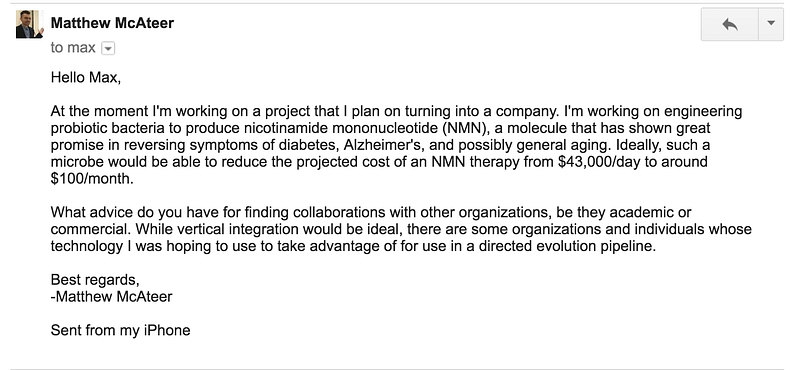
QUESTION: “How can I form valuable partnerships for my biotech company?”
Firstly, I love getting questions like this, where the subject matter is outside my realm of awareness. It sounds like you are doing some really interesting work.
Since it sounds like you’ve already identified potential collaborators, I’m going to focus on how you can turn those “leads” into actual partnerships.
Let the other person say no
The hardest part of forming partnerships is usually psychological: Most people convince themselves that they haven’t yet “earned” the right to partner with a major company or esteemed academic. And as a result, most people talk themselves out of ever trying to connect with these potential partners.
So, the best advice I have on creating partnerships is this: Let the other person say no.
To do this, you need to shift your mindset from “rejection mitigating” to “upside maximizing”. In other words, you need to strive to form partnerships with the best possible companies and people. If you do, there is of course the possibility that you will be rejected, but there is also the opportunity that you will get a “yes” — and typically all you need is one “yes” to change the trajectory of your company.
It’s very easy to find reasons why the other person might not want to work with you, but leave that to the other person . You are doing amazing work, and you should give yourself the opportunity to work with amazing people.
If you put yourself out there, the worst thing that can happen is nothing. If you don’t put yourself out there, the best thing that can happen is nothing.
The choice seems pretty clear.
If you can convince yourself to reach out to the potential collaborators you’ve identified, then the rest is pretty easy.
Tactics: Finding email addresses and writing pitches
Once you have an “upside maximizing” mindset, there are a few tactics that may help you more effectively connect with potential partners.
(1) Finding email addresses
The best way to connect with potential partners (in this space) is via email. In other spaces, it’s sometimes easier to make the initial connection via a direct message on Twitter/Instagram, but even in those cases, I like to transition the conversation to email.
For academics, their emails addresses are almost always available on their university’s website. Google their name and university, and you will almost always find the academic’s “homepage”, which will include contact details.
For companies, you will need to identify particular people within that company that you can email. For smaller companies/startups, this could be the CEO or the VP of business development/corporate development. For bigger companies, you can try connecting directly to someone in the relevant department.
To find these people, start by using LinkedIn. Let’s say I’m looking to connect with someone in business development at the biotech company Amgen. (I think you may be better off connecting with somebody directly in the relevant department, but since I’m not sure what that department would be, I’m just going to use “Business Development” in this example).
I would google something like “Business Development Amgen LinkedIn”.
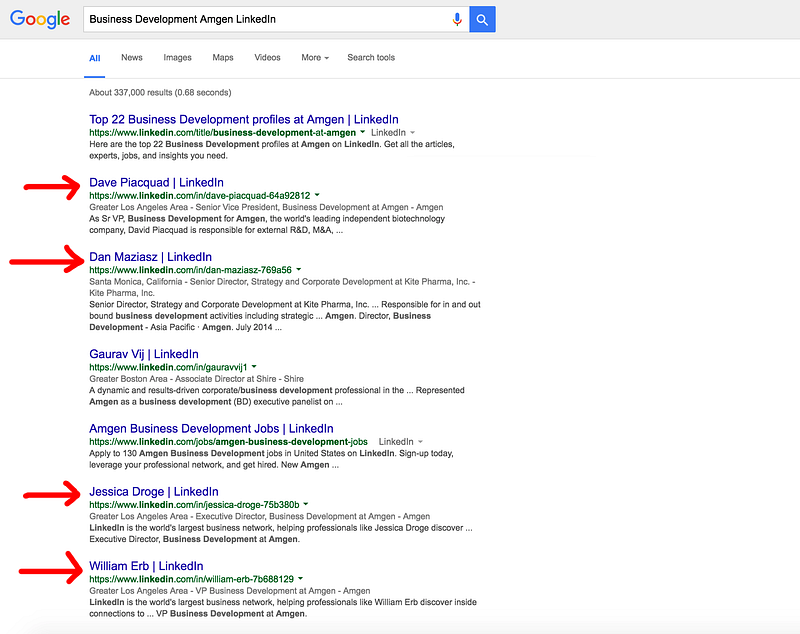
Out of the first seven results, four look like promising leads. I’ll click through on the first one — Dave Piacquad.
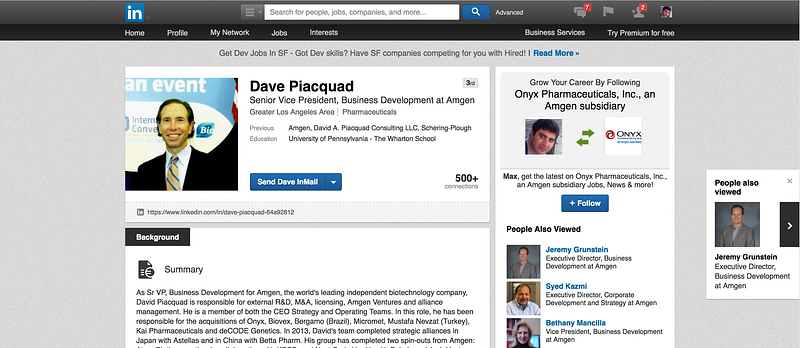
The next steps is to use a Chrome extension called Rapport to reverse lookup Dave Piacquad’s email. (Rapportive only works with Gmail)
With Rapportive, you feed it an email address you know, and it will tell you if there is a LinkedIn account associated with the email address. But, you can also try to guess the email address, and if you guess correctly, Rapportive will confirm the email by showing you the LinkedIn account you found earlier.
This is actually fairly straight forward since most corporate email addresses have similar formats. Here are my guesses for Dave Piacquad’s email:
- [email protected]
- [email protected]
- [email protected]
- [email protected]
- [email protected]
- [email protected]
- [email protected]
- [email protected]
To start guessing, I open Gmail, compose a new message, and type my guess into the “To” field. If I guess incorrectly, Rapportive will show me a question mark.
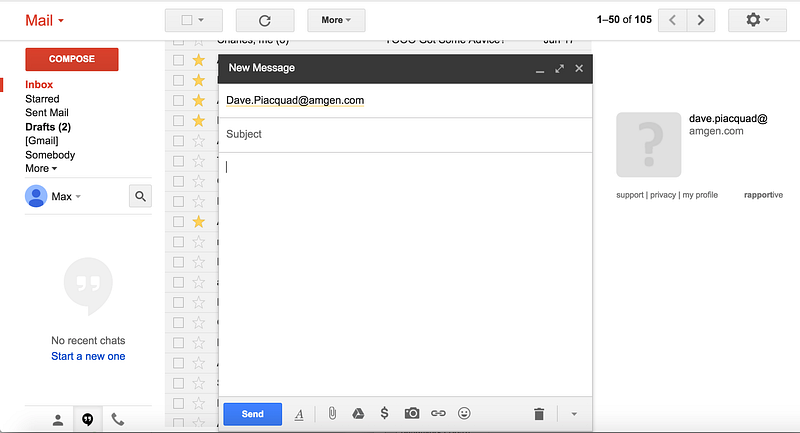
If I guess correctly, Rapportive will show me the associated LinkedIn account.
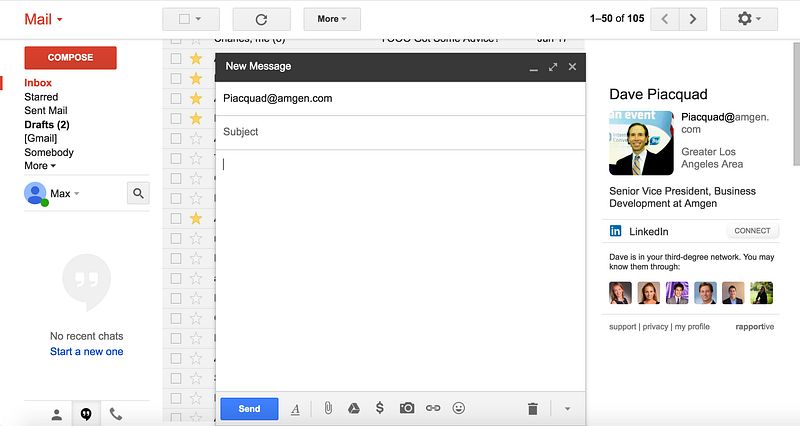
I can then click through to the LinkedIn account to confirm.
If you are having trouble guessing correctly, head over to Google and search for “Amgen corporate email format”. In some cases, corporate emails have different extensions than you might expect (for example, Goldman Sachs uses [email protected] and Yahoo uses [email protected]).
Update: Since posting, a few people have also recommended checking out Email Hunter for finding emails.
(2) Writing your pitch
Once you find the relevant email address, you will need to craft and send your “pitch” via email.
A good pitch is short and should only have a few components: 1. Introduce yourself, 2. Introduce your company/project, 3. Explain why you’re reaching out, 4. Call-to-Action.
Here’s an example:
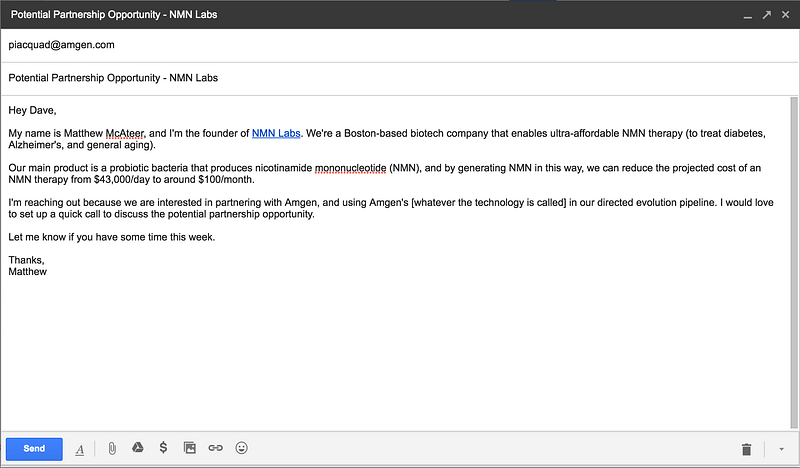
Typically, my Call-to-Action is setting up a phone call. I find it much easier to work out the details of a potential partnership over the phone.
If you don’t hear back within 2–3 days, send a quick follow up. “Hey Dave, Just following up on the message below. Let me know if you have some time for a quick call. Thanks, Matthew”. Most likely Dave saw your message and meant to respond, but got caught up doing something else and forgot.
If you still don’t hear back, wait a week and try one more time. If that doesn’t work, try reaching out to somebody else.
If Dave gets back to you, and says he can’t help, ask him to connect you with someone who might.
Once you’re on the phone with Dave, simply explain what you are hoping to get out of the partnership. You may feel inclined to give Amgen something in return (like a stake in your company), but don’t offer this right away. Again, give them the opportunity first to tell you what they want from the collaboration. Many times, they may just want to help, and that’s enough.
If you feel like your conversation is stuck, you can then try offering something to the potential partner. You can also try pitching the partnership as something more temporary. For example, “We can try working together in this capacity for three months. If it goes well, we can determine the terms of the longer partnership then”. By making the partnership seem less of a commitment, it may be easier to get your foot in the door. Once you get things going, you’ll have inertia on your side.
I would also recommend giving your company a name, and making a very basic website (you can use carrd.co or strikingly.com). The name makes your company more tangible and easier to talk about, and the website gives you a place to provide extra information, so you can keep your pitch short.