
Any growth ideas for my FinTech startup?
After writing about my startup experience here on Medium, I started to receive a bunch of emails with questions about startups, entrepreneurship, product, etc. Even though I’m also at the beginning of my startup journey, I was encouraged to write up my advice/answers publicly. Hopefully, you enjoy the way I write and think. Send your questions to [email protected]
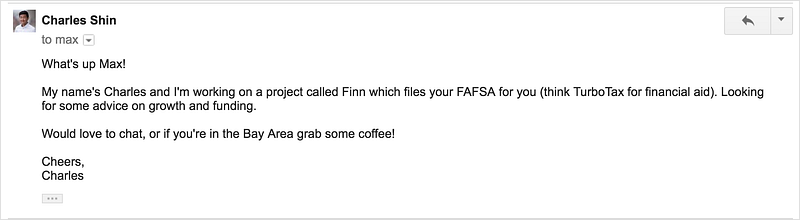
QUESTION: “Any growth ideas for my FinTech startup?”
Firstly, I think this is a great concept (Finn is “TurboTax for financial aid”) and hope the product is successful (If you agree, you can sign up for Finn’s Beta here).
Here are some quick growth ideas that come to mind:
1. Become the FAFSA authority (via content)
For a product like Finn, trust is everything. Presumably, Finn will require that users share sensitive personal info (like their family’s tax return and social security number), and if Finn doesn’t have my utmost trust, there is no way that I’d be willing to relinquish this info. Without trust, I also wouldn’t feel comfortable recommending Finn to any of my peers.
So, your primary concern should be establishing trust.
I think the best way you can do this is by producing high-quality content (written, video, etc.) that’s tangentially related to financial aid. This can include 1. Understanding FAFSA, 2. Scholarships, 3. Personal finance for students, 4. Choosing the right college for you, 5. Picking a college major, 6. Transitioning from high school to college, etc. The content doesn’t even need to be directly related to Finn, as long as it resonates with your target market. In fact, you shouldn’t try to directly sell Finn with any of this content.
Good content will help accomplish four main things:
(1) It will position you (and Finn) as a trusted “financial aid authority”
The more you write, the more expertise you can demonstrate, and the more trust you can build. Also, the more times Finn’s name is associated with valuable content, the more authoritative Finn becomes — it’s simply impossible for humans to overcome “recognition bias”.
Note: Your instinct might tell you to present Finn as an abstracted, impersonal black box, so that the service feels more “official” and less like someone’s side project. But, I think the ambiguity of a black box is much worse from a trust perspective, than a more human-centric approach.
You should use your content as a way to build a personal relationship with your users. Trust is a very personal thing, so you should treat it as such.
(2) It will help you generate more leads
If you write an article about “picking a college major”, you won’t be selling Finn anywhere within the article. But, you will be giving your target market something super valuable, which will compel many readers to investigate the source of this value — i.e. Finn. (In the same way, some readers of this post will scroll to the bottom, read the byline, click on the link for my company, and become customers).
Writing tangentially related content gives you the ability to create more access points to the world of Finn.
(3) It will make Finn more “distributable” because people prefer stories
You can only share the link to Finn on Facebook so many times. But, you can share infinitely many stories around areas of interest. Like this one: How Students Missed Out on $2.7 Billion in Free FAFSA Money
(4) Overcome seasonality
Like TurboTax, Finn will be a seasonal business with much of its activity in the early part of the year. In the off-season, you can focus on driving growth via consistent, valuable content. Growth can take the form of capturing email addresses or building a following on a particular platform (i.e. Medium, Snapchat, Twitter, etc.). Then, when “FAFSA season” comes around, you will have an engaged audience that you can convert to customers.
I know “content marketing” is often hard to motivate because it’s more challenging to mathematically correlate your efforts with a direct ROI. Give it a chance though. I think content is a really important part of your business.
2. Cheap, targeted ads
Depending on your budget and monetization model, financial aid seem like a great space for direct, targeted ad campaigns on Google and Facebook. Here’s what I found:
If you search for “FAFSA” or “Financial Aid” on Google, the search results are consistently void of any ads. This probably means that there aren’t very many parties bidding on these keywords. Without competition, you can probably show up on nearly every “FAFSA” and “Financial Aid” Google search for very cheap.
On Facebook, you can create a custom audience for your ads filtered by education level, age, and household income, as well as a number of other parameters including “people who have expressed an interest in or like pages related to FAFSA”.
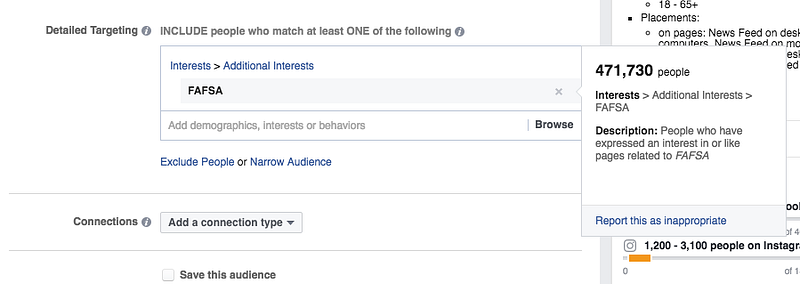
You can also try a different ad set directed at parents, since I suspect it’s often the parents who file FAFSA.
For your Facebook ads, try linking to the direct site, as well as to your content. I suspect the content will outperform a lot of the time.
3. Guidance counselors
Depending on your business model and enjoyment of B2B-like sales, you may want to consider selling to guidance counselors and schools, rather than individuals. This can be a much higher leverage sale (i.e. you sell to one school and 500 students become users).
Additionally, from a monetization standpoint, I suspect guidance counselors would be highly incentivized to pay for and recommend Finn to their students. Here’s my reasoning: If a guidance counselor’s student gets more financial aid, the student is more likely able to attend a more prestigious private university, which reflects nicely on the guidance counselor.
Even if you prefer to sell direct to consumer (rather than packaged up in “school-wide” bundles), guidance counselors are certainly a great channel to market through. You can experiment with content and ads directed at guidance counselors, and see how those perform.
There are of course many other ideas. You could partner with a company in a tangential space like The Common App, The College Board, The Princeton Review, etc. You can create a promotional event, where one Finn user wins “free college” (sponsored by a company you partner with). You can give students “credits” to Finn for referring other users. And so on.
You also asked about ideas on funding. I’ll leave that for another post.