
Mavlo’s Education
Short Story, Long Road
A boy with thick blonde hair, brown eyes, and budding muscles performed sleep and dreaming in a crude hut on the shore of a western continent, 38 degrees north of the unfamiliar equator. He woke with the sun, listened for weather and waves, then rose and went to drink handfuls of rainwater from the hollow of a cratered rock. He untied a patch of crude cloth, took a few nutmeats and dried berries, chewed, swallowed.
“Now,” he thought using images, not words, “I will make a new adventure.”
Walking through a field of tall foxglove lit by the sounds of buzzing bees, Mavlo put each foot forward exactly eleven marks at a time. “O, Uh, E, M, Ah, Buh, I, Ss, Tuh, Zet, Juh,” he counted by his own system. Using an invented ruler, the boy believed that measuring movement on a curve was the best game he’d ever played.
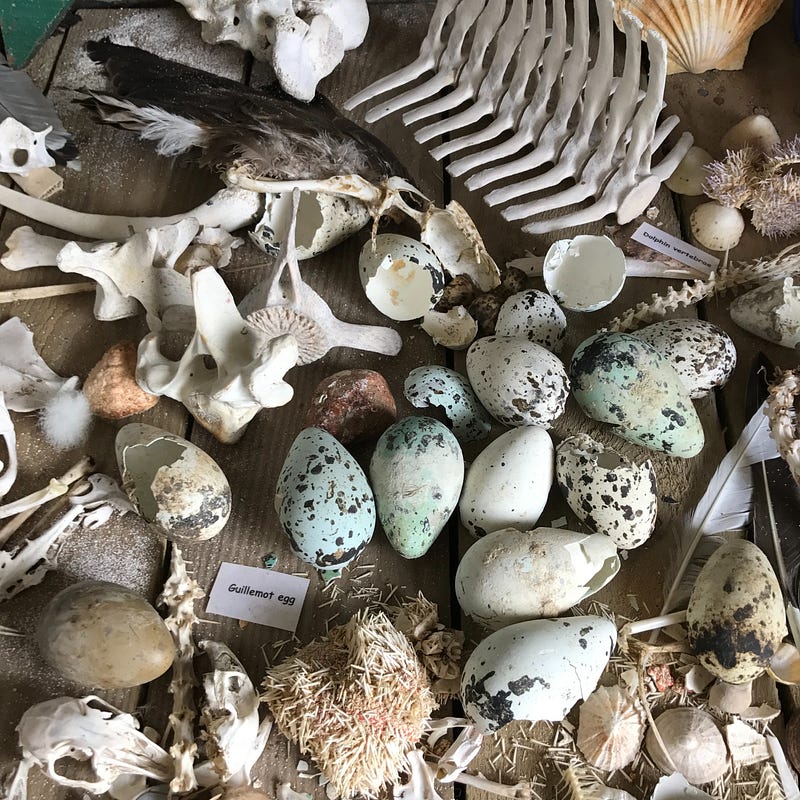
One warm sunset several days before, when the idea of counting steps to make magic was a blue dot in his imagination, Mavlo found a white curved stick, like wood but not wood — unbeknownst to him, it was a piece of whalebone — sticking out of the spiky beach grass on a wide stretch of sand between his hut and the sea’s lip. He tossed it towards an unblemished sky to watch it turn over on its way back to the soft, dry sand. Then he flung it from the side to test horizontal airborness. Only the birds heard Mavlo’s utterances and understood his meaning to be: “This thing will bring me pleasure. With it I will construct a new world.”
It slid through the air like a djinn on a flying carpet. Mavlo’s mind held the image of a bearded man with a triangled hat and billowing clothing who sat on thick cloth supported by air. He’d seen the picture on a tattered paper found while scavenging the beach.
He had no letters to make the sounds that represent “djinn” or “paper.” All he had was memory of a long-gone woman and found objects with which to build his education. With parents as unknown as the equator, Mavlo had no word for “orphan,” but he’d been made one by an ocean angry with the ship that carried his family about a mile from the shore that was the edge of his life.
For the uncounted hours between infancy and mobility on two legs, Mavlo was raised and protected by a traumatized woman who could not speak. When Mavlo’s head reached the height of her shoulders, she fell into a deep sleep and never woke. Her body attracted worms and creatures with wings, so Mavlo dragged her away from the shelter and into the sea’s shallow water. Her corpse soaked the motion of the rolling waves in a liquid that tasted of the water that came out of Mavlo’s eyes. The sound of water wrapped them as it both disposed and comforted in the way of Nature.
From that day, the sound of waves comforted Mavlo as he became used to his singularity and made a reality based on meeting needs. All his actions were rooted in the saving grace of curiosity. And now, against the music of the waves, Mavlo discovered the bone.
When he tired of tossing it, Mavlo sat under the nut-giving tree and examined the bone using all of his physical and intuitive senses. Taste — no, he didn’t want to eat it. Touch — smooth, curved, satisfying in his hands. Smell — dry, no moisture scent. Sound — it was interesting to put each end into his ear, but it only served to block the sounds of waters and winds. Sight — white, white, white. Intuition — “How can I change it?”
Taking it in hand for another walk on the beach, zigzagging from shore to meadow and back, Mavlo thought and thought until hunger gripped his belly. Laying the bone at the base of a berry bush, he grabbed twigs and stabbed the berries until he’d constructed a lollipop lunch.
While eating and thinking, he kicked at a slice of stone until it came out of the sandy clay. Smooth and slim, knife-like, Mavlo connected the stone to the bone via imagination. When most of the bush’s twigs were empty, Mavlo carried the stone to the sea, washed it clean of clay and used a sharp edge to cut marks into the bone. Careful to use the space of his foot’s length to measure cut-marks, Mavlo fashioned a ruler.
He put it down at the line where the sand was no longer wet and walked the length of the eight-marked curve, counting in his own unique way each mark as each footstep planted. Then he picked up the ruler, pointed it in a new direction and measured a walk.
When he reached the hut, his ruler-walking ceased. He went into the cool, dark space, put the ruler with his other collected treasures, his academe, his dictionary made of air and found objects.