
Maverick AMM: a More Stable Solution
In our report of Maverick’s internal backtesting results, we explained how our novel AMM technology could protect Liquidity Providers (LPs) from Impermanent Loss (IL) in the event of a stablecoin depegging.
At the time, this seemed like a hypothetical issue, but today the crypto world is still recovering from the catastrophic depegging of UST that occurred less than two weeks later. Overnight, IL-protection in stable-pair LPing went from a theoretical problem to a major cause of concern for investors. And in the last 24 hours, Celsius suspended withdrawals from their platform, sparking fears that forced liquidations might present further risks to both stablecoins and liquidity staking protocols alike.
As we discussed in a blog-post last week, the depegging of UST revealed a fundamental weakness in current AMM design–one that Maverick’s liquidity shifting technology is built to address.
Working with the UST price feed from the week of the crash, we demonstrate in this post that if LPs had invested their stablecoins in Maverick AMM, they would have been protected from the severe IL many of them experienced when UST depegged. Read on to learn how Maverick AMM’s intelligent design makes it the AMM for stable-pair and liquid staking LPing.
Tracking the Depeg Across Different AMMs
To demonstrate Maverick’s theoretical performance during the depeg, we began by plugging the historical UST price feed into our backtesting dashboard, which simulates trading activity in UST-USDC pools across four different types of AMM:
- a basic constant product (xy=k) AMM
- a stableswap AMM (i.e., Curve)
- a Uniswap V3 position with its liquidity concentrated within 20 ticks/basis points
- Maverick AMM
As with the previous backtests, the dashboard simulates trading demand over time and routes trades to whichever AMM can offer the best price at any given moment. In the case of this simulation, which models the run on UST, the AMM which is prepared to offer sellers the most USDC in return for their UST will “win” the trade.
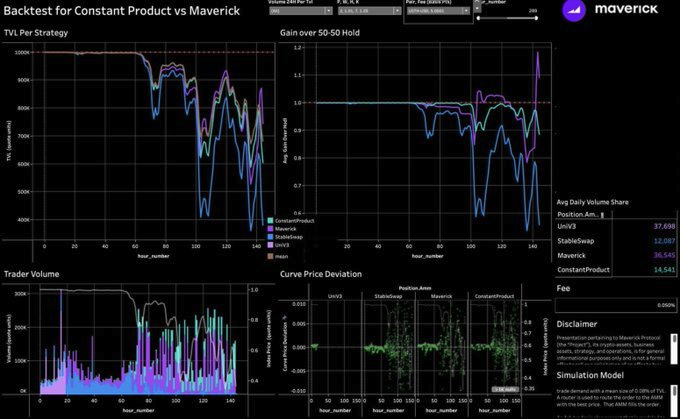
The chart in the top right of this image shows how the four AMMs performed vs. a straightforward 50–50 HODL strategy (i.e., the value of holding a position of 50–50 UST-USDC during the depeg).
As we can see, only Maverick AMM was able to offer any gain over the 50–50 HODL, while the other AMMs all resulted in varying levels of IL–just as they did in real life. Let’s dig a little deeper to explain why Maverick’s AMM performed so much better.
How Maverick Protects LPs
As we’ve covered in other posts, Maverick AMM natively and intelligently shifts a pool’s underlying liquidity distribution as trade demand becomes lopsided. In other words, it can do what Uniswap V3 LPs would ideally have done, but natively in the contract and autonomously.
The IL on Uniswap V3 was a result of LPs being left to move their own buckets once the run on UST began. In these tests, Maverick AMM responds quickly to trade demand and moves all the buckets itself, saving LPs from the more severe IL experienced in other AMMs. Put most simply, Maverick AMM does all the work for its LPs.
Moreover, Maverick AMM actually moves liquidity during a swap depending on the swap size. This is a degree of freedom that other AMMs do not have: in other AMMs, the LP can only adjust liquidity concentration before or after a swap, not during a swap. This gives Maverick AMM LPs an edge over even the most diligent Uniswap V3 LP.
Unlike other AMMs–where LPs overpaid sellers for UST–LPs in a hypothetical Maverick UST-USDC pool would still have a substantial amount of USDC even after UST depegged, since, in response to the sell pressure from the depegging, the AMM would have shifted liquidity into more appropriate price ranges.This liquidity shifting means that, once the peg is lost, the Maverick AMM does not buy UST at above-market prices, thereby protecting LPs from IL.
Conclusion
Current AMMs are not built to handle a subtle depegging–let alone a severe depegging like UST. They are designed with the expectation that stablecoins will maintain a 1:1 peg, and are not sufficiently advanced to protect LPs when these expectations are shaken.
As we explained in last week’s post, this weakness should also be of major concern to liquidity staking protocols which–like stablecoins–expect to maintain a 1:1 peg between tokens. Even for fully-backed tokens like stETH, market fear can trigger a run on redemptions and shake these pegs loose. If a large holder like Celsius is forced to exit their stETH positions to pay off obligations elsewhere, this could potentially have a devastating effect on the peg.
Already, the distribution of ETH-stETH on Curve has drifted further as a result of continued sell pressure, down from 30.6%-69.4% at the time of our last post to 21.6%-78.4% as of this writing, and stETH is trading at almost a 6% discount to ETH.
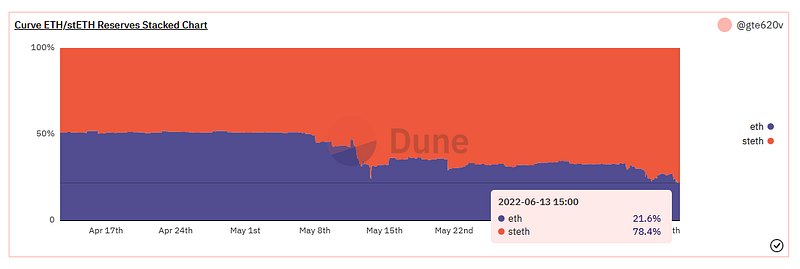
The Curve AMM will keep doing what it was designed to do: facilitate swaps between stETH and ETH, leaving LPs in the pool holding larger bags of stETH, which will remain illiquid until the merge. There is no mechanism to halt the run or disincentivize whales from dumping their holdings into the pool.
The design of Maverick’s AMM promises the best of both worlds: a concentrated liquidity model that can facilitate cheap, efficient swaps for stablecoins and liquidity staking protocols, but which is also capable of managing its own reserves in order to protect its LPs from unexpected events like a depegging.
About Maverick Protocol
Maverick Protocol is the infrastructure for decentralized finance, built to facilitate the most liquid markets for traders, liquidity providers, DAO treasuries, and developers, powered by a revolutionary Automated Market Maker (AMM).
Website | Twitter | Telegram | Announcement Channel | Discord | Medium | YouTube
DISCLAIMER: The information provided in this Medium Post pertaining to Maverick Protocol (the “Project”), its crypto-assets, business assets, strategy, and operations, is for general informational purposes only and is not a formal offer to sell or a solicitation of an offer to buy any securities, options, futures, or other derivatives related to securities in any jurisdiction and its content is not prescribed by securities laws. Information contained in this Medium Post should not be relied upon as advice to buy or sell or hold such securities or as an offer to sell such securities. This Medium Post does not take into account nor does it provide any tax, legal or investment advice or opinion regarding the specific investment objectives or financial situation of any person. The Project and its agents, advisors, directors, officers, employees and shareholders make no representation or warranties, expressed or implied, as to the accuracy of such information and the Project expressly disclaims any and all liability that may be based on such information or errors or omissions thereof. The Project reserves the right to amend or replace the information contained herein, in part or entirely, at any time, and undertakes no obligation to provide the recipient with access to the amended information or to notify the recipient thereof. The information contained in this Medium Post supersedes any prior Medium Post or conversation concerning the same, similar or related information. Any information, representations or statements not contained herein shall not be relied upon for any purpose. Neither the Project nor any of its representatives shall have any liability whatsoever, under contract, tort, trust or otherwise, to you or any person resulting from the use of the information in this Medium Post by you or any of your representatives or for omissions from the information in this Medium Post. Additionally, the Company undertakes no obligation to comment on the expectations of, or statements made by, third parties in respect of the matters discussed in this Medium Post.