
Mato Paha- Bear Butte, SD- A Place of Reverence, Not of Instagram
I leave Billsburg, SD, beer and gas place, T-34, and head west until I hit South Dakota’s highway 79. I go north.
Hills replace the prairie’s horizon marking South Dakota’s east river geography shifts. Paha Sapa is what the Natives call these hills. Paha Sapa lands on the English tongue to mean the heart of everything that is. People who speak English call this place the Black Hills and usually associate it with Mount Rushmore, four white presidents carved into granite as if keeping watch.
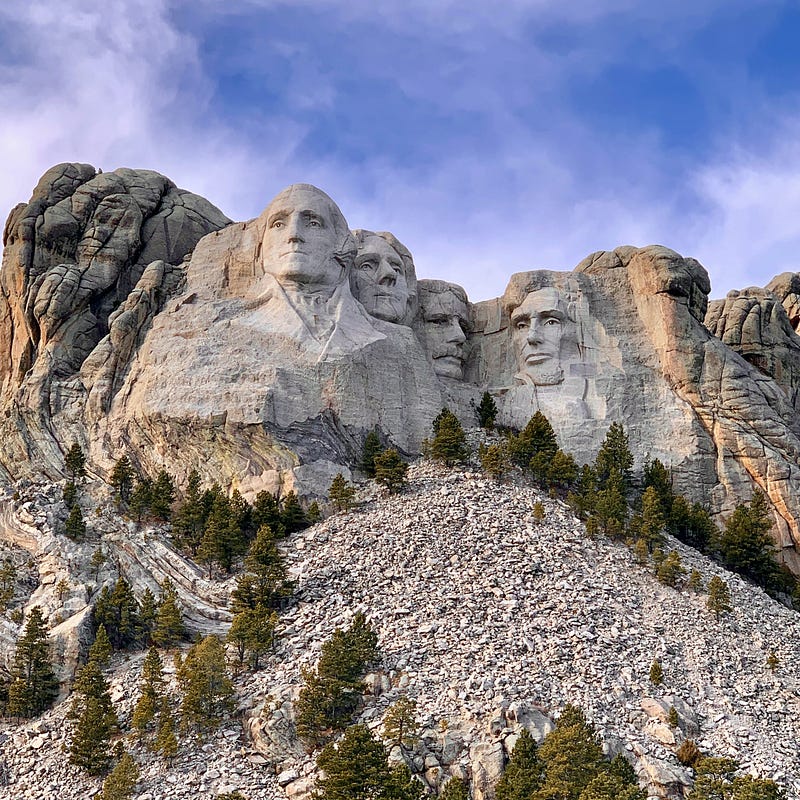
Natives don’t understand these hills in this way. They’ve revered each curve of what they see as the womb of Mother Nature. To them, this was the home for animals and birds. They never lived here. To them, this is not a place to be taken for granted. To them, Paha Sapa was a spiritual place they visited for their ceremonies, vision quests and burials.
They’d travel from where they hibernated in the winter and where’d they’d followed buffalo. They’d travel here to Mato Paha. Mato Paha translates into English as bear mountain.. One legend claims that long ago a bear and a sea monster battled here until the valleys filled with blood. The sea monster bit the bear who crawled away to die. The ground where the bear died is said to have exploded and darkness covered the earth. This hill was the result when the light returned. This account may explain the volcanic rock that makes this hill possible.
Another legend contends, “A group of small Lakota children were playing in the Black Hills, a majestic cluster of pine covered mountains, when they accidently stumbled upon and woke up a sleeping bear. The enraged bear rose from his slumber and charged the youth. They scrambled up a tree seeking safety, but suddenly the tree started growing very tall, as did the bitter bear. An eagle swooped down and scooped up the frightened kids, and the enormous bear chased them all throughout the Black Hills. Exasperated, sleep covered the bear like a heavy blanket. His body transformed into the igneous rock that is now recognized as Mato Paha.” (Gavle, 2018).
This legendary hill and the area surrounding it now called Bear Butte. I put my blinker on out of habit. Not a car for miles. I pull into what looks to be a do-it-yourself ranger station with Bear Butte State Park painted in yellow on its main sign, painted brown. I park my car and get out. Breeze meets South Dakota’s east river sweat that covers me. Humidity subsided. I feel relief.
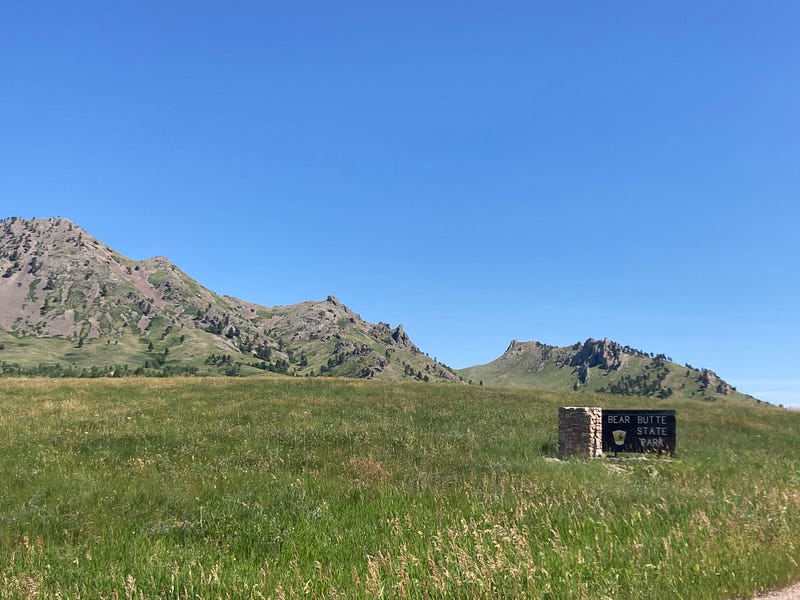
I read the plaque that nailed to the station’s sign to learn some history. The South Dakota Government secured this land via Ezra Bovee who came to own the Natives’ Holy Land via the United Stated Government’s Homestead Act. This act was enacted in 1862 by Abraham Lincoln. It granted, “Any U.S. citizen, or intended citizen, who had never borne arms against the U.S. Government could file an application and lay claim to 160 acres of surveyed Government land.” (National Archives).
Bovee and his family came to sympathize with the Natives who wandered onto their ‘property’ to carry out rituals repeated for generations in this place they viewed as the center of their Mother Earth. It is said Bovee even approached Lakota elders in the 40s to carry out a ceremony on the hill to pray for the end of WWII (National Archives). He also sought Federal protection of these lands from capitalistic development in mid-50s when he requested Bear Butte become a national park. The Federal Government didn’t show any interest in Bovee’s request (National Archives).
He sold the land to the South Dakota state government in 1961 instead. South Dakota turned the land over to the Department of Parks and Game who built this station where I am standing as well as registered it as a National Historic Landmark. This means Bear Butte was selected by the Federal Secretary of Interior to be recognized as a place as having historical significance.
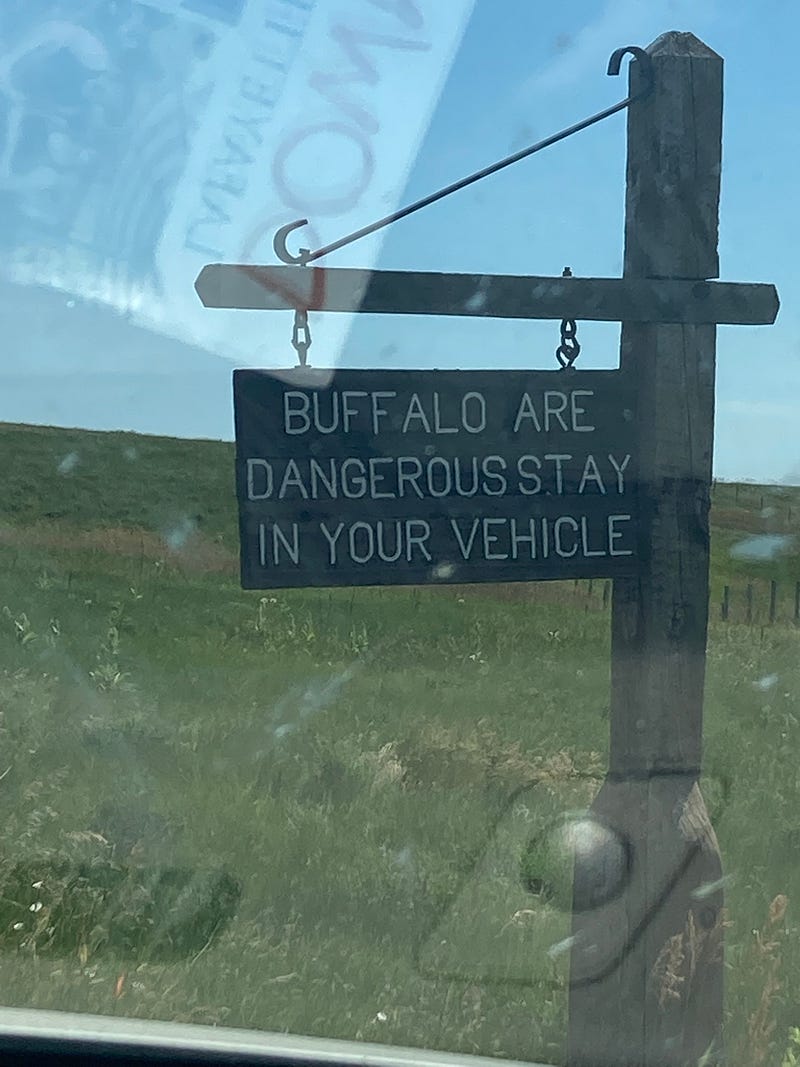
I wonder what the Natives think of all this as I stuff twelve dollars into the envelopes the State of South Dakota provides so I can pay the park’s entrance fee without having to pay a state employee to staff this park that doesn’t make any of the top ten travel destinations in South Dakota articles that I check out.
I get back into my car and drive up the hill to an A-Frame house and a parking lot with handful of cars. So different to the parking garage I battled a few years ago when I visited Mount Rushmore about an hour south of here, a National Monument that brings over 3 million people into the hills, twice the State’s population. I’m thankful at the sight, having grown tired of such crowds.
I park next to the Bear Butte’s trailhead. There’s another structure built by South Dakota’s Department of Parks and Game. This structure serves to educate people before they hike up the trail.
A sign reads:
Welcome to Bear Butte State Park
This mountain is a dynamic and living cathedral. It is a Sacred Place. We are all visitors at this special place. Some of us come for spiritual renewal, some to be closer to nature and some to learn.
Whatever the reason, we must respect this site and the people gathered here.
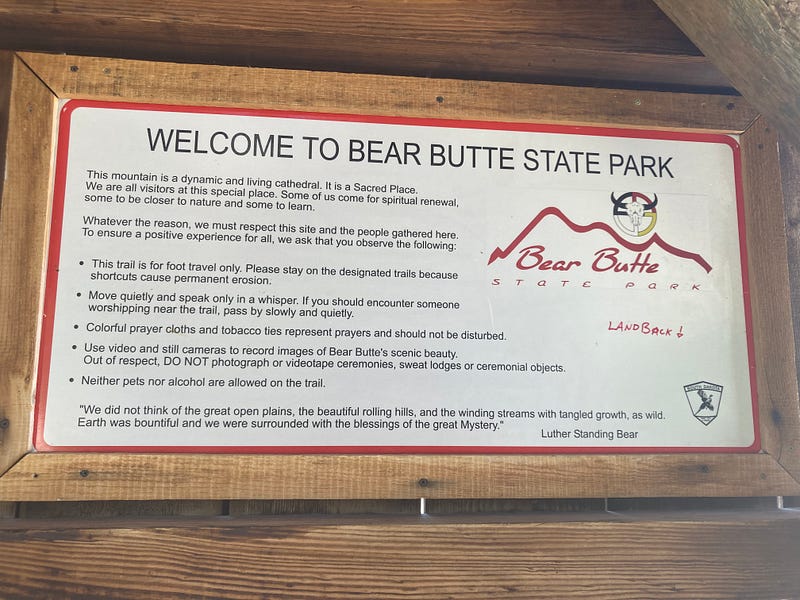
One of the rules they ask visitors to respect is not to take video or pictures of the ceremonial artifacts seen on the hike. I’m happy to abide, so tired of the diy supermodels who come visit the land near my home in Joshua Tree and use nature to promote their vanity.
I put my phone in my purse and head up the carved-out trail that leads past long leaves of grass and deciduous trees. Pieces of cloth in a multiplicity of colors tied into the trees’ branches. Tobacco Ties, as Natives call these, are made of discarded pieces of cloth and filled with a tobacco the Lakota call cansasa (chun-sha-sha) made of the native red willow that grow wild along nearby creeks and rivers. These are seen as offerings to earth, the spirits and to the creator, the Lakota referred to as Wakantakan.
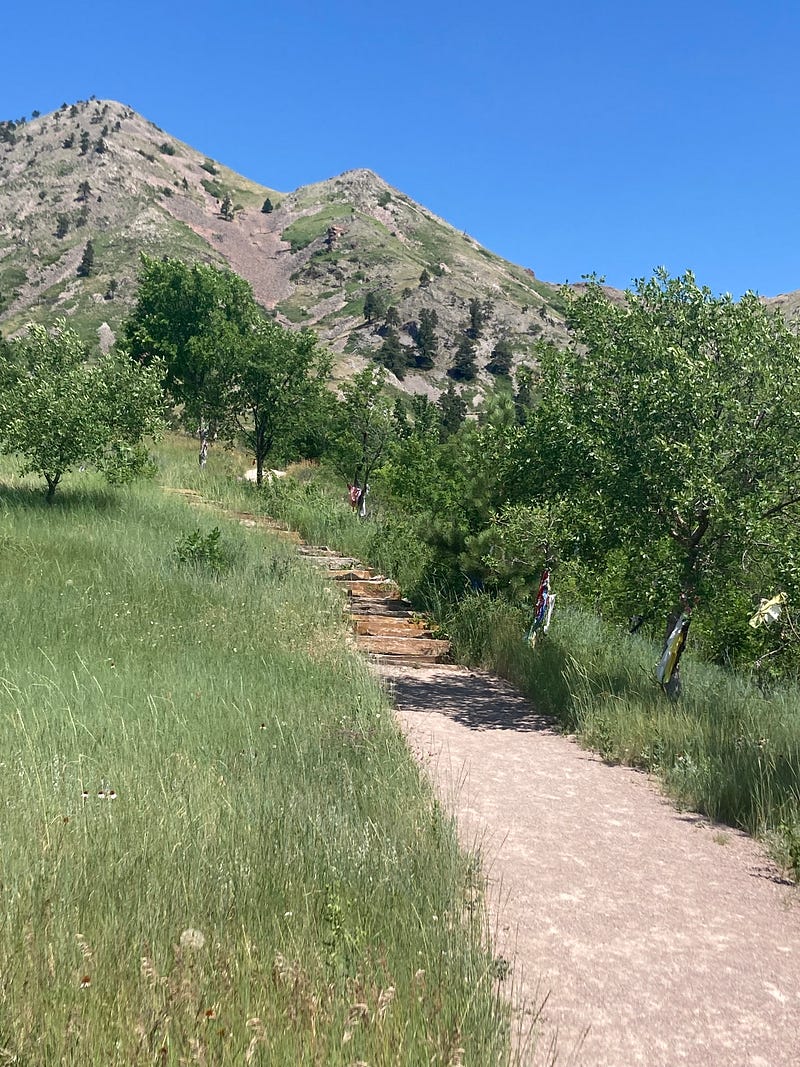
Watantakan is said to have appeared to an Ogalala Sioux shaman on this hill in the mid-1800s. He claimed the spirit came to him in the form of a bear and gave him powers that he asked these be bestowed to his son, Crazy Horse.
The U.S government, at this time, had promised this area to the Natives in the 1851 Treaty of Fort Laramie. However, they changed their minds as Crazy Horse grew into a man when gold was discovered in these hills.
I wonder if Crazy Horse walked the same path I am on now when he came to discuss the increase in gold grabbers in 1857. I do know the discussion proved fruitless with the US government who revised the Fort of Laramie in 1868, which reduced the Native lands from 60 million acres to 20 million. By 1874, the US Government directed General George Custer to go into these hills they claimed was infested with barbarians. His order was to kill all of the Natives if he had to because he was to build a civilized fort, so the US could get on this gold.
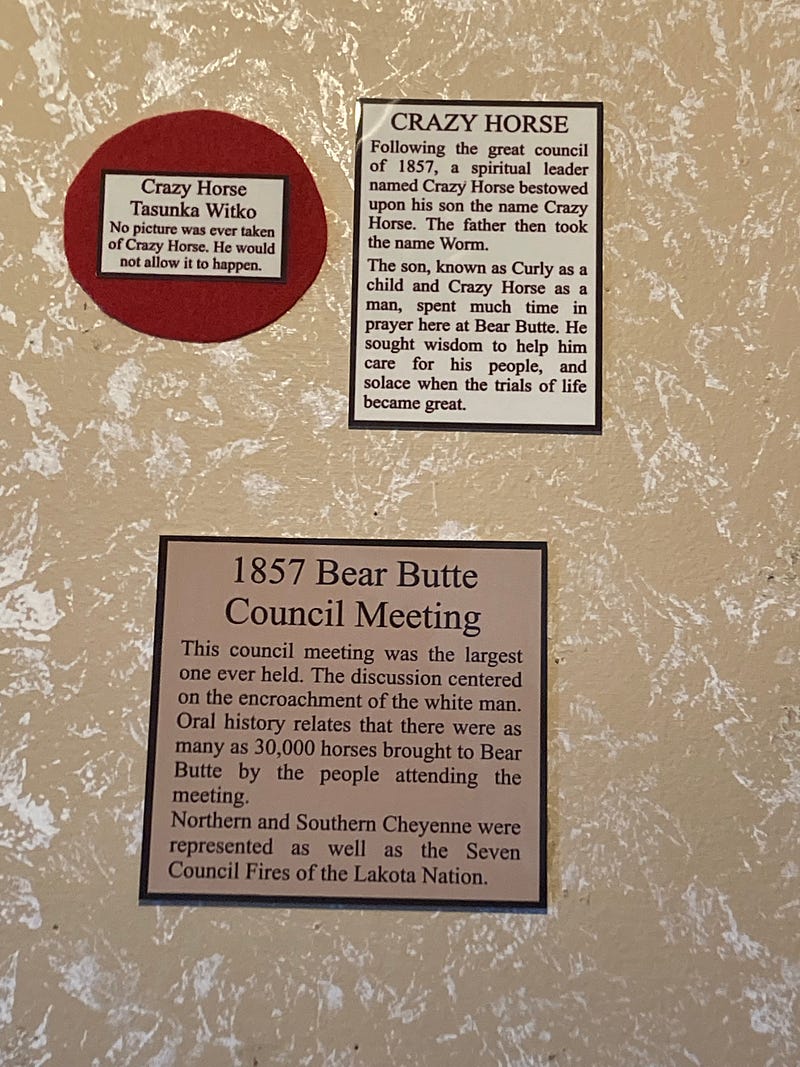
Crazy Horse led a battle called Little Big Horn in Montana, which left Custer dead.
However, the US government never relented, and the Black Hills’ demographic transformed from animals and birds to settlers given a plot of land by a political entity more than a thousand miles away to a destination for travelers who want to see four white guys carved into a mountain.
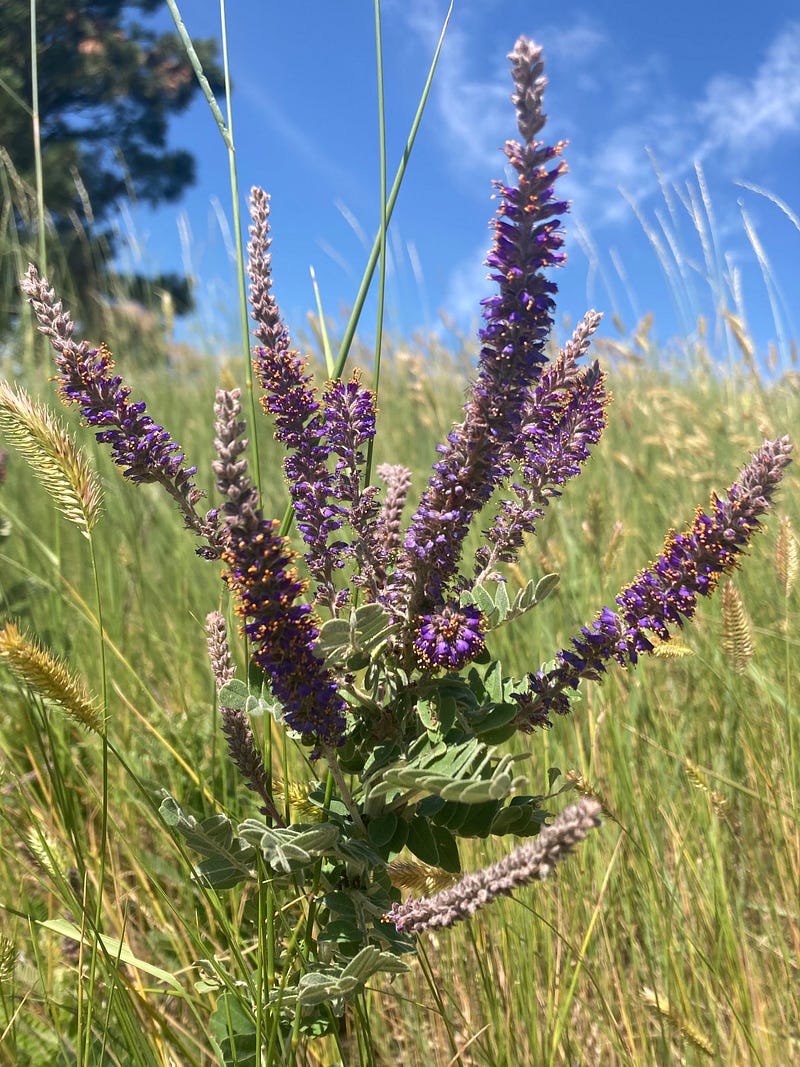
These are my thoughts as I take a picture of a pollen covered thistle. I walk a bit more. I can almost hear the muted heartbeat of the bear keep time with my steps. Something loosens inside me. I find myself in tears, the kind that come from human existence. I let them fall to the earth and mix in the dirt.
I return to my car some time later. There’s less cars in the parking lot than before. I start mine and drive towards state highway 79, the road that brought me in. As I drive, I cannot help but wonder why I’d never been to Bear Butte even though I went to college about an hour north in Spearfish, SD twenty some odd years ago. I write this oversight off as a folly of youth. Something about the injustices of this life have turned me into something more reverent, I suppose.
I press on the gas, heading for Sturgis, South Dakota, a place where I know I’ll see more white men where shirts that read: My Rights Don’t End Where Your Feelings Begin. The US, the irony.