
Maternal Mortality Has Been Unkind to the Women in My Family
Returning home alone after taking a pregnant woman to the ER is the worst feeling ever

My cousin died today!
It was supposed to be a happy celebration. A birth is always a celebratory event. In Nigeria, gifts follow the expectant mother to and from the hospital.
Her husband and her younger brother had both accompanied her to the ER when she felt the first signs of labor. As they both held her hands and walked through the doors of the hospital, they never thought it’d be the last time they would do so.
It was her third pregnancy.
With clenched fists, heads raised to the skies, they prayed. Muttering at first but getting louder the longer she stayed in the ER.
The doctor’s face bore a semblance of the bad news they were about to receive. Our baby did not make it. The mother was battling for her life after the cesarean section.
This is my second family member to die during childbirth. This is even more devastating because we lost both mother and baby.
According to the World Health Organization (WHO), maternal death is the annual number of female deaths from any cause related to or aggravated by pregnancy or its management — excluding accidental or incidental causes, during pregnancy and childbirth or within 42 days of termination of pregnancy, irrespective of the duration and site of the pregnancy.
My aunty, Amaka, died while giving birth to her second child in 2007. She was one of the first people to call me beautiful. She asked the midwives if she’d given birth to a boy or a girl. When they told her it was a boy, her last words were — Thank God. We named my cousin Thank God because of that.
Being there with an expectant mother during labor is one of the most gut-wrenching experiences there is. You are as tense as ever but must maintain a calm appearance to encourage the mother.
“Approximately 808 women die every day from preventable causes related to pregnancy and childbirth. This is about one woman every two minutes. For every woman who dies, an estimated 20 or 30 encounter injuries, infections, or disabilities.” — United Nations Sexual and Reproductive Health Agency.
My six-month-pregnant aunt noticed that her stomach was larger than her other pregnancies had looked. This was her fourth. Multiple scans had shown that she was not expecting twins. So, what could be the problem?
The doctor requested that they conduct a more intricate scan. After various studies and external consultations, they diagnosed it as hydrops fetalis. None of us had heard of such a condition before, so it took a lot of counseling to understand it.
It took a while for my aunt to accept that she did nothing wrong. That it was not her fault.
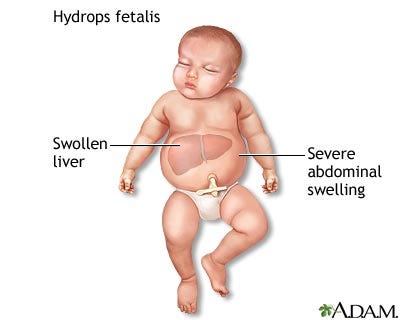
Hydrops fetalis is a serious condition that occurs when abnormal amounts of fluid buildup in two or more body areas of a fetus or newborn. It is a symptom of underlying problems.
There are immune and nonimmune types of the condition.
Immune hydrops fetalis is most often a complication of a severe form of Rh incompatibility. This is a condition in which a mother who has an Rh-negative blood type makes antibodies to her baby’s Rh-positive blood cells, and the antibodies cross the placenta. This leads to problems including total body swelling. Severe swelling can interfere with how the body organs work. This is now preventable with the RhoGAM. They administer pregnant mothers who are at risk for Rh incompatibility this drug as an injection. It prevents them from making antibodies against their babies’ red blood cells.
Nonimmune hydrops fetalis is more common. It accounts for up to 90% of cases of hydrops. This condition occurs when a disease or medical condition affects the body’s ability to manage fluid. There are three main causes for this type — heart or lung problems, severe anemia (such as from thalassemia or infections), and genetic or developmental problems. — National Library of Medicine, US. Department of Health and Human Services.
My aunty’s case was the nonimmune hydrops. The doctor advised us to opt for immediate delivery. This was a last-minute bid to save her life.
I walked my aunty through the doors of the hospital. And when the doctor put the stethoscope to her stomach, we both knew it was gone. My aunty had complained of not feeling it kick.
In the ER, the doctor administered the first dose of drugs meant to induce the delivery. Nothing happened throughout the first day. And the second. And the third. My aunty was inconsolable. She was now carrying a stillbirth. It was agonizing to witness such anguish and be unable to help.
But, I knew I was responsible for making sure my aunty fought. Her baby was gone but she could fight for her three babies waiting for mummy to come home. She had to fight for her beloved husband who was shuttling between taking care of their three kids at home and being there for her at the hospital.
After the third day, the doctor tried the method of the Foley Balloon Catheter. It sounded foreign to us but we agreed to — like we had any choice. We just wanted her alive and well.
It would take six days but my aunty finally got dilated enough to push the dead fetus out. We all cried when that baby came forth. It was a bittersweet ending.
Many other families have gone through one or all of the cases my family has. It is never easy.
Getting the call that my cousin died a day after her newborn was a devastating experience. It hurt.
I could never imagine the pain of her husband and her brother who had held her hands as she walked through the doors of the hospital.
They walked out holding each other. In tears.
Rest in peace, dear Chidinma. This one’s for you.
References
- The Global Health Observatory — WHO
- Maternal Health — United Nations sexual and reproductive health agency (UNfpa)
- Hydrops fetalis — National Library of Medicine, US. Department of Health and Human Services.