
Matches Made In Hell
Pandemic Dating & We
Every day, around the world, women are subjected to the threat of online predators. As the ill-effects of pandemic-related isolation grows, so have the the profits of online dating services and apps. If left unchecked, the personal safety threats faced by millions of dating app users will further fuel the fire of violence committed against women. Meanwhile, dating app businesses are funneling their profits into attracting new business and prospering via repeat dating app users.
What’s Love Got to Do With It? Absolutely Nothing.
Now that I’ve put dating on hold, indefinitely, I’ve experienced a surge of bonus me time. After more than my fair share of bad dating app experiences, I understand how being socially isolated is profitable for the big business of online dating services, such as those offered by companies like the Match group.
Despite my own dating app failures, things are looking pretty green for dating app companies like Match Group. According to the MarketWatch August 2020 article Match Group Chief Executive Shar Dubey contextualized Match’s pandemic era profits as happening “despite” the pandemic.
Me — I would argue that online dating apps’ profits are soaring because of the pandemic, not despite of it.
From the MarketWatch article, here’s how Shar described the phenomenon of dating apps’ profit surge during the pandemic (emphasis mine):
Despite the pandemic, our user trends, like engagement and willingness to pay for our products, is up, proving what we’ve always known: Our products satisfy a very critical human need, and those needs aren’t going anywhere,… — Chief Executive Shar Dubey
Maybe this ship has already sailed, but I think Shar may benefit from a review of Maslow’s pyramid because — hey, maybe it’s just me, but I happen to believe I have a very critical need to not be sexually assaulted again by the likes of guys like Andy, whom I met on Match.com and reported to Match.com in 2017.
Me, Match, and One Predator
After matching with Andy on Match.com, we met at a local brew pub. Our date concluded after Andy sexually assaulted me in a parking lot. I reported the incident the next day to Match.com. They were quite courteous in their response, and I left it at that.
Three years later, I discovered Andy was back online dating after I saw his profile on one of Match’s “products,” the dating app, Hinge. Once I saw his profile, I reported my experience with Andy from 2017 to Hinge in June of 2020. Hinge responded kindly, and assured me that Andy’s profile would be removed from Hinge, and thanked me for alerting them to his behavior.
What I didn’t know in the summer of 2020 was that the Match Group bought Hinge in 2018: I didn’t realize I was actually reporting the assault to the same place again. And gosh, it seemed as though they didn’t even remember me.
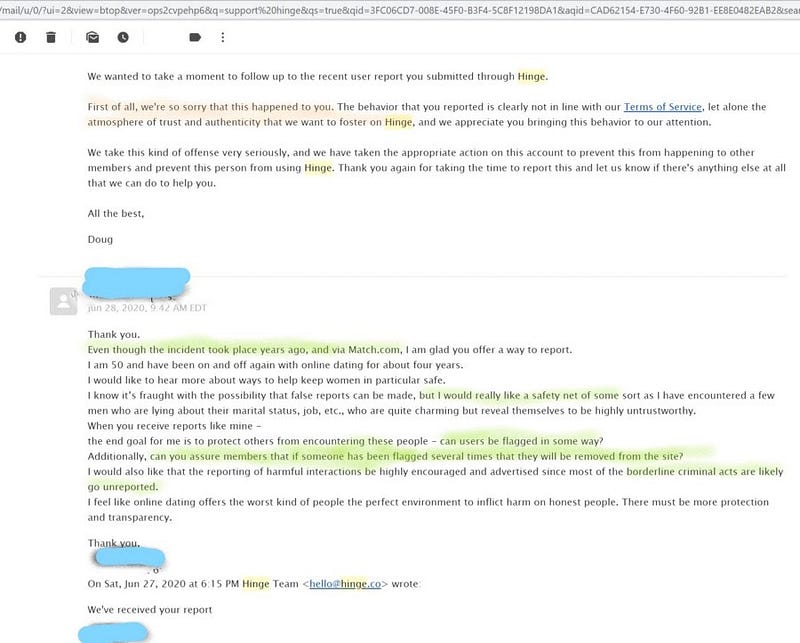
If you read my email exchange (image above) with Hinge, you’ll see I describe Andy’s actions as “borderline criminal.” What I should have said was “criminal, but a complete waste of my time to report because he didn’t rape or beat me.”
Truly, I was left dazed, scared, but physically unharmed. But to make things a little less murky for ya: that was the last time I wore a skirt on a first date.
To Report or Not to Report
So, who knew about what happened to me? My friends. Who else knew? The Match Group. Who has all of the data for every user that reports another user for criminal behavior encountered via the most popular dating apps in the world? The Match Group, for one.
What if I were “raped?”
I put “raped” in quotations because using that word conveys the act of a specific type of assault, being the penetrating violence of our bodies in a situation where we feel trapped. So, I wasn’t raped.
But the truth is that there are levels of sexual assault that women have to deal with throughout their lives; and via the process, we learn which battles are worth fighting. You do what you need to do. Women know this.
So for argument’s sake, had I been “raped” (in the classical sense of the word) by Andy, I would have filed a report with the police, despite having any expectation that justice would be served in the end.
Why would I or any woman not report being sexually assaulted to the police? Far beyond the scope of this essay, however here’s one quote from an authority on the matter. In the height of the “me too movement” PBS’s Judy Woodruff asked Soraya Chemaly of the Women’s Media Center Speech Project for reasons why women don’t report sexual assault. From the transcript:
I think there’s fear of shaming, of blaming, of retaliation, of being doubted. It’s very hard, because we have a cultural predisposition to perpetuate a lot of rape myths. And one of those is that women excessively exaggerate as victims, that they make things up, that there are misinterpretations… the culture in general attributes lying to women who come forward. — Soraya Chemaly (2019)
That’s from 2019, people. And now it’s 2021. I see no end in sight when it comes to women holding their attackers accountable because women still aren’t safe to tell. And many of us have been brainwashed into thinking that certain sexual assaults are just not worth mentioning to anyone, much less reporting to the police.
What If I Were Killed?
What if Andy or some other sociopath I met online killed me? Then I wouldn’t be here talking. But had I been killed, you all would’ve heard about it. That’s one truth.
Here’s another truth — if Andy had killed me in 2017, and was caught, no one would have even brought up how we came to meet in the first place. And if they did, the legal system would quickly redirect accountability to the users involved. (Me included.) I suppose I made some pretty silly assumptions about how dating services might screen their users for criminal histories or ban them for repeated complaints by other users.
What I Know (Now) About Online Predators
I believe most of us would want to know if our perfectly handsome, photo verified, witty chat buddy is also a registered sex offender, violent criminal, or even just your common, garden variety sociopath.
Video conferencing and phone conversations can tip us off. But the very best cons will likely go under the radar. And since the most popular dating apps and services do not include background checks — as of press time — it’s up to us, to you, the consumers to protect ourselves.
What Online Dating Apps and Services Do & Don’t Do (As of Press Release)
- Dating app services do not screen their users to verify identity in order to remove registered sex offenders or violent criminals from their dating pool.
- Dating app services do not typically share user’s reports of sexual assault or other forms of criminal behavior with law enforcement. Why? I guess it could be because of the risk that the reporters may have just “misinterpreted” their date’s actions or even, perhaps, the women who report are just straight up lying.
- Some dating app services offer background checks and identity verification services but these services are usually provided for premium members only. So, anyone on a budget? Yeah, I thought so. Roll the dice. You’re probably savvy enough to avoid a con.
- Some dating app services offer face recognition for you to voluntarily employ so that you can prove to other users that you are the person in the profile pics. My advice is if you’re going to use apps like these then you use the face verification tool — AND — don’t chat with anyone who does not offer the same in return. It’s quid pro quo until further notice, fellas.
Some Practical Advice
- Vet them while you’re on the app. You don’t need to go into the chat assuming they are criminals out to get you; but, consider your safety whilst chatting away. Ask questions. What do you do? Do you have kids? Are you a sociopath — sorry — don’t ask that question. Where do you live? (i.e. city, suburb, not their address ladies.)
- If he’s got nothing to hide, then you now have some useful info with which you next use to Google him. Even with a first name, his occupation, and the city where he reportedly lives and works, it doesn’t take too long to find someone.
- Been and done Googled the fella? What if you find nothing? Big red flag. You must stop. Return to Start. Trust me — there are other fish. Or crabs. Or something better. I think.
- If you Google him and his identity matches what he’s saying , i.e. — “oh, he really is an attorney at Fogelmeister, Crow and Smith “ — then at least you know he is basically the person he puts himself out there to be. (Proceed with caution.)
- Do not give out your phone number. Not until you meet his parents — and then — still be cautious. (Yes, you can always block him. But with your phone number, he can find you.)
- If you really want to know who you are meeting, you must run a background check. To do this effectively, you will need his real name. birthdate, and phone number. Mobile numbers are fine.
- If you’ve gotten to the point of the background check, you need to know how to analyze these reports for red flags. You take what you know from the initial vetting process, what he’s told you, and you compare it to the background check. Some red flags you may come across include: multiple aliases and emails that don’t jive. (If his name is Fred Thompson, and he has multiple alias such as “Mary Frampton” or “Ted Lewinsky,” or you find emails with names like “[email protected].” These could be signs that he may just be “un-datable.”
- In lieu of or in addition to running a background check, you may want to search public court records in the county in which your date lives. Name and birthdate should be enough. You could wait until your second date for the court records search, presuming another meeting is what you both want…
Discouraged? I hear you.
Hold. Them. Accountable.
If you’re not prepared to do the research yourself, then I suggest you delete the app for the love of yourself. Delete it. And keep your ears open for any “socially conscious” dating app services out there who are willing to put their profits into providing safe matches for all of their users (and not only for those with expendable incomes).
The technology is available for any one of these corporations to employ to screen for predators.
The problem is the Match Group, and their cronies, just don’t seem to want to spend all that money on our safety. So unless they prove otherwise, they have not earned our business. My dating advice? When it comes to Match, I suggest we all play hard to get.


