
Mastering the Mindset of a Mature Product Owner: Powerful Questions to Forge a Path to Success and Growth
Ask yourself these questions and check if you have the right mindset to grow as a Product Owner
What do Iron Man, Henry Ford, Thomas Edison, and Winston Churchill have to do with this article? Find it out!

Work on your Mindset and the Skills will follow. That was the advice I gave to a colleague of mine a couple of years ago. I believe that to be successful, you must have the right skills and gain the needed experience. But to get there you first need to have the right mindset. This is even more important the more leadership responsibilities you have. In addition to your character and your ethics, you need to be in a good state of mind and mindset.
We, as Product Owners are the domain-focused leaders of the product development teams. We are responsible for leading the team and the product towards success. That is why, if you want to become successful and mature as a product owner, you have to build the right mindset.
What is the right Mindset? What mindset does a Product Owner need?
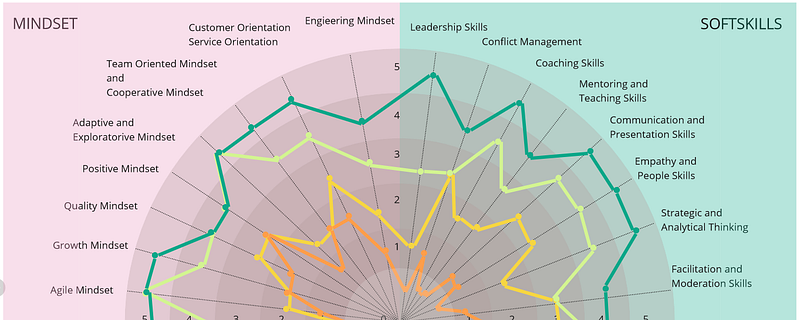
In my last articles we explored different Maturity Models for Product Owners, we concluded that a good Maturity Model should include Skills. We explored what topics mature Product Owners focus on, where they spend their time, and why they (can) focus on the Problem Space.
In this article, we now explore the mindset of a mature Product Owner.
What is the right Mindset for a Product owner?
A good Product Owner knows that nothing is certain. You can not predict your user’s behavior, feelings, beliefs, or needs. So predicting things in the Problem Space is hard. On the other hand, developing things in the Solution Space, and creating the right Product with the needed features that satisfy the product’s Value proposition is also unplannable. The more complex the product and the more dependencies you have to others the more uncertain the Solution Space gets. So good Product Owners know, that they know nothing. And that is why a certain Mindset is helpful in such a complex situation as we find in product management and product development.
Let’s start with the obvious one — the Positive Mindset.
Positive Mindset
You are more likely to succeed if you are a positive person and have a positive mindset. You tend to focus on the positive things and the achievement and the development team and product team as well as your stakeholders like to work with you because you give them energy even in troublesome times. Staying positive is often key, focusing on the negative things doesn’t help you and will drain energy and focus from your stakeholders and your team.
But be aware of Toxic Positivity — It is not the goal to forbid negative experiences and pressure yourself or others to display only positive emotions, suppressing any negative emotions, feelings, reactions, or experiences.
Ask yourself these control questions or rate the statements:
- When presented with challenging situations I tend to be dramatic and focus on the negative things.
- Are you the person in your team who helps others stay positive?
- When a challenging situation arises do you see positive things as well?
- Do you challenge something positive to improve or do something different?
Growth Mindset
Only staying positive is unfortunately not the solution and not the only thing you need to succeed. You will get challenged by the market, and the users, and all these challenges will have an impact on you and your strategy. To overcome these challenges you need the right Growth Mindset. A Growth Mindset is the opposite of a Fixed Mindset. It helps you to see the potential in your product, yourself, and others. With a good Growth Mindset, you know that you can learn, adapt, and overcome troubling situations, challenges, and problems. You know that you can always learn, improve, and become better. And you know that in the end, everything will be fine. You only have to keep going, learning, adapting, and iterating till everything is fine in the end. One major important thing when it comes to a Growth Mindset is the factor of learning. People with a Growth mindset always learn and become better. They can always tell you something new, something they just read, learned, or heard.
Some quotes and Ideas:
I have not failed. I’ve just found 10,000 ways that won’t work. Thomas A. Edison
If You’re Going Through Hell, Keep Going — Winston Churchill
There is rarely damage in which there is not also opportunity. — unknown
Do you have a Growth Mindset?
- What was the last thing you have learned?
- When did you learn it?
- Why did you learn it?
- Do you have a regular habit of learning?
- Do you have an attitude to try things out?
- Do you see failure as a learning opportunity?
Engineering Mindset
With an Engineering Mindset, you are capable of executing effective problem-solving approaches through critical thinking, creativity, and a systematic understanding of how things work. You know that you can solve technical problems through professional engineering. This involves applying scientific principles, practical knowledge, and a persistent drive to innovate, analyze, and optimize solutions to complex challenges.
With a strong Engineering Mindset, you are always improving your technical solutions and adapting your solutions to new challenges. You know you can engineer yourself out of trouble and misery.
Metaphor:
Take Iron Man as a strong metaphor for an Engineering Mindset. Tony Stark always learns from his mistakes. Over time he assembles all the special skills from all the Avengers within one Iron Man suit and that makes him unstoppable.
Ask yourself the following questions:
- Do you try to solve problems even though they seem to be very hard to solve?
- Are you trying to fragment a hard problem into smaller pieces and try to solve them piece by piece?
- Are you eager to understand problems and solutions on a detailed level?
- Are you not afraid of asking questions to get to the bottom of a topic?
- Do you want to learn even when it involves hard work to learn things?
- Do you strive to innovate and create an outstanding (technical) solution?
- Are you eager to optimize solutions until they are done properly?
Adaptive and Explorative Mindset
Very similar to the Engineering Mindset and the Adaptive- and Explorativ Mindset allows mature Product Owners to adapt to new situations, explore alternatives, and even experiment on hypotheses they create. An Explorative Mindset goes hand in hand with one fact. Nobody knows what the market and the users want. The least of all Product Owners or Software Engineers. Not even the users know what they want.
If I had asked people what they wanted, they would have said faster horses. — Henry Ford
A good Product Owner knows that we have to create hypotheses and experiment to verify or falsify them. To understand that and to believe in that Product Owners need a good Explorative Mindset they need to live that concept and be able to adapt to new learnings they gain from these experiments.
Questions to ask yourself:
- Are you flexible when it comes to changes?
- Do you easily adapt to new situations?
- Do you welcome new learnings even though it means you have to adapt your behavior or your plan?
- Are you eager to explore uncharted territory?
- Are you enthusiastic about new things and want to try them out?
Agile Mindset
Building on a strong Adaptive- and Explorative Mindset an Agile Mindset is important for Product Owners to develop products in a modern, efficient, and effective way. A distinctive agile mindset relies on agile principles that favor individuals and their interactions and working solutions over processes and documentation; that favors collaboration and change over contracts and plans. If you truly believe in agile, you work on empowering your team. You develop the product in iterations, experiment, and gather feedback through close customer collaboration
Quotes about an Agile Mindset
If you set your goals ridiculously high and it’s a failure, you will fail above everyone else’s success. — James Cameron
Success is not final, failure is not fatal: It is the courage to continue that counts. — Winston Churchill
Questions to ask yourself:
- Do you adapt your plans to the learnings you have?
- Do you favor working in small iterations and learning through early and often releasing your results?
- Do you gather feedback and adapt your behavior and strategy along with this feedback?
- Do you seek direct cooperation with your users and customers?
- Would you rather work closely together with your team members and users than create documentation and contracts?
Team-Oriented Mindset and Cooperative Mindset
Because Product Owners are responsible for the success of a product but are also not capable of developing the whole product by themselves, it is an important trait of a Product Owner to be a team player and have a cooperative and team-oriented mindset.
A Product manager’s motto: With great responsibility comes no power. — Dan Olsen
Having a cooperative mindset means, believing that teamwork creates better results and is more efficient and effective. Being team-oriented and having a team-oriented mindset, is to know that you need your team and you put your team above and before you- your success and the success of your product depends on it.
Ask yourself the following questions:
- Do you believe in your teams’ capabilities?
- Do you trust your team?
- When challenged with a task, do you ask your team to help you or do you confront them with a concrete plan?
- When talking to management or stakeholders do you say I or “we”?
- When having success do you present them as your work or as your team’s work?
Service Orientation/Service Oriented Mindset.
Very similar to the Agile Mindset is the Service Oriented Mindset. Great Product Owners know they have to deliver a product that satisfies all the needs of the users. They know they must provide a good service and product to succeed. They also know that there are different categories of needs and features and figure out a good mixture of these features. The Kano Model describes these different categories very well.
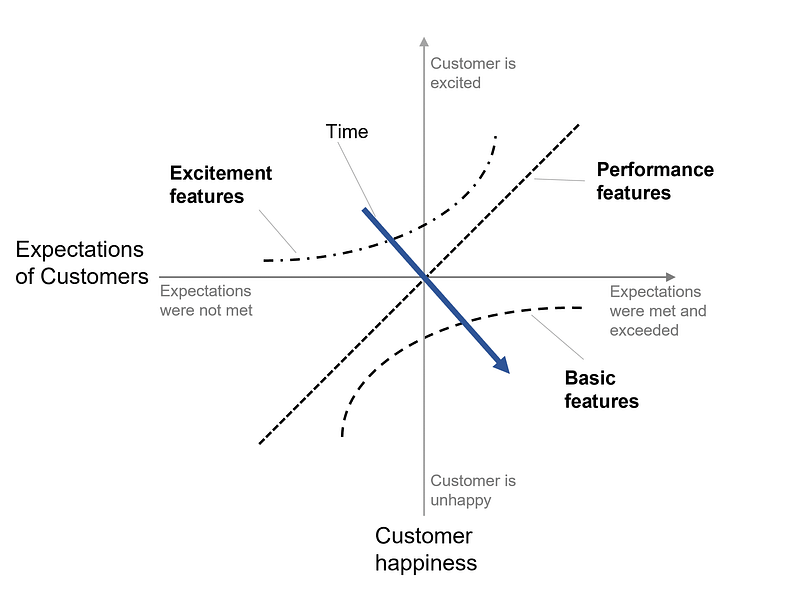
Having a good Service-Oriented Mindset means that you put the customer and user first and at the center of all your actions. Customer-centric development is a result of such a good mindset. A Product Owner with such a strong focus on this Mindset often represents the customers and users in discussions within the team and the organization.
Ask yourself the following questions:
- When was the last time you brought the user’s point of view into a discussion?
- Are you prioritizing the user needs and customer needs?
- Do you talk with your team about good services and improving services?
- Do you bring in different features to satisfy the user’s needs in the best way?
Quality Mindset
To deliver great products and services you need to ensure the best quality. Having a Quality Mindset means that you constantly care about improving the quality of your work by testing and gathering feedback. A Quality Mindset is an approach that prioritizes excellence in all aspects of work, emphasizing attention to detail, precision, and a commitment to high standards.
Improve quality, you automatically improve productivity. — W. Edwards Deming
Questions to ask yourself:
- Do you care about the quality of a feature?
- What are you doing to ensure the product fulfills what it is supposed to deliver?
- Do you understand the expected quality of your users?
- Do you regularly test or have measures in place to hold the quality level high?
- Suppose you are faced with the decision of whether to deliver something unstable or invest more effort and thus miss the promised delivery date. Do you prioritize the quality of a function above all else?
Final thoughts
In conclusion, cultivating a winning mindset as a Product Owner is a multifaceted endeavor that demands a balance of positivity, growth, technical insight, adaptability, agile principles, team collaboration, customer focus, and a commitment to quality. It’s about fostering an environment where learning, innovation, and excellence are not just encouraged but are integral to your ethos. Reflecting on the powerful questions outlined above can serve as a compass, guiding Product Owners towards a mindset that not only drives their personal growth but also propels their teams and products towards success. Remember, your journey as a Product Owner is as much about developing the right mindset as it is about mastering skills and techniques. In embracing this journey, you become more than just a leader or a Product Owner; you become an inspiration and a catalyst for transformation within your team and organization.