
Master Python Scope by the LEGB Rule

Introduction
The variables scope (or namespace) is a very fundamental concept in programming languages. Every developer, no matter which language he or she is using, knows the definition of local and global variables. However, things become a little complicated in Python. Following questions appeared lots of times in interviews for Python developers:
- Why Python needs the
nonlocalkeywords? - What is the LEGB rule?
- Differences between global and nonlocal variables in Python?
- How many types of variables in Python?
- …
This post will explain the Python scope from elementary to profound. After reading, you will totally master this significant concept.
Four Types of Variables and the LEGB Rule
The LEGB rule defines an order in which the Python interpreter retrieves a variable’s name. The four letters represent four types of variables in Python:
- Local Variables (L): Variables in a function
- Enclosed Variables (E): In the context of nested functions (explain later)
- Global Variables (G): The uppermost level variables
- Built-in Variables (B): Variables in Python built-in modules
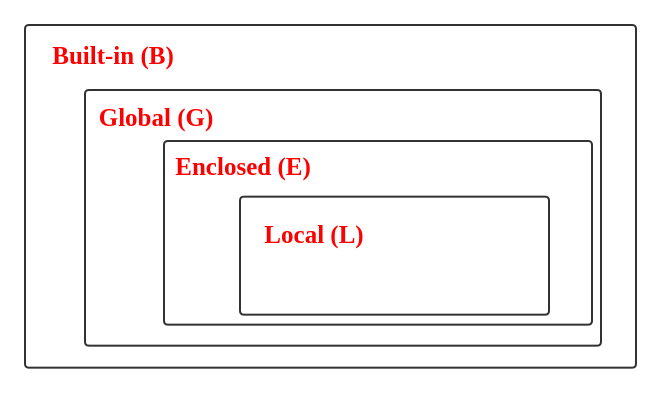
When a name is called in a program, the correspond variable will be retrieved sequentially in the local, enclosing, global, and built-in scope. If the naming variable exists, then the first occurrence of it will be used. Otherwise, an error will be raised.
Let’s see an example:
As the above example shown, the function print_name() called the local variable name. The function print() called the global variable name.
Master the Global Keyword
If we want to modify the global name variable in the function, a statement with the global keyword is needed.
Master the Nonlocal Keyword
The concept of enclosing variables are mentioned in the context of nested functions. For inner functions, the variables of outer functions are neither local variables nor global variables. Here comes the nonlocal or enclosing variables. For example:
As shown above, three different names represent three different types of variables and they are called by the LEGB rule.
If we would like to change a nonlocal variable’s value in the inner function, a nonlocal keyword is needed.
The statement is as simple as global keyword statement.
Conclusion
The LEGB rule defines the order in which Python looks up its variables. If we want to change a global variable in a function, a global statement is needed. If we want to change a nonlocal or enclosing variable in an inner function, a nonlocal statement is needed.
Thanks for reading! More great Python tutorials are here:


