
#MaskorTest, Those Are Your Options
A Surgeon’s Guide to the Ethics, Economics and Effective Measures of this Surviving Pandemic
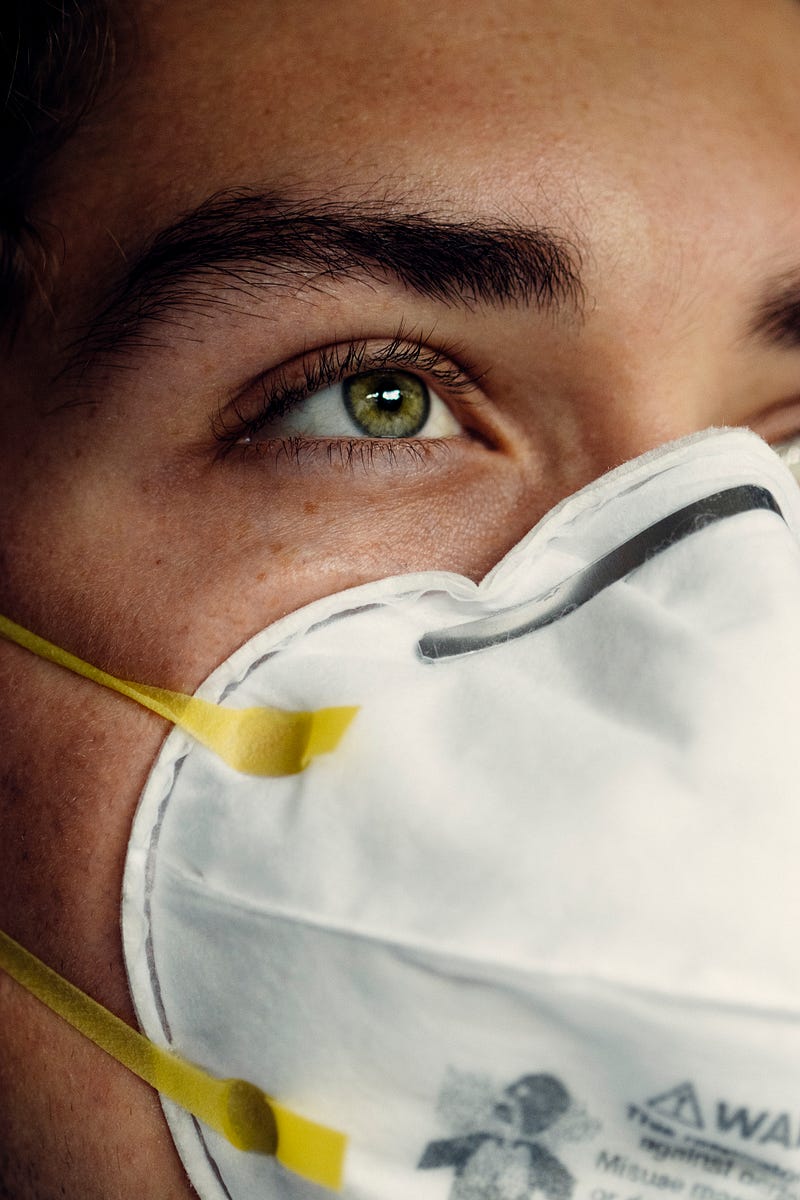
The pen is mightier than the sword. Or, in my case, the scalpel. My pen is mightier than my scalpel.
I realize that now, we have the luxury of time. We have the luxury of being armchair observers of the biologic Armageddon unfolding before us. I realize that we aren’t in the hospitals, gowned up and sweaty (I am on Team 17, awaiting deployment into the COVID tents). I realize that I am ingesting information with alarming speed and voracity, simultaneous feeds from the television, my phones, my computer — instilling intravenously the notes, facts, opinions of a world in fear. I realize this. But at the same time that I realize this, I am wondering why our government leaders aren’t coming to the same conclusions that I, as a simple civilian, came to two weeks ago. They must have access to the same data, if not more. They must be watching the numbers climb on the US charts, the best in the world at everything, and now the best in the world at coronavirus. So the only answer, then, is this: they are ignoring the information. Ignoring, or being indecisive.
I realize, too, the size of the US and the immense ramifications of drastic measures in our huge, defiantly obstinate country. But taking several days to decide on a position about masking is too long. Those are three days in which our infected count has grown by 45,000 (coronavirus.jhu.edu). The deaths in New York City are piling up. It’s hard to make Americans do anything, but I thought that Dr. Yuen (@hkumed) had a good point: so educate them. Educate us. So far, we have had one consistent message: stay home. I think the point is being driven home (no pun intended), but the curve hasn’t flattened. Not to my eye, in fact, the line still looks like it’s going straight up every day.
And while the message of ‘Stay home’ is great, it is not enough for this to be the sole message from our government. People are still asking: well, what do I do when I do go out? What do I do if I have to commute to work? Because the fact of the matter is, people are going out, making clandestine trips to the grocery store or taking the bus to their jobs as Seamless delivery people and they have no guidance about what to do if they DO have to leave their homes.
The answer is: mask. Mask and wash your hands.
Let’s review what we know so far, which is still nothing and changes frequently: COVID-19 is aerosol spread. It’s not airborne, insofar as we know. Aerosol means it’s spread in droplets, so it has to be a wet droplet coming from your orifices. The majority of it is in saliva and mucous (supposedly 100 million virus particles per milliliter) but there’s been data showing it in tears, blood, and stool. If you didn’t smear other people’s bodily fluids onto your face before, don’t do it now! With the knowledge that the virus is aerosol-spread, we know that any covering that protects your vulnerable mucous membranes (eyes, nose, mouth) is helpful. While the ideal really is goggles plus a face mask, most people are getting adequate protection with just a face mask. What about the N95? I’m sure you know by now that N95s help with airborne particles — that is, things that are even smaller than droplets. I know there’s a fear that if the droplets can be aerosol, they can be airborne, so I think that there’s no harm in wearing an N95. Just know that these really are being used in the hospitals where there is a risk of virus becoming airborne during procedures and intubation, and that for a regular person walking around in the street, it is too uncomfortable and impractical to use. For me, I do not think an N95 for a civilian is necessary, but if you are being overly cautious, go for it (I realize that two weeks ago, we did not think regular surgical masks were necessary, either).
Why do we need to wear a mask? Okay, here’s the clincher, right? It’s actually because you, and the dumb people around you, could be shedding virus without even knowing it. That’s right, I have been saying (screaming into the void) for three weeks that we need to test asymptomatic and mildly symptomatic people because they are the ones walking around spreading the virus. It’s not the people who are already intubated in the ICU (though they are spreading it too, they have more virus in their body, for sure, but they are already isolated). Please see the next section on testing. Reports from Europe and China have shown that asymptomatic virus carriers can be up to 25–30% of the population. That’s 1 in 3 people are out there, touching something in the grocery store and putting it back.
Let me back up for a second. Asymptomatic means people who have no symptoms. Walking around, throwing a football and laughing when the his other two friends fumble it. One of those guys probably has coronavirus. Mildly symptomatic is the category that worries me the most. People who are walking around sniffling (“Oh, it’s just allergies”) or have a sore throat and a cough (“I’ve had this really long cold”) and they are not masking and rubbing their noses and then holding onto the handrail on the subway. My two cents as a physician: I tell people that they know their bodies best, and they know when they are ill, but that only applies, truly, to maybe 10% of people. The other 90%, they have no clue what is normal sometimes, and you know what? I don’t blame them! They didn’t get medical training for 12 years and sometimes haven’t even seen another person’s normal body to see what that can look like so when I see people’s grapefruit-sized growths hanging off their backs, butts and balls and they’re like, “Oh that? It’s been there for years.” Which is the #1 reason why I DO NOT TRUST PEOPLE to have an accurate assessment of their symptoms. Period. The end. They do not know what is normal. Which is why we need to be masked. And tested.
Recurrence and relapse is another issue. Reports out of Wuhan say that individuals come back with another infection, and the second time is worse. They go to the ER, get sent home, and the second time back they get intubated. Well. Is it relapse or re-infection? We have no way of knowing because we are not testing. In the literature right now, we are calling them PPUP. Possibly positive but unknown testing status (sermo). I think this should be ‘Presumed Positive but unknown’. This is the majority of the public right now, at least in New York City, in my mind. We just assume that you have the virus but we can’t test. Testing, as of last week, was reserved for healthcare workers, sick patients, and those with comorbidities and the elderly. I will tell you something: I couldn’t get tested and I’m category 1: symptomatic healthcare worker. I know a friend, a nurse who has been battling breast cancer, on chemotherapy, and she is category 2: asymptomatic, at risk — she couldn’t get tested. I know others. Who are we saving these tests for? Andy Cohen? (Honestly, I do watch Bravo and WWHL but ever since I heard he got tested and I couldn’t, I have been upset. See my other story.) And I know a guy who went to the ER, had a saturation of 85%, tested positive, and was sent home. What? What are we doing?
Third? The trifecta of BEATING THIS PANDEMIC and flattening the curve should be assumed as thus:
- Wear a mask (wear it properly, it should be snug around your face, chin and nose)
- 2. Wash your hands after touching things outside your home! (I literally have been carrying hand sanitizer to the grocery store and was super excited to see that Dr. Yuen endorsed this as well.)
- 3. Social distancing (at it’s most basic, it means stay home, but there are plenty of ideas from my friends in Hong Kong about what it means when you do have to go out: stay 6 feet apart. Take off your mask only to eat, and even then, face the wall.)
Church and concerts are temporarily out of the question. I also appreciate that each building in Hong Kong has it’s own ‘Infection Control Supervisor’. Someone who stands at the doorway and takes your temperature when you walk in with an infrared handheld device, and asks you if you have any respiratory symptoms at all, and if you do, you are turned away.
So there you have it. Simple, effective guidelines that have helped other countries and should help us.
Let’s talk about masking. My new rally cry is: #MaskorTest, those are your options, and I’m addressing the state and federal governments here. You can tell everyone to put on a mask or test everyone, those are the things that will help us. Anything less is like shoveling water out of a sinking boat with a teaspoon, without addressing the gaping hole in the bottom of the boat that’s letting the water in.
On an individual basis: If you have not been tested and are PPUP, wear a mask. Wear a mask if you’re asymptomatic. Wearing a mask prevents you from spreading it but it also prevents you from getting it, right? And in our world of self-interests, I should only need to tell you that. If I cannot appeal to your higher self who acts for the greater good, then I appeal to you acting for your own good. And why not? Protect yourself! There’s no shame in that. So I was going to say that the only people who can walk around without a mask are those who tested negative but with the risk of reinfection etc etc, those people should wear a mask, too.
The fact of the matter is, our government is not allowing us to test because we don’t have enough tests. At first I thought it was a restriction of artifice — if we don’t test, our positive numbers can’t go up, and our country looks great in terms of COVID numbers (like hospitals not allowing us to test for Cdiff, a gut bacteria). But we are testing, and our numbers are going up, and we still do not have widespread testing that will give us a baseline of who is actually infected, who is actually contagious, and who is actually (fingers crossed) immune. We have such as large population that this data should be rolling in. If we had drive through testing every few blocks (S. Korea was testing 10,000 people daily), convert Starbucks walk-up windows into COVID screening centers, for god’s sake. We need to test everyone, and right now the money should be directed towards contact tracing, testing and surveillance. Pouring money into PPE and ventilators, while absolutely necessary, will not, in itself, stop the flood.
The ethical principles of medicine are simple and straightforward. Autonomy, beneficience, non-maleficience, and justice. Not having wide-spread testing violates all four of these ethical principles.
1) Autonomy: people have a right to decide what to do when presented with all the facts of their medical condition. Right now, people CANNOT have all the facts because they do not know their COVID status. They cannot make an informed decision because they are not informed.
2) Beneficience: Do good. We are in this healthcare industry to help people. I do not know how we are helping people by restricting testing. I agree, we should all be taking the same universal precautions (see the trifecta above) regardless of COVID status, but I do think that knowing the status will help put people’s minds at ease (“Phew, I don’t have it!” though more often these days I’m hearing, “I do have it, great, it was mild, now I got it out of the way!”) So we are not doing anyone any good.
3) Non-maleficience: we take the Hippocratic oath to do no harm. I think by limiting the availability of testing, we are harming people physically and mentally. The numbers don’t lie.
4) Justice: equal, equitable healthcare. We are already seeing that immigrant and lower income households are at risk. They may not have the ability to work from home, or the resources to be without a job while the rest of us are sitting around. And if they do venture out, they don’t have the PPE or the access to care that they should. So this population needs to be tested and screened, or else we will see their infection and mortality rate disproportionately high. And everyone at the top, the basketball players and celebrities who are tested and sitting at home raising money for Broadway — that’s great, but why are they getting tested and access to care? And everyone in between those two groups — people doing their jobs, being safe, all those people should be tested, too. When it comes to testing, it should not be who has the most connections or the most money can get tested. Are you kidding me? If our socioeconomic divide wasn’t obvious before, it is obvious now.
6.6 million Americans filed for unemployment. So I think the cat’s out of the bag, the economic value of not testing, well, that train has left the station. Not only are we not saving money from the tests we didn’t make, we are now losing money, at a federal and individual level. Consider this: in our state, a healthcare worker with symptoms is told to self-isolate for 7 days and return to work after 3 days of being asymptomatic and afebrile. So, at minimum, 7 days off work. Let’s say a healthcare worker at an entry level makes $15/hr. That’s $840 lost income for the individual and at least 56 lost work hours for the institution. For a test that costs $30 to make. And actually, some new kits out of the UK and Bangladesh cost less than that, perhaps $5 per person. So what is the hold-up, if not cost? Apparently, it’s bureaucratic red tape, what seems to be inbred in-fighting between the Trump administration, the CDC and the FDA. You know what? Get over yourselves and allow hospitals and companies to make their own tests, faulty as they may be, put the testing out there, in the hands of the people, and we will figure out it. I didn’t even factor in the $34,000 dollars it takes to get treated for coronavirus (even though the new bill ensures that testing is free, if you can get your hands on a test, your treatment if you get sick and recover will likely bankrupt you).


