
Marriage Shouldn’t Make You Feel Lonely
But I felt lonely and emotionally abandoned.
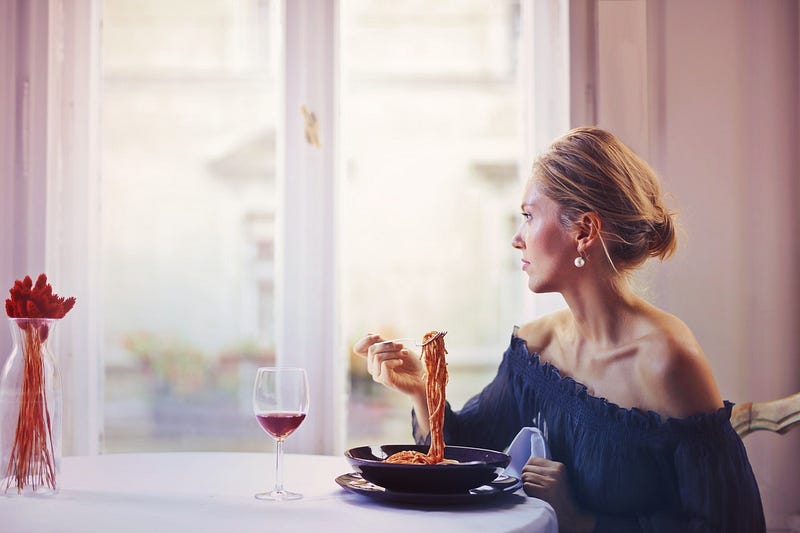
“I’m lonely,” I tell my sister.
“Col, I feel terrible for you,” she says. “Even at the worst of my marital problems, I never felt that way.”
It was an encapsulating, heart-withering sense of solitary.
Technically and physically a man was residing in our home.
Yet emotionally I was unescorted, stag, single, solo…you get the point.
I realized I wasn’t living with a man.
But rather me, myself, and I.
I could be in the room with my husband, sitting next to him on the couch, or snuggled under the covers. It didn’t matter our physical proximity. The expanse between our connection was cavernous.
I always say, “There’s nothing more painful than the distance between hearts.”
Inhabiting the same space as someone physically but not emotionally isn’t living, it’s surviving.
A distance takes residence in a marriage for a variety of reasons.
It’s not the same for everyone.
It might be you’ve grown apart, or another person has grown between you, it might be vastly different schedules or priorities, sadly, there are too many reasons to list.
One day, I asked my marriage counselor how I attracted myself to this particular man. He uttered a phrase that explained everything…
Emotional abandonment.
To be clear, this isn’t discord. It’s neglect. Emotional abandonment is when a person is no longer invested in you. Essentially, it’s sending the message, “I’m here but I’m not here.”
I’m not interested.
This separation of heart and body happens frequently in marriages.
And this is where loneliness resides.
As I mentioned earlier, the divide is caused for many reasons. The average couple who has been unhappy too long can simply grow distant from one another or there could be a devastating affair. In my case, there was an extenuating circumstance.
I had attached myself to a narcissist.
An individual with this disorder is not capable of the type of emotional intimacy a healthy relationship requires.
It’s surprising I didn’t recognize the loneliness sooner.
I blame it on being a party girl. My husband and I were the good-time Charlie and Charlene. We used to joke that we wanted to bring friends on our honeymoon.
Overly social might not be descriptive enough.
We were having too much fun for me to realize the lack of depth.
It took a long time for the party dust to settle.
But when it did I was completely and utterly by myself.
Loneliness didn’t just haunt me and hurt me.
It made me uncomfortable.
In my very own skin. I think because I grew up surrounded by love. The complete antithesis of my now unassisted heart. I had never known what it was like to not experience the type of love that made you feel adored.
The absence of it was agonizing.
I knew I had to escape.
Don’t get me wrong.
I tried to get my husband’s attention. I told him I dreamed about meeting someone who would actually be interested in me. What my passions were, what made me happy, what I loved to do.
I told him I thought about leaving.
He told me I betrayed him.
Because I said I dreamed of meeting someone who would find me interesting.
Our marriage counselor explained I was sharing my feelings. Not a betrayal. He even said ‘dreaming’ or ‘fantasy’ as I referenced, was not uncommon and something marriages often experience.
Again, fantasy, not reality.
He was saying people daydream, even in the healthiest of relationships. So the fact I was expressing my feelings like this was not shocking or a betrayal.
I am no longer married.
I would say I’m alone.
But that isn’t accurate.
Because I no longer live with a separation of heart and body.


