
Marketing: The Make or Break Force For Every Business

“Marketing should be at the table, but not be the meal,” says McKinsey’s article Beyond belt-tightening: How marketing can drive resiliency during uncertain times.
Every business, irrespective of its size or industry, faces the unrelenting challenge of capturing the hearts and minds of consumers. Marketing is the battleground where brands fight for supremacy, where success can mean soaring to the top or falling into oblivion.
The story of Steve Jobs and his iconic Apple Super Bowl ad serves as a poignant reminder of the power of marketing. Back in 1984, Jobs famously hired the creative agency Chiat\Day to craft a groundbreaking advertisement to launch the Macintosh computer during the Super Bowl XVIII. The result was a visually stunning and emotionally charged commercial that showcased Apple’s innovative product and left a lasting impact on viewers. This ad was a testament to the significance of creative branding in capturing the audience’s imagination and establishing a profound connection with consumers.
Fast-forward to July 2023, Apple reached a 3-trillion-dollar market cap, and the marketing landscape has experienced a seismic shift. Fueled by the data-driven era, today’s tech entrepreneurs and businesses tend to emphasize conversion-focused strategies over creative branding. The digital age has ushered in an unprecedented era of data analytics, artificial intelligence, and marketing automation, allowing marketers to measure every aspect of their campaigns and optimize for ROI. As a result, there is a growing emphasis on technology-driven initiatives to drive conversion rates, customer acquisition, and revenue growth.
However, in this pursuit of immediate results and ROI, some marketers risk overlooking the enduring power of creative branding. While technology undoubtedly provides invaluable insights and precision in targeting, it is the art of storytelling, emotional resonance, and brand identity that creates a lasting bond with consumers.
Marketing, at its core, is a dynamic and multifaceted discipline that goes beyond merely selling products or services. It is the art and science of identifying and understanding customer needs, creating meaningful connections, and delivering value that meets those needs. Marketing encompasses a wide range of activities, from market research and product development to advertising, sales, and customer support. At the heart of it all lies the customer — their desires, pain points, and aspirations.
The example of Apple’s Super Bowl ad illustrates how creative branding can transcend the boundaries of a mere product launch and become a cultural phenomenon. The ad, inspired by George Orwell’s “1984,” featured a powerful narrative of liberation from a dystopian society. It struck a chord with viewers, positioning Apple as a trailblazer, challenging the status quo and empowering individuals through technology. The ad’s impact went beyond immediate sales; it solidified Apple’s brand identity as an innovator and an agent of change, influencing consumer perceptions for years to come.
While the digital era has brought about unprecedented data-driven marketing, it does not render creative branding obsolete. Instead, these two facets should complement and reinforce each other. Technology-driven initiatives can provide valuable insights into consumer behavior, preferences, and trends, guiding the development of creative branding strategies. Personalization and data analytics can be employed to craft storytelling that speaks directly to the individual consumer, enhancing engagement and conversion rates.
Moreover, creative branding adds an emotional layer to marketing efforts, making the brand more than just a faceless entity but a relatable and trustworthy partner. A strong brand identity fosters brand loyalty, encouraging repeat purchases and turning customers into brand advocates. In a cluttered marketplace, brands that successfully evoke emotions and build lasting connections with consumers are more likely to thrive. A well-crafted brand story that aligns with the company’s values and mission can create a loyal customer base and foster word-of-mouth marketing, which remains one of the most potent forms of promotion.
Today, the role of CMOs has become more multifaceted than ever before. They must navigate the complex interplay between technology and creativity, understanding that both elements are essential to marketing success. CMOs should encourage collaboration between data analysts, technologists, and creative minds to harness the power of both worlds. A comprehensive marketing strategy requires a harmonious blend of data-driven insights, personalized experiences, and compelling storytelling to build strong brands, drive conversions, and cultivate long-term customer relationships to maximize the customer’s lifetime value.
What is marketing?
When I went to the Haas Business School, UC Berkeley, I took a class with Professor David A, Aacker, “father of modern branding”. We studied the 4Ps, that is product, price, place, and promotion, as the foundation of marketing. Since then, I’ve had a career from marketing to chief executives across EdTech, Digital Media, IoT, artificial intelligence, and SaaS.
Here is a diagram I put together that may do fair justice to modern-day marketing:
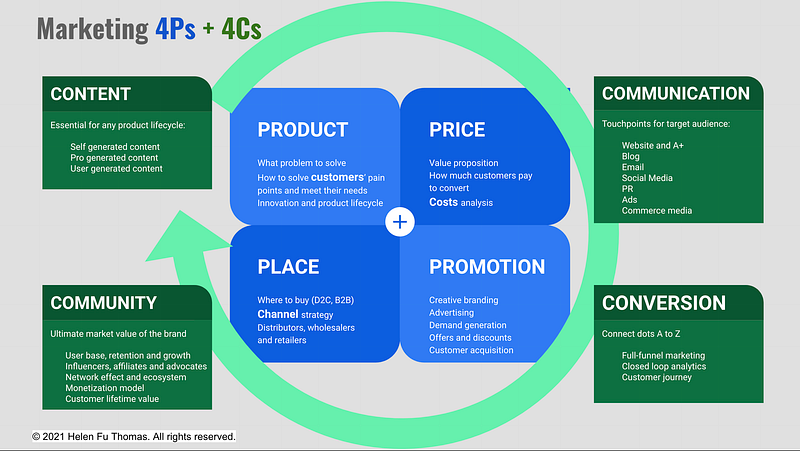
Here I intentionally put “PROMOTION” in front of “PLACE”, which implies channels in the diagram, because in the digital era, a marketer would pursue a direct-to-consumer or business-to-business marketing strategy upfront using their own website and social media to convey the value proposition to their potential customers as the initial go-to-market approach. This helps validate the product before broader market penetration across appropriate channels.
Recognizing the fundamental 4Ps in marketing is essential for every business because the common misperception of marketing is just to sell, sell, sell. That’s when marketing loses its seat at the table, and inevitably, the business loses its traction and long-term trajectory.
Another common mistake, or at least a short-sightedness, is to see marketing as the cost of business instead of the engine for innovation by making the business case with a customer-driven investment mindset.
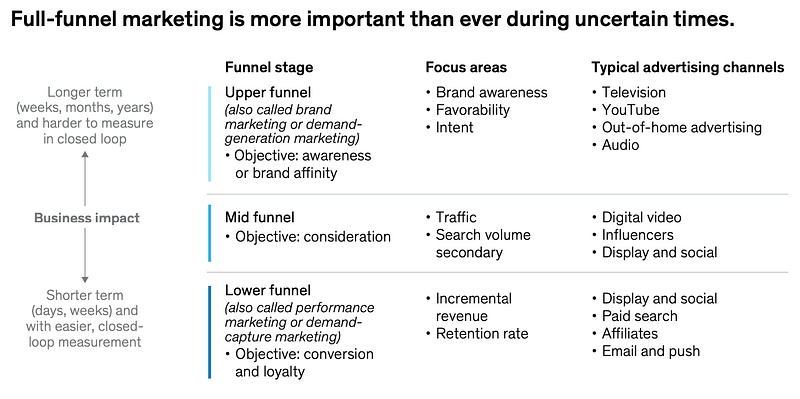
Here is the illustration of full-funnel marketing in McKinsey’s article:
At its best, marketing is a powerful force that propels businesses to new heights. It is the art of understanding consumer desires, predicting trends, and delivering products or services that consumers didn’t even know they needed. Effective marketing can create a lasting emotional connection with customers, leading to brand loyalty and advocacy. It can drive demand, boost sales, and catapult a business into the limelight, commanding a prominent position in the market.
The role of marketing is far from easy. It requires a delicate balance of data-driven insights and creative genius. It demands adaptability in the face of ever-changing consumer behavior and technological advancements. Moreover, marketing is not just about advertising; it extends to product development, pricing, distribution, and customer service. A cohesive marketing strategy weaves all these elements together to create a seamless and captivating customer journey.
In the age of information overload, marketing must cut through the noise to capture attention. It is about telling compelling stories that resonate with consumers on a personal level, igniting emotions and sparking conversations. Marketing is not just about selling products; it is about selling experiences, values, and aspirations. The businesses that understand this fundamental truth and master the art of storytelling are the ones that thrive.
While marketing can wield immense power, it is not without its challenges. The rise of social media and online platforms has democratized marketing, giving every business a voice but also making it increasingly challenging to stand out. Consumers are inundated with marketing messages, and their skepticism is at an all-time high. Cutting through the clutter and building genuine trust with consumers is a herculean task that only the most adept marketers can accomplish.
In this dynamic landscape, businesses must view marketing as an investment rather than an expense. It is not merely a department within the organization but the very heart that pumps life into every aspect of the business. The companies that prioritize marketing and allocate resources wisely will be the ones to seize opportunities, weather storms, and navigate the turbulent waters of the market.
In conclusion, marketing is a double-edged sword that can elevate businesses to greatness or bring them to their knees. Its role is far-reaching, encompassing everything from understanding consumer psychology to crafting compelling narratives. In the face of fierce competition and rapidly changing consumer behavior, mastering the art of marketing is not just an option; it is imperative for businesses seeking long-term success and sustainability. Embrace the power of marketing, wield it with precision, and watch your business soar to new heights.
This marketing series will continue to delve into the 4Ps and 4Cs with case studies and real-time examples.
P.S. Thanks to Penny Bauder for capturing my journey here https://readmedium.com/how-helen-fu-thomas-of-dmai-tackles-the-extreme-work-life-balance-of-being-a-woman-in-stem-during-982b51d96ab2