March Madness History Lessons - Round 2
The 2016 March Madness first round was unlike any in history. On Friday alone there were wins by 10, 11, 12, 13, 14, and 15 seeds, and a total of 10 double digit seeds won a first round game, the most ever! Everyone loves a good Cinderella story, and the slipper certainly fits for Hawaii, Yale, and Stephen F Austin. And of course there was the epic Michigan State loss, maybe the biggest first round upset in tournament history. There were buzzer beaters and buzzer losers.
But enough about the past- what can history teach us about the future? Let’s take a look at the games…
3 vs 11
Other than the 1 seeds going 4–0, the 11 seeds were as good as anyone in round one with three upset wins and a close loss. Now those three teams will go for a second upset. 11 seeds are 13–25 in the second round against 3 seeds, so about one in three of them win historically.
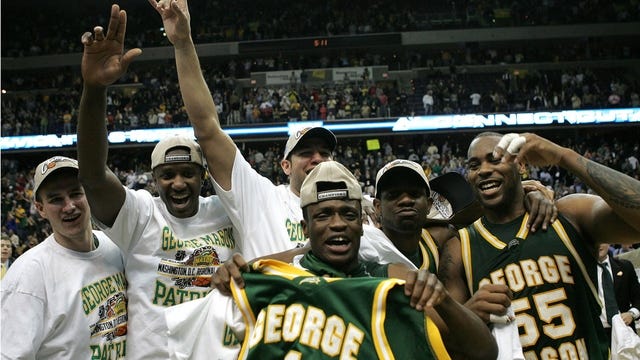
Over the last six tournaments, that record has gone up to an even 5–5 including a pair of teams that went all the way to the Final Four, VCU and George Mason. There’s no correlation between big or small conference here and also no correlation between 11 seeds that won by a lot or a little in the first round.
One strange correlation does arise over these last 10 such match-ups- 3 seeds that won by single digits in round one were 4–1 vs their 11 opponent, while the other 3 seeds that won by an average of 22 in round one were 1–4 vs their 11. Perhaps there’s some overconfidence? That could paint Texas A&M as the most vulnerable 3 seed, though the stats point to them being fairly safe.
Wichita State matches up well with Miami, though not quite as well as with Arizona. Miami is the better team but it should be close. Gonzaga and Utah are pretty even, and the Pac 12 looked weak in round one with an unprecedented 5 teams upset by double digit seeds. If Gonzaga holds the lead, Utah could struggle- they don’t do well creating extra possessions on the boards or by forcing turnovers.
One of these 3 seeds is likely to fall in round two- at least one. Choose wisely.
4/5 vs 12/13
Everyone loves to pick the 12–5 first round upset, and the 13–4 is becoming popular too. This year there were three such upsets and that leaves us with three of these match-ups where there’s one Cinderella and one clear favorite. The underdog 12 and 13 seeds are 15–31 in these games over their history, though just 6–18 this century. That would mean about 1 in every 3 or 4 of these games turns into an upset.
Of those 6 recent teams to pull a second upset as a 12 or 13, they won by an average of 15 points, so take these guys seriously if they grab an early lead. And though recent history has seen the underdogs’ winning percentage drop, there were 5 losses by a single possession so about half of the teams were right there at the finish. Don’t get too excited with any winner though- 12s and 13s are just 1–25 in the Sweet 16 and that win was against an 8 seed.
Hawaii brings a top 10 defense and their first tourney win ever to its game with Maryland. Little Rock does well limiting opponents at getting good shots and will need to do so against a strong Iowa State offense. On the flip side, the Trojans should get some open shots- they’ll need to hit their 3s to pull another upset. Don’t forget how poor Little Rock looked for the first 35 minutes against Purdue; they may be outgunned here.
The underdog with the best shot here might actually be Yale. They are dominant on the boards and shoot a great percentage from downtown, though they don’t take many 3s. Duke gives up a lot of offensive boards and plenty of good shots. Yale will have an excellent opportunity.

1 vs 8/9
1 seeds are a collective 107–17 in the second round against their 8 or 9 seed opponent, which comes out to about one such upset every two years.
A look at more recent history shows that the 1 seeds have been more vulnerable of late, with 5 such upsets in the last 6 years. Have the tides turned? Of those five upsets, four of them came down to a one possession game- perhaps the 8 and 9 seeds are just a bit luckier lately. Two of those five upsets also came against relatively unproven mid major 1 seeds Wichita State and Gonzaga (and arguably a third depending on how you feel about Villanova and the new Big East).
All four 1 seeds this year are from the big five conferences. The match-ups look relatively safe overall for the 1s. St Joseph’s doesn’t foul, turn it over, or allow offensive boards often so that should at least keep them in the hunt against Oregon. The best bet may be UConn. They’re playing well above a 9 seed level over the past couple weeks and bring a near top 10 defense to their game with Kansas, and both Kansas and Bill Self have a long history of struggling with limited prep time and in particular in this second round.
Kansas should win, but UConn is the 8/9 to keep a close eye on. And if they or another one of these teams do win, watch out- three of the five most recent teams to pull this upset carried that momentum all the way to the Final Four!
2 vs 7/10
In the second round, 2 seeds are 79–38 with a 68% winning percentage, so there’s a pretty sizable drop-off from 1 to 2 seeds this round. Strangely enough, 2 seeds beat 7 seeds 73% of the time while they beat 10 seeds just 59% of the time. That could hint at Oklahoma being vulnerable to 10 VCU but is probably just statistical noise. About 1 in 3 of these games goes the underdogs’ way, and there are three such games this year.
Both Xavier and Villanova look fairly safe statistically in their match-ups, though Nova as a top 3 seed has lost their last three second round games to big upsets. VCU should force some turnovers against Oklahoma but they tend to give up a lot of good looks and the Sooners don’t, so that doesn’t bode well.
Truthfully these 2 seeds all look pretty safe, like 70% likely to win safe. Of course, if that’s true, that would mean about a 66% chance of all three such teams winning- which puts us right back where we started. Upsets happen.
The other three match-ups
The most intriguing match-up of the weekend is longtime rivalry Kentucky vs Indiana, the only 4 vs 5 on the bracket. The rivalry is suspended now, but Christian Watford certainly remembers. Historically 4s are 36–30 against 5s, a slight 55% advantage, though they have won 9 of the last 13 games.
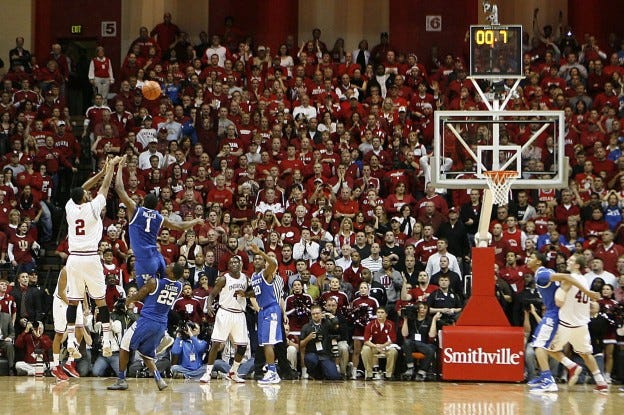
Kentucky and Indiana are both terrific underseeded teams. Both teams love to crash the offensive boards, and both teams are prone to giving those chances up. But crashing the boards can also leave a team vulnerable to leak-out fast breaks. So give the slight edge to Kentucky here, whose stud guard combo of Jamal Murray and Tyler Ulis have a clear advantage vs Indiana’s guards.
Does the slipper still fit for Middle Tennessee State after a shocking victory over Michigan State? You probably remember Florida Gulf Coast winning twice in 2013, but 15 seeds are just 1–6 after round one, and the losses are by an average of 15 points. So can the Blue Raiders shock again? Their biggest team strength is probably shooting 3s where they’re a top 15 team, and they just happen to be playing Syracuse and Jim Boeheim, who basically perfected the 2–3 defense. The best way to beat a zone is often just to shoot right over it. You saw what happened when Middle Tennessee hits their 3s, 11 of 19 against Michigan State. Can they do it again?
What about darling Stephen F Austin who flat out embarrassed West Virginia on Friday? 14 seeds are just 2–18 in round two, but this may be no ordinary 14 seed. Of the 20 that won previously in round one, 19 did so by single digits, including 11 with a one possession win. These Lumberjacks dominated a strong West Virginia team from start to finish. They’ll be ready.
SFA usually forces a ton of turnovers; Notre Dame is an excellent ball handling team. SFA tends to get into a lot of foul trouble and give up easy points; the Irish don’t draw many fouls. Both of these defenses give up a lot of good looks. Both offenses make a lot of them. This could be a real prizefight!
Enjoy the games!!
If you like this article, please comment below or share it with your friends- either now or after you use it to beat them in your pools. Follow Brandon on Medium or @wheatonbrando for more sports, humor, pop culture, and life musings.