Marathi Language Phonetic Transliteration — for ‘The Manache Shlok’ Translations and Explanations
Guide for the phonetic representation being used for explanations for Shlok 77 onwards
In the various articles wherein I am translating and explaining ‘The Manache Shlok’ (pronounced ‘Ma-nā-ce Shlo-ka’) originally written by Samarth Ramdas Swami, I will be using the phonetic representation given below while referring to the Marathi (pronounced ‘Ma-rā-ṭhi’) language words.
In the 17th century, a very famous Saint, Samartha Ramdas Swami, who lived in India from 1608 to 1681, wrote a small book containing 205 verses.
He was also a philosopher, poet, writer, and spiritual master.
The name of the book, written in the Marathi language is “Shri Manache Shloka” (श्री मनाचे श्लोक) — which means “A Dialogue With Our Mind.”
Marathi Language Phonetics
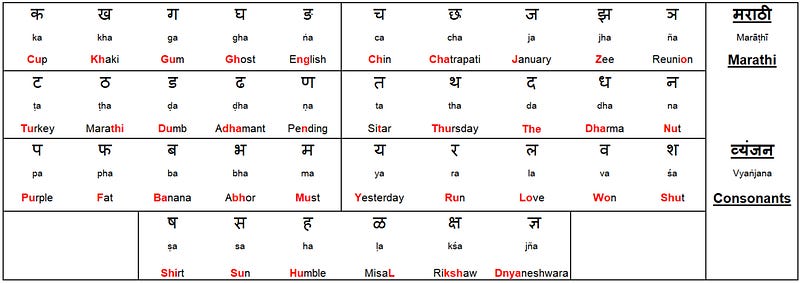
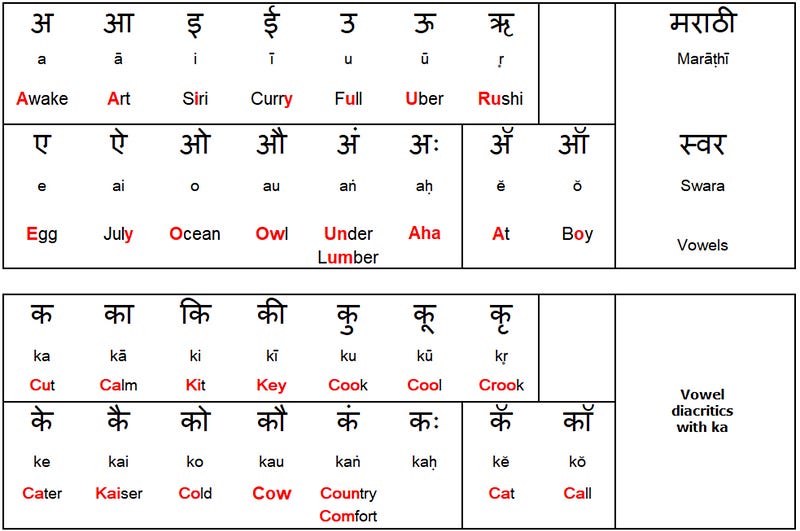
A quick guide to the Marathi language phonetics and pronunciation guide is given in the pictures below — one for the vowels and other for the consonants with the closest sounding English words (for some consonants it is hard to find any English word though). You can also refer to the Wiktionary Marathi Transliteration.
You can also listen to these words for correct pronunciation in the YouTube videos of these shlokas.
स्वर — Swara — Vowels
व्यंजन — Vyaṅjana — Consonants
Different and Hard to pronounce consonants in the Marathi language
Note that some of the consonants in the Marathi language are very unique and it is hard to find exact English words for their correct pronunciations — I have tried to give the closest words here. These consonants are:
- छ — cha — I had to use the Marathi language word accepted in the English language for this — Chatrapati.
- ञ — ña — Here again it was tough for me to find an exact word — hence I have chosen the word ‘Reunion’ — in which the sound of the ‘o’ is closer to this consonant’s pronunciation
- ठ — ṭha — Another aspirated (wherein a small but forceful puff of air is used with the corresponding unaspirated consonant) consonant — related to unaspirated ट — ṭa — sound. Hence again I used the word ‘Marathi’ — pronounced ‘Ma-rā-ṭhi’ — itself to represent this.
- ढ — ḍha — One more aspirated related to unaspirated ड — ḍa. Hence used the word ‘Adhamant’ which will be pronounced as ‘ai-ḍha-maṅ-t’
- ण — ṇa — This one is which many even in India, who speak other languages, find it hard to pronounce. It is aspirated resonant sound for corresponding unaspirated न — na. Other than the word used here ‘Pending’, I thought of ‘Bond’, ‘Hand’ where if you add more forceful puff on the ‘nd’ sound it will sound similar to this one.
- त — ta — For this also I had to use original Marathi language word ‘Sitar’ which is a musical instrument made famous in the western world by Pandit Ravi Shankar.
- ध — dha — Here again I have used the word ‘Dharma’ adapted in English to illustrate the aspirated sound for corresponding unaspirated द — da.
- भ — bha — To give an idea of its sound, if you remove the first ‘a’ in the word ‘Bahama’ — as if ‘Bhama’ you will be close to its pronunciation. Try it.
- ष — ṣa — One more example of a sound that even most of the Indian origin people will find it hard to pronounce. It is extremely close to the regular श — śa — which is the sound in the word ‘Shut’. If you try to pronounce the ‘Sh’ in this word as if you are trying to start whistling and then say the word ‘Shut’ — you will probably be close to the sound of this one.
- ळ —ḷa — Another example which even many in India will find it hard to pronounce. In the pronunciation of ल — la — as in ‘Love’, if you try taking the tip of the tongue turned back towards the hard palate first and then while keeping it touched to the palate, slide it forward and then release it. Try saying the ‘l’ sound of the word ‘Misal’ in that way and probably you will be close to correct pronunciation.
- ज्ञ — jña — Here too, I have used the name of the great Saint Dnyneshwara as an example for pronunciation, due to lack of available better English word.
To understand how these consonants were originally developed in the Sanskrit language, you can refer to the article by Colin Kenney, and you will understand why the Sanskrit language is called the most scientifically developed language while being one of the oldest languages used by mankind.
I welcome any comments, suggestions from other experts who might have even better examples.