
Probing Evolution
Many Strains of Coronavirus Are Out There, but Only One Is Important
Scientists analyzed functions of over 100 distinct SARS-CoV-2 variants — how many strains did they find?
A study published July in the Frontiers of Microbiology, titled “Geographic and Genomic Distribution of SARS-CoV-2 Mutations,” conducted the largest bioinformatics analysis to date. From a total of 48,635 genomes of SARS-CoV-2 isolated from laboratories across the world, the study identified 353,341 mutational events. “Our analysis…confirms a low mutation rate of the virus, with an average of 7.23 mutations per sample with respect to the reference SARS-CoV-2 genome sequences,” the authors remarked.
The most prevailing mutation in this study is D614G, where the amino acid at position 614 changed from D (aspartic acid) to G (glycine); the prior D614 now becomes the G614 variant. Other studies agree that G614 is the dominant variant that represents 75.7% of all circulating SARS-CoV-2 worldwide as of July. For more information about what the D614G mutation means for the pandemic, kindly see here:

Variants vs. strains
This article focuses on what other variants or strains of SARS-CoV-2 are out there. Variants mean any genetic mutation that makes a virus’s genome distinct from others. But mutations do not always result in modified biological properties. To qualify as a strain, the variant has to differ at both the genomic and functional levels, such as the G614 strain.
“A mutation is a change in a genetic sequence. The fact of a mutational change is not of primary importance, but the functional consequences are,” explained Prof. Jonathan P. Stoye, a virologist at the Francis Crick Institute in London. “However, it should be stressed that only a fraction [of] all mutations will be advantageous; most will be neutral or harmful to the virus and will not persist.”
The 68 different strains of SARS-CoV-2
Presently, only one July study published in Cell, “The Impact of Mutations in SARS-CoV-2 Spike on Viral Infectivity and Antigenicity,” has investigated the functions of various SARS-CoV-2 variants. Academics at the China World Health Organization (WHO) Collaborating Center selected 106 mutations that are predicted to confer functional changes. They then synthesized the 106 different SARS-CoV-2 variants to study their infectivity in human cells and reactivity to monoclonal antibodies and convalescent sera.
“An amino acid change (D614G)…was found to be more infectious, but no evidence of being resistant to neutralizing antibodies has been demonstrated.”
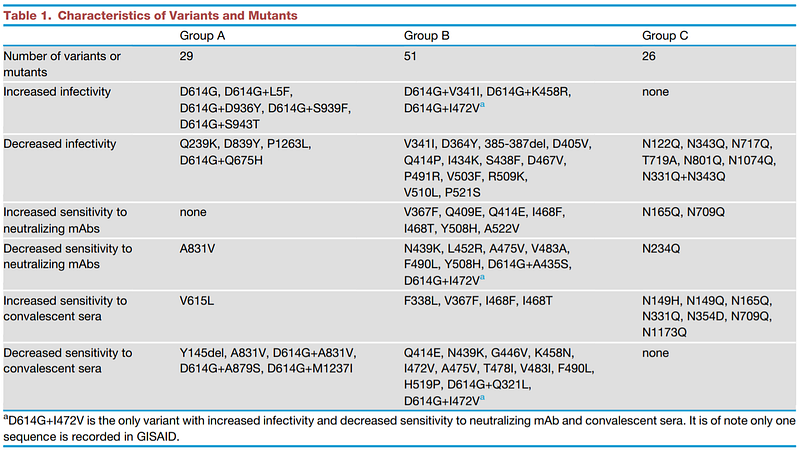
Compared to the reference Wuhan strain (wild-type or original SARS-CoV-2), their molecular analyses discovered that 68 variants (or strains) with altered biological characteristics (see figure below):
- 24 variants had lower infectivity: All had a 4- to 100-fold decrease in infectivity, except for two variants (V341I and N331Q+N343Q) with over 100-fold reduction in infectivity.
- 8 variants had increased infectivity: One variant has the D614G mutation alone, and the other seven have the D614G plus one more mutation. But no difference in infectivity was found between single and combined D614G mutations, which indicates that the D614G mutation alone is responsible for the enhanced infectivity.
- 9 and 10 variants had increased and decreased sensitivity, respectively, to neutralization by monoclonal antibodies.
- 5 and 12 variants had increased and decreased sensitivity, respectively, to convalescent sera — the blood component of recovered Covid-19 patients that contain a mix of antibodies, which may or may not be specific to SARS-CoV-2 proteins.
Practical, real-life implications
The great news is that all of these 68 variants or strains of SARS-CoV-2 comprise less than 1% of circulating viruses, except for the D614G mutation with over 70% prevalence. “Of all variants, D614G is of particular note,” the study authors from China WHO Collaborating Center stated. “Nevertheless, as RNA viruses mutate all the time and some variants may only appear during a certain period of time, whereas others could emerge in an unpredictable fashion, continued analyses of the circulating strains in terms of the mutation frequency and temporal pattern are warranted.”
“However, it should be stressed that only a fraction [of] all mutations will be advantageous; most will be neutral or harmful to the virus and will not persist.”
Another positive finding is that the D614G mutation does not seem to confer increased resistance to monoclonal antibodies made by the immune system. “An amino acid change (D614G)…was found to be more infectious, but no evidence of being resistant to neutralizing antibodies has been demonstrated,” researchers explained. “This dominant [G614] strain could effectively infect the four cell lines tested, being 10-fold more infectious than the original Wuhan-1 strain.”
A major drawback, however, is that none of the four types of human cells used in this study were derived from the respiratory tract, but rather the liver and kidney. This same limitation applies to another landmark study, “Tracking Changes in SARS-CoV-2 Spike: Evidence that D614G Increases Infectivity of the COVID-19 Virus,” from the Los Alamos National Laboratory in the US that first found that the G614 strain is more infectious in human kidney and liver cells. Similarly, another pre-print study, titled “D614G mutation of SARS-CoV-2 spike protein enhances viral infectivity,” also used human kidney cells.
Therefore, such results may not fully recapitulate what would happen when SARS-CoV-2 enters the respiratory tract into the lungs. Even if it does, it does not guarantee whether it directly reflects human-to-human spread in real-life. “These [cell culture] assays don’t account for the effect of other viral or host proteins and the parade of biochemical host-pathogen interactions that must occur to support infection and transmission,” a research review by researchers at Yale School of Public Health clarified.
Short abstract and closing
At least 353,341 mutational events have occurred in SARS-CoV-2 genomes. But only mutations that change the virus’s biological properties can be called as strains; otherwise, they are just variants. To grasp how many strains are out there, researchers synthesized 106 variants of SARS-CoV-2 that were predicted to modify the virus’s biological properties. Results showed that 68 of such variants had altered infectivity and immunogenicity. But each of these variants or strains comprise only <1% of circulating SARS-CoV-2, except for the D614G mutation with >70% prevalence. The D614G mutation does not increase the virus’s resistance to antibodies but made it more infectious in cultured human kidney and liver cells. So, it remains unclear if results directly reflect virus spread among humans.
Thus, out of the 68 characterized strains, only the G614 strain is clinically relevant. The others may fade away over time as the milder Δ382 strain did.


