Literary Impulse & Paper Poetry ‘Eudaimonia’ Prompt Submission
Many Dandelions
An exploratory free-verse poem and thoughtful note in response to the eudaimonia prompt
After first pass, I wonder if eudaemonia might have form in the capitol city of Utopia
maybe it’s caught in the pages of Arcadia’s Declaration of Independence or maybe it’s cross-stitched through the navels of a Dystopian people, a blanket of space-time holding everyone together and splitting them all horizontally in half.
But I revisited the margins of my weekday midnights, a place where fairies and witches lull my spelling. and I practiced the rigid lines and the sparse curves of the word, until I got it right, and Aristotle arose from his home in the Collective Mind
but not as a figment of play-acting tomb but whole and faulty — dull pieces drifting in the loft of a real person.
(and I do wonder if he felt fulfilled and satisfied, looking back at his search for truth, in the swift daydream-moments after consuming his cyanide)
After I’d held the archeologist’s glass, half-empty his strife to find an imprinted remnant of bone; his dream of brushing away earth’s dust to glean a mural of empty solar system’s dome,
I thought, he must not have perfected the word as I said I had, but alas, I only know I tried.
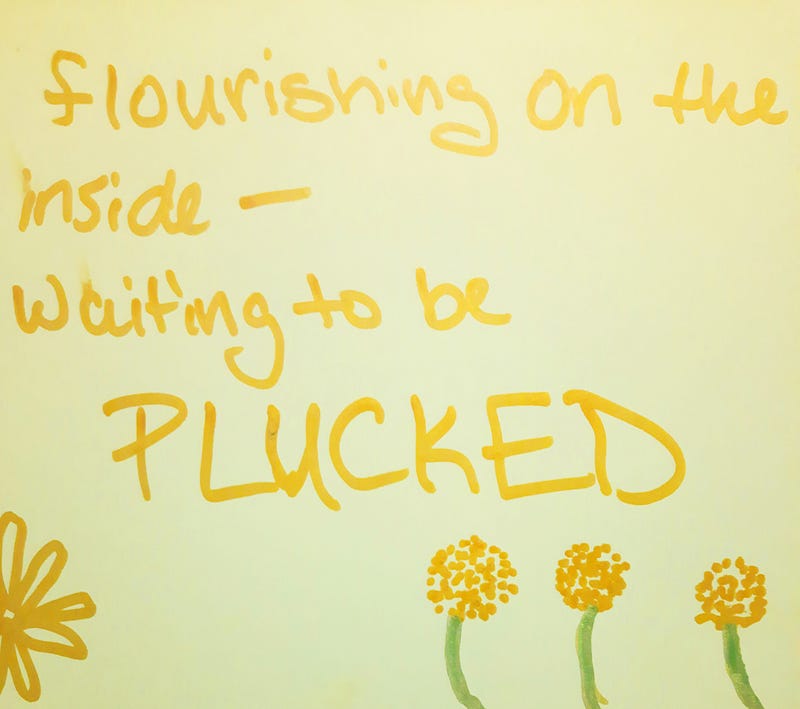
Eudaemonia, I decided, though they say it’s objective and the subjective are primed to reject it, is always within us each and all, and flourishing on the inside —
waiting to be plucked, as among many, a Dandelion.
~A Poem Written by Chloe Paulina Hawes
I wrote Many Dandelions in response to Paper Poetry and Literary Impulse’s prompt on “eudaemonia”. My venture in writing for the prompt transformed from ignorance and into a learning process. Therefore, this piece doesn’t expand upon my personal experience of eudaemonia per se, but it traces my thought processes, in a way, as I learned the somewhat ambiguous definition of “eudaemonia”. Eudaemonia has two modern English spellings, by the way, which include the one I use here, and “eudaimonia” as is used by other beautiful, talented writers in response to the subject prompt. As I traversed the internet’s eudaemonia webpages, I naturally came across a relatively recent story on Aristotle. I imagine many, if not most, other eudaemonia prompt participants came across the same story. An archeologist believes he has found Aristotle’s tomb, but the true nature of the archeologist’s discovery is debated. That same archeologist appears in Many Dandelions, as I contemplated his feelings of life fulfillment whilst finding such an incredible piece of humanity’s history in solid form. Did he have a sense of eudaemonia, or did he achieve or experience eudaemonia after his amazing find? Or did he, as so many of us do in our own ways, let public contention surrounding the claim negate the discovery itself, along with its abounding possibilities? What if the object of the archeologist’s digging wasn’t Aristotle’s tomb, at all? Questions trail the mention of eudaemonia, in my own mind, at least. That doesn’t mean I have no conclusion on eudaemonia’s real world origin — because I do. I believe eudaemonia is achievable, so to speak, no matter who you are or what circumstances you’re in, because, as cliched as it is, satisfactory life fulfillment is a flourishing meadow of pretty weeds we all have within ourselves.
~Note on “Many Dandelions” by Chloe P. Hawes
Thank you to Paper Poetry and Literary Impulse for the opportunity to join this prompt. The prompt guidelines are in the following link.