
Manuscripts Don’t Burn but Poetry Does Survive
The Stalinist Purge of Georgian Poets and the Power of Poetry
If you are not a Medium member and are hitting a paywall try this link.
Soviet literary history is notorious for its bloody purges, in which entire categories of intellectuals were erased from history. Yet compared to the purges of Georgian poets during 1921 and 1931, the Great Purge of 1937 was extreme, due to the number of the poets who were executed, as well as the absurdity of the accusations made against them.
Within the space of a few months, Georgia’s most original and talented writers and poets — Paolo Iashvili, Titsian Tabdize, Nikolo Mitsishvili, and Mikheil Javakhishvili — were arrested, interrogated, tortured, and executed on spurious charges, such as spying for the US.
These writers believed in the freedom and autonomy of the poet’s voice. They lost their lives in part because they would not betray their friends. Under Stalinist rule, these deeply held convictions alone were enough to merit execution. Their summary executions and the banning of their works cast a dark shadow over Georgian literature from which it has yet to fully recover.
New Visions of the Past
In the Spring of 2023, a new museum opened in the heart of Old Tbilisi and on the premises of the old Soviet Writers Union. Revolutionary in its political objectives and stunning in its aesthetics, this museum aimed to illuminate the dark passages of Georgian history and to heal wounds that had festered for generations.
On 20 March 2023, I returned to Tbilisi, a city where I have passed some of the most important moments of my life, even since I first arrived in 2004. By 2023, a dramatic change had taken place, and not only in the city’s physical profile. It was a tense period in Georgian politics, soon after the government agreed to withdraw its controversial Foreign Agent’s Bill on 9 March, following intense protests throughout Tbilisi.
Had it passed, the bill would have required any Georgian organization that received more than twenty percent of its funding from a non-Georgian source to register as a so-called “foreign agent.” The disturbing terminology was evocative of the Soviet political atmosphere, in which every outsider was treated as a potential spy.
As Zviad Kvaratskhelia, the director of leading Georgian literary publisher Intelekti, explained to me, the term “agent” has a particularly ominous resonance in the post-Soviet context. “It brings us back to the days of Soviet repressions and purges,” he explained, “when merely expressing dissent put your life at risk.” To Zviad’s relief, the Foreign Agent’s Bill was withdrawn.
Among the many signs of change amid the tensions linked to the controversy over the bill was the newly remade Writer’s House, on the premises of the former Soviet Writer’s Union, which now houses a museum on the first floor. On the floor above the museum is the Writer’s Residency, with each of its rooms named in honor of famous writers who passed through Georgia during the 19th and 20th centuries: Boris Pasternak, Alexander Dumas, John Steinbeck, and the British diplomat Oliver Wardrop and his sister Marjory, who translated Georgian literary classics into English. On the ground floor of the building is a series of meeting halls, which lead at the end to a sculpture garden.
The building of the former Writer’s Union, on 13 Machabeli Street in the Sololaki neighborhood of Old Tbilisi, was constructed between 1903–1905 in the Art Nouveau style by the renowned German architect Carl Zaar. The architecture combines European grandeur with touches of Orientalist aesthetics.
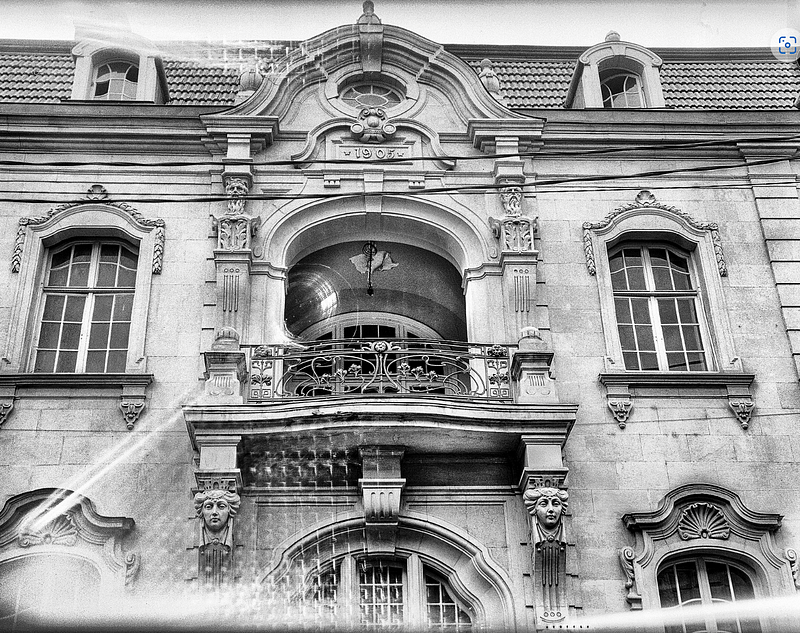
In 1911, on his deathbed, cognac manufacturer David Sarajishvili bequeathed the house to his wife, with the proviso that she would reserve a major portion of it to an exhibition space for Georgian folk arts. Three days after the Bolsheviks seized power, Sarajishvili’s mansion was turned into an artist’s collective. In 1923, the Art Nouveau mansion became the headquarters of the newly formed Georgian Writers Union.
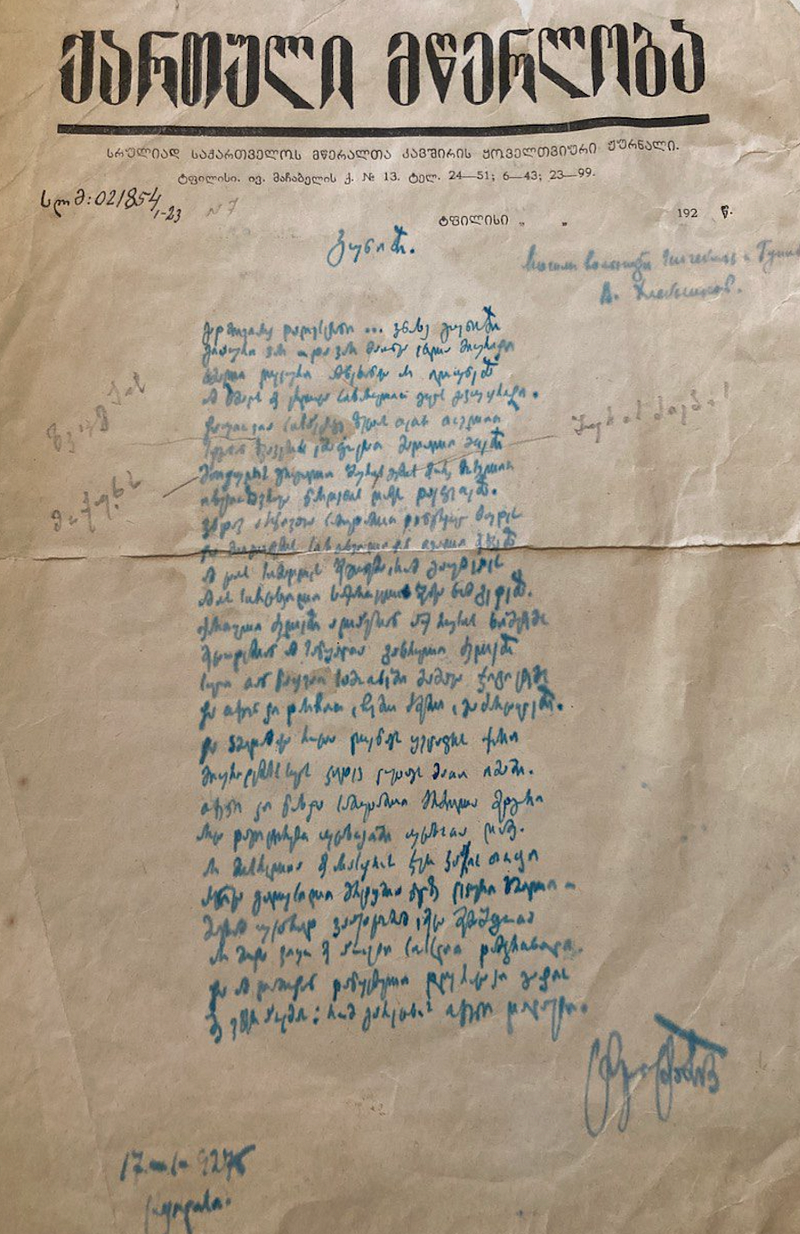
In addition to serving as a venue for formal and informal literary meetings, the Writers Union provided Soviet writers with their livelihoods. The Soviet state furnished writers with a regular income in exchange for specific literary outputs: translations of authorized writers, poems praising Stalin, and edited collections of poems celebrating the new Soviet era. Many poems from this period are preserved in their original versions on elegant stationery bearing the blue Writer’s Union’s letterhead, suggesting that they were composed — or at least revised — on this very premise.
The mastermind behind the purge of 1937 was the Mingrelian Georgian Lavrenty Beria (d. 1953), head of the NKVD. As Stalin’s henchman, Beria implemented Stalin’s most vicious and brutal plans, including the genocidal deportation of the Chechens, the Ingush, the Crimean Tatars, and many other so-called “punished peoples” in 1944. Beria took a special interest in persecuting poets, particularly the ones who refused to be incorporated into his network of spies and informants.
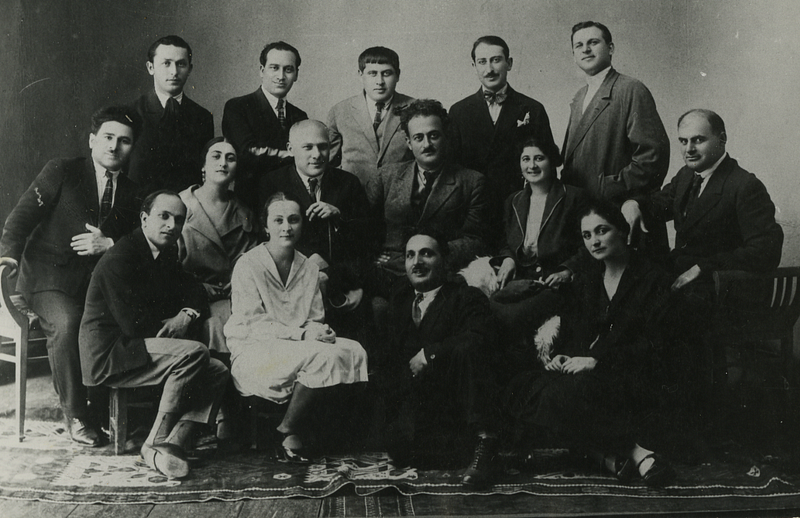
The Writer’s Union was the epicenter for many of the accusations that infected the air during these years, and the meetings that took place in this building often laid the foundation for a chain of accusations that would end with the writer’s execution. Beria personally interrogated and tortured many of his victims. It was this legacy that led Galaktion Tabidze — a cousin of Titsian who survived the purges — in 1953 to call Beria a man who “has shed so much blood / that he has turned into blood” and to denominate him someone so full of evil that he “turned even Eden / into a desert.” At the time that the purges were taking place, such words could not be publicly uttered. Ironically, Beria was himself executed immediately after Stalin died in 1953. Only then was it permissible to criticize him.
Museum of Repressed Writers
The newly opened Museum of Repressed Writers, on the premises of the former Soviet Writer’s Union, powerfully intervenes within a long history of silences. Consisting of a single extended exhibit, the museum puts multimedia techniques and materials to good use to give new life to this subject. As the museum’s founder Natasha Lomouri explained, the museum has been in planning for many years and overcame many obstacles to its construction. The permanent exhibit aims to honor the poets who have been suppressed in Soviet textbooks as well as in world literary histories: Titsian Tabidze, his cousin Galaktion Tabidze, and their close friend Paolo Iashvili.
The exhibit is spread across three large rooms. You first enter a hallway with blue panels in Georgian and English before being ushered into a dark room covered in portraits and poetry. On one of the most prominent ones, in oversized Georgian font, Galaktion poses his famous questions, interrogating the bloody Soviet past: “Who did this? Why? For what?”
Other panels are covered with lists of executed poets and their suppressed poems. The exhibit concludes with an art installation of long winding white sheets hanging from a tall ceiling, with the poems of Georgia’s many repressed and executed poets emblazoned on them in black letters.
A Return to Authoritarian Rule?
From the Writer’s House to Sovlab, to the Georgian Literature Museum, Georgian cultural institutions today passionately defend freedom of expression. They understand the dangers that a return to authoritarianism poses for Georgian civil society and literary expression. Indeed, just six months after the Museum of Repressed Writers was opened to wide acclaim, the director Natasha Lomouri was replaced by a political appointee of the ruling Georgian Dream party. This is the same party that had proposed to criminalize contact with international organizations through the Foreign Agents Bill. Such actions bring the specter of Soviet authoritarianism uncomfortably close to home.
Before leaving Tbilisi, I visited the Giorgi Leonidze State Museum of Georgian Literature, the primary repository of Georgian writers’ manuscripts since its founding in 1930. I met with the museum’s director Lasha Bakradze, himself a prominent cultural critic. I observed how impacted I had been by the dossiers of the many repressed writers that were preserved (in facsimile) and on display in the Museum of Repressed Writers. Yet I was perplexed by the fact that the dossier of my favourite poet Titsian Tabidze, which would have documented the interrogations he underwent and any confessions he made under torture, was nowhere to be seen.
“Will Titsian’s dossier ever be recovered?” I asked.
I was particularly curious because I had read of the brutal interrogations to which Titsian had been subjected and the lengths he went to preserve his integrity while imprisoned and subjected to torture. In a bitterly comic incident, when asked whom he had “collaborated” with, Titsian named the 18th-century Georgian poet Besiki as an accomplice in his anti-Soviet activities.
The interrogators had no idea who Besiki was, and they scoured Tbilisi hoping to arrest this suspicious individual. This anecdote exemplifies the dark sense of humor and irony that permeates Titsian’s poetry, a quality that is part of why I love him.
Bakradze reflected for a while on my question. “There once was such a file,” he finally said. “We know that it existed because, as the Soviet Union was collapsing in 1989 and Georgians declared their independence, the new leader Zviad Gamsakhurdia demanded to see the dossiers of all the repressed writers.” Perhaps, Bakradze speculated, Zviad Gamsakhurdia was interested in the fate of his father, Konstantine Gamsakhurdia, a pioneering and iconoclastic writer who began his career in the 1920s, at the same time as the executed poets, and yet who magically survived the purges.
In addition to being the son of a famous writer who survived the purge, in 1990 Zviad Gamsakhurdia became the first democratically elected president of Georgia. According to Bakradze, soon after assuming power, Zviad asked the officials in his newly-formed government to see the dossiers of all major writers from that period, including the dossier of Titsian Tabidze. He was handed a huge stack of papers, which he stored in his bunker in the building that is now the Georgian Parliament. That building was set on fire during the coup of 1991–1992. During this coup, Gamsakhurdia was exiled from Georgia.
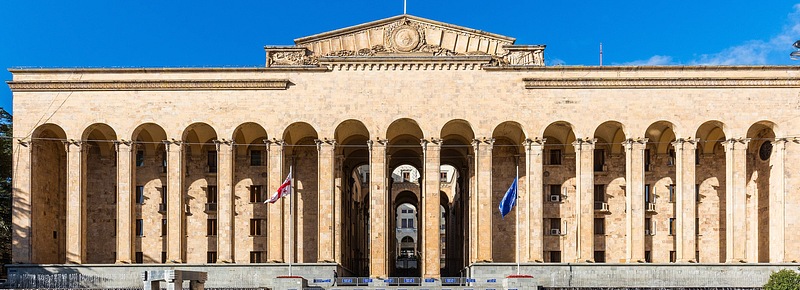
After the Parliament building was burned, the dossiers disappeared from the historical record, but their traces remain in the imaginations of lovers of Georgian literature, as well as — perhaps — in physical form. As Bakradze explained, when Gamsakhurdia’s office was searched soon after the fire, no ashes were visible in the place where the manuscripts had been stored. This suggests that someone managed to get the dossiers out in time, or perhaps they were removed long before the fire. From these reports Bakrazde concluded that the dossiers may still be intact somewhere. Perhaps they are in the possession of someone who prefers to keep them hidden from view, such as Zviad’s wife Manana Archvadze-Gamsakhurdia, well-known for her hostile relationship with the current Georgian government. Bakrazde still hopes that the dossiers are preserved and will someday be discovered.
Manuscripts Don’t Burn
My conversation with Bakradze about the missing dossiers concluded with a quotation from Mikhail Bulgakov’s classic novel Master and Margarita. The novel was written between 1928 and 1940, but the rules of Soviet censorship meant that it was only published long after the author’s death in 1967. In the novel, Bulgakov’s main character — simply called “master” — tries unsuccessfully to burn his own manuscript, after it has been rejected by a long list of publishers.
The story mirrors the author’s own biography. Overcome by despair concerning his fate as a censored writer in a repressive system, Bulgakov himself committed this act of incineration: He burned the first draft of his novel, before rewriting it later and giving it a second life.
In the novel, the master’s beloved Margarita rescues the manuscript from the fire, and the master eventually reconstructs the charred fragments. Even the devil Woland, who is an ambiguous figure throughout the novel, wisely informs the master that manuscripts don’t burn. Bulgakov’s effort to fuse his own personal story of despair and its resolution with his novel offered a kind of catharsis to which many Soviet writers — particularly the ones who were repressed, silenced, and imprisoned — could relate.
In the case of the novel — and for much of Soviet literature — the devil was right. Master and Margarita survived, despite the state’s many attempts to destroy and later to censor it. The lesson of Bulgakov’s novel — and of Bakradze’s hopeful account of the missing dossiers — is torn from the darkest pages of Soviet existence. In Georgia today, the writers who were repressed and executed during the purge live on in the imagination — and in the suffering — of everyone who has ever experienced persecution for their beliefs and their words.
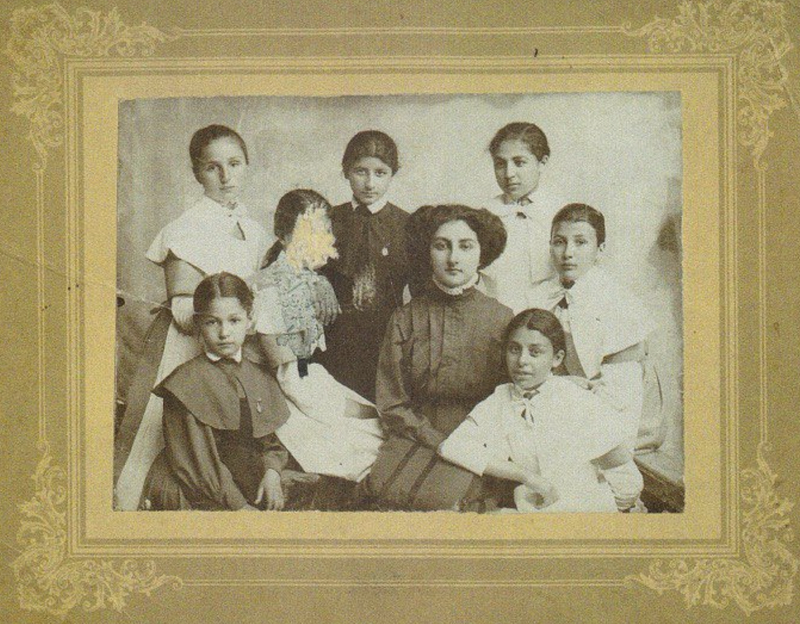
They also haunt the erased and defaced photographs, many of which were taken at the Writer’s Union, in which the eyes and faces of suppressed poets are either scored out or entirely erased. The Museum of Repressed Writers and the Georgian Literature Museum gives these erased poets a second life. May these brave cultural institutions, which speak the truth to governments that don’t always want to listen, never be erased.
References and Links for Further Reading
No scholar or critic of Georgian literature can pass over the ground-breaking work of Donald Rayfield. Two of his works are particularly relevant to the topic of this essay:
Donald Rayfield, “The killing of Paolo Iashvili,” Index on Censorship (1990). Available open access.
Donald Rayfield, “The Death of Paolo Iashvili,” The Slavonic and East European Review 68.4 (1990): 631–664. This is a longer and more scholarly version of the above article.
The website niamorebi is in Georgian, but it is a priceless repository of images and archives from the poets discussed in this essay. For the images alone, it is worth perusing even if you don’t read Georgian.
Finally, even in its politically compromised state, if you are ever in the area you should certainly visit the Writer’s House of Georgia.
Thanks for engaging with my work! You may be interested in my other writings on the Caucasus which are gathered together in this list:
You can also join my substack to be the first to get updates about my reading and writing:


#/media/File:Parlamento_de_Georgia,_Tiflis,_Georgia,_2016-09-29,_DD_07.jpg)