
Manipulating Data for the Benefit of Charter Schools
“Because there are no facts, there is no truth
Just data to be manipulated
I can get you any result you like
What’s it worth to you?
Because there is no wrong, there is no right
And I sleep very well at night
No shame, no solution, no remorse, no retribution”
- Don Henley, The Garden of Allah
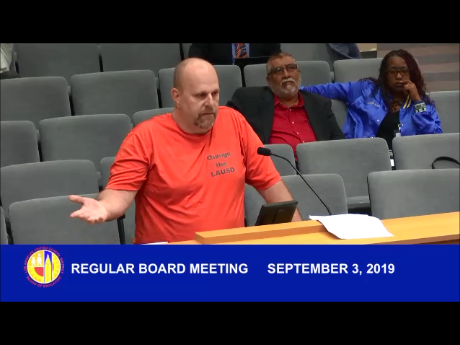
After a summer filled with revelations about confidential dealings between the California Charter School Association (CCSA) and Nick Melvoin, one would think that this Los Angeles Unified School District (LAUSD) board member would take some time to regroup. Instead, Melvoin charged ahead during the first meeting of the school year by placing an item to updated board rules on the agenda. It was his fourth attempt to pass the changes that had been formulated behind closed doors. Unlike a previous attempt, this new version did not reduce the amount of time allotted for public comment. However, he still seemed dead set on reducing transparency, as I noted in my public comment:
Again, it would be really nice if the creation of these rules had been done in the public realm and with the public able to have some input into what was happening here. If they had, perhaps the rules would state that these meetings could only take place when most parents, teachers, and students could participate. Instead you meet during school hours.
In reviewing these proposed rules I did notice that there is a line stating that “Board Members shall maintain strict confidentiality of any confidential matters discussed in closed session consistent with the Brown Act.” Given that these rules are coming from Nick’s Secret Committee, I know where this is directed; Melvoin was not happy with another board member actually letting the public know what had happened during the superintendent search. I thought that we were looking for more transparency, not less.
It seems that, at the same time Melvoin was complaining about another board member, he met behind closed doors with the CCSA while they were in the process of suing the district. Apparently, Melvoin was revealing information about that lawsuit to the CCSA.
I would like to know if anyone is investigating Melvoin’s release of this confidential information. After all, if someone is suing the district, they should not be getting information obtained from our lawyers about what strategies are being used in defense of LAUSD.
Also, in these confidential documents that were obtained from the charter school industry, we find out why the School Performance Framework (SPF) is being imposed on the district. It turns out that the charter schools want to use it to get access to school facilities beyond what they are getting through Prop 39.
Again, where do loyalties lie? These are private schools trying to get access to our public facilities and Melvoin is going to help them by using the SPF. So let’s not pretend that this is all about giving parents information. Assigning a Yelp type score that has been calculated by crunching data so that it gives you the results that you want is not giving parents information.
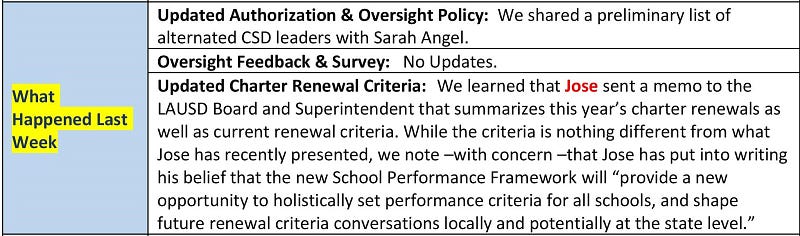
It turns out that these same confidential documents show that when the Charter School Division wanted to use the same SPF indicators as a way of approving or rejecting charter renewals, charter schools did not want the score to be used that way. Apparently, the SPF is good for public schools but private schools should not be held to those same standards.
As you consider this subject, let’s look at the source of this proposal.

While a resolution authored by Jackie Goldberg and aimed at eliminating the SPF was on the agenda, it was instead forwarded to the Curriculum and Instruction Committee that will give it a complete public hearing at their meeting on October 8, 2019, at 10:00 AM. Hopefully, this discussion will include a deep dive into the origins of this form of performance measurement, the ways the CCSA intended to use it against the district, and a determination of whether the performance measurement as designed by the contractors achieved the results originally intended by the board’s resolution.
Even with their intentions fully revealed, the charter school industry is committed to defending the SPF by defeating Goldberg’s resolution. Speak Up, an astroturf organization created to help elect Melvoin, is in hardcore propaganda mode. They claim that eliminating the Yelp-like rating system will deny “parents access to student growth data”, but in fact, an artificially created scale of one to five stars is not data at all. The SPF was supposed to “give parents a better way to evaluate their schools” but it turned into a system that has Melvoin’s handlers at the CCSA interpreting the facts based on what they want parents to think.
Despite Speak Up’s emphasis on measuring growth, the system that was developed also only partially uses growth in determining the score a school will receive. Raw test scores and graduation rates are also used as are vague performance indicators like “school climate.” The exact weight of each measurement in the overall score is determined not by the parents who will be using the rating system but by district bureaucrats directed by the CCSA.
The SPF punishes schools that accept the challenge of meeting the needs of students facing educational challenges by using raw test scores in the calculations. What the version that was presented to focus groups for review lacked was any information for parents seeking specific services. Nor was the ability to serve these types of students included in calculating the score. Since this system was created to benefit the charter school industry, this oversight should not be thought of as accidental considering their failing record of providing special education services.
While Speak Up alleges that parents “spent a year attending working group meetings” developing the framework, in reality, the parents who participated were not chosen from the general population but from Melvoin’s mailing list. Opinions obtained by these focus groups are, therefore, not indicative of what the average LAUSD parent needs from this web site but from what Speak Up’s members want. Even with the biased selection of the population, all of the participants in the group that I attended opposed the Yelp-style rating.
The resolution that created the SPF was passed with board majority that included convicted felon Ref Rodriguez. The election of Goldberg changed the direction of the board to one that focuses on the 80% of students who attend LAUSD schools. Overturning a performance measurement system written by the charter school industry would be an important step in ending the practice of turning over public school facilities to private entities. This is especially true when these same charter school entities express “concern” with using this same system as a way to “shape future [charter] renewal criteria”. If this new system is ill-fitted for the goose, the gander should have no part of it.
Carl Petersen is a parent, an advocate for students with special education needs, an elected member of the Northridge East Neighborhood Council and was a Green Party candidate in LAUSD’s District 2 School Board race. During the campaign, he was endorsed by the Network for Public Education (NPE) Action and Dr. Diane Ravitch called him a “strong supporter of public schools.” His past blogs can be found at www.ChangeTheLAUSD.com. Opinions are his own.


