
Manfred von Richthofen: The Red Baron and the Legend of Aerial Warfare
In the annals of military history, some individuals stand out as icons of their time, permanently imprinting themselves on humankind’s collective memory. One such person is the well-known Red Baron, Manfred von Richthofen. A legendary World War I aviator, he achieved unmatched success and gained the respect of both allies and enemies as he soars through the skies in his characteristic scarlet aircraft.
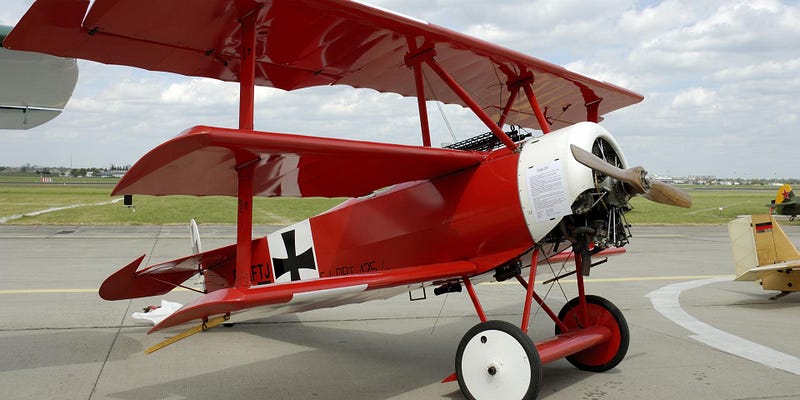
On May 2, 1892, Manfred Albrecht Freiherr von Richthofen was born in Breslau, Germany (now Wrocław, Poland), into an aristocratic family. The lineage of the Richthofen family stretched back several centuries, giving them a colourful past. Major Albrecht von Richthofen, Manfred’s father, was in the military, and this background would be crucial in determining Manfred’s future. Manfred had an interest in aviation from a young age. The rapidly developing field of aviation technology, which was still in its infancy, captured his attention. Eventually, this fascination would drive him to seek a career in aviation. Aircraft combat was a brand-new type of warfare that the world saw with the start of World War I in 1914. Manfred von Richthofen was a cavalry officer at first because he was eager to help with the war effort. But his desire to fly made him ask to be transferred to the Imperial German Army Air Service. Manfred would discover his true calling in the cockpit. His aircraft were painted a vivid red, earning him the nickname “Red Baron.” His unusual colour scheme served as a tactical advantage by helping other pilots recognise him quickly and as a representation of his daring and fearlessness in the face of peril. Manfred von Richthofen made a name for himself as a capable and determined fighter pilot very fast. Through his astute tactical awareness, accurate shooting skills, and remarkable aptitude for anticipating his opponents’ movements, he started to rack up wins at an incredible pace. The success Richthofen achieved in the air was astounding. He had accomplished an incredible 80 confirmed kills by the time of his death, an accomplishment never before seen in the history of aerial combat. His total was higher than that of his opponents, solidifying his record as the highest-scoring ace of World War I. Richthofen’s accomplishments were not the result of a lone wolf; rather, they were a reflection of the cooperation and camaraderie of his squadron, which is well-known as the “Flying Circus.” They were a mixed bag of experienced pilots that flew with accuracy and efficiency, which helped make Richthofen a great success. Manfred von Richthofen was renowned for his gallantry in the face of war’s brutality. He was well-known for upholding an air combat code of honour and for frequently abstaining from attacking weaker enemy pilots. Richthofen’s famous red Fokker Dr.I triplane came to represent his strength and daring. The Red Baron’s legend was cemented when its unique appearance instilled fear and awe in the hearts of both enemies and friends. Manfred von Richthofen tragically lost his life in the skies over Vaux-sur-Somme, France, on April 21, 1918. He was deep in Allied territory, pursuing an enemy aircraft when he was hit by a single bullet, probably fired from the ground. He made a controlled crash landing after being fatally injured. The premature passing of Manfred von Richthofen signalled the end of an era in aerial combat. But his influence lasted long after the war. Future pilot generations found inspiration in the Red Baron, who came to represent aviation perfection. For many years, the Red Baron’s legend has been ingrained in popular culture. Numerous literary works, motion pictures, and documentaries have honoured his accomplishments and delved into the enigma surrounding this remarkable aviator. Beyond his combat record, Manfred von Richthofen left behind a lasting legacy. He was the epitome of what it meant to be a professional: brave, skilled, and completely committed to his work. Even now, his impact on the aviation industry is still felt. The Red Baron, Manfred von Richthofen, is still remembered in the annals of military history. Pilots and aviation enthusiasts alike are continually inspired by his audacity, skill, and unwavering spirit in the face of aerial combat. His legacy is woven into the fabric of human achievement, a monument to the heights that can be attained through unwavering dedication and unwavering determination, even beyond the scarlet triplane and the skies of World War I. Even though the Red Baron’s flight was cut short on that fateful day in 1918, his legend lives on and will always be a tribute to excellence in the skies.


