
Managing the Expectations Gap in Parenting
How families can evolve when members are growing in different directions.
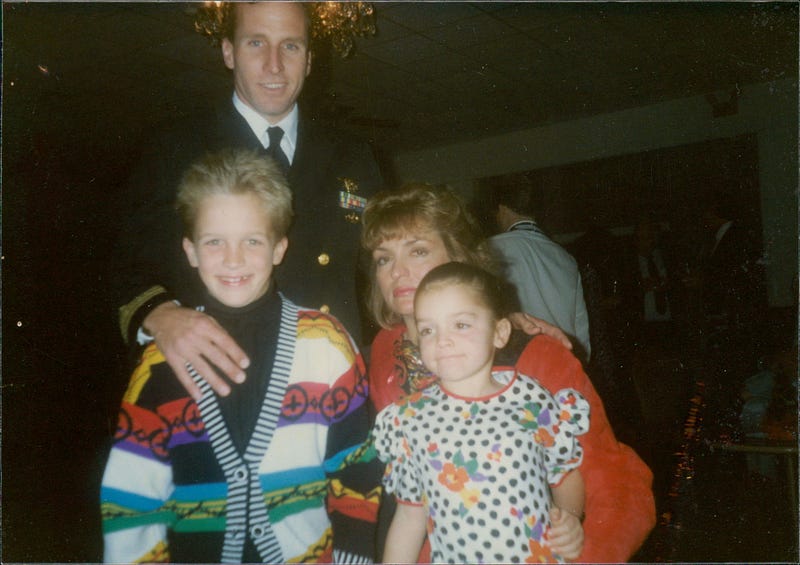
My childhood was stable but marked by moments of chaos. We uprooted and moved to a new state each year, having to not only rehabituate, but also make new friends.
It also strained our relationships with each other. My parents, despite being genetically close to me, grew up in very different households. They were raised by, “The Greatest Generation”, born just prior to the Great Depression and World War II, when the world was on fire. They were stern and tough and passed those values down.
For example, my dad’s father commanded a military base and raised his kids as you’d expect such a man to. Dad was expected to be at the dinner table at 6 PM sharp while wearing a collared shirt. Talking back or breaking the rules was highly inadvisable.
With my generation, “feelings” were finally taken into consideration, and we shouldn’t be whipping kids into submission or screaming at them. But that didn’t always align with what this tougher generation expected.
I was an imaginative, sensitive kid, and not made of steel like my dad. Where he’d been the 8-year-old scoring all the team’s goals, I was the 8-year-old chasing butterflies in the middle of a game. And this diverging trend continued for some time. My parents expected to have a more hyper masculine, down the middle son.
“Man up!” Dad would tell me, trying to get me to stop crying after hurting myself.
The problem began, as it often does, with the expectations. And sadly, this is a common source of family tension and, sometimes, dissolution. Having the ability to loosen these expectations might just be the key to helping a family prosper and love each other even more.
Heartburn for the youth
Aristotle wrote of young people in his book Rhetoric, “They are high-minded, for they have not yet been humbled in life nor have they experienced the force of necessity.”
His palpable frustration may well have been a result of his own struggles with his son, Nicomachus. One could only imagine how opinionated a man like Aristotle was as a father. One’s identity could surely buckle under this overbearing pressure.
Often, the negativity towards “kids these days” is a reflection of our own biases. Per a study by Dr. John Protzko, authoritarian people think youth are less respectful, intelligent people think they are less intelligent, and well-read people think the youth read less. In short, our dominant traits become a measuring stick we use against all others.
And this often infringes upon healthy parent-child relationships, which is unfortunate, because they predict overall wellbeing and lower psychological distress throughout life. Yet this tension is a natural extension of children growing up. There’s a give and a take of letting the child be independent and also protecting them.
For example, when my sister was 15, she had infamous battles with my parents over her autonomy. She was bold and had a rebellious streak in her, and she grew to loathe having a curfew and other rules.
One night, she took it to another level and snuck out at midnight with my parent’s Lincoln Navigator to go to a party. She slammed into a curb on the way home and got a flat tire, stranding her. Fortunately, my friends and I bailed her out and helped change the tire. My parents didn’t know about the incident for many years — thankfully. Because they would have gone nuclear. Yet this was a crystalized example of my sister lashing out for being stifled for too long.
Mom and dad expected her to stick to the rules. My sister expected more freedom for her age, and this was her way of subverting them. Fortunately, both parties grew out of this phase.
Unfortunately, the same expectations-gap problem can metastasize into adulthood and often does. Choosing a different lifestyle than your parents hoped for, or choosing not to have children, can invoke hard-to-mend rifts. Conversely, grandparents may not be as involved as new parents want.
The end result, and the saddest extension of this — are estranged parents and children. One study showed 10% of Americans are estranged from at least one parent.
My ex-girlfriend had completely estranged herself from her mother. She was aged 31 and hadn’t spoken to her mother since she was 21. It was a topic I didn’t dare bring up after a few mistaken broaches, as it put her in a foul mood and often led to 30 minute rants.
One cause of these estrangements, beyond abuse (the most common factor), is a values breach. A values breach can include the renouncing or embracing of strong religious beliefs. The rejection of LGBT children or lifestyle of an adult child. Yet most problems begin much sooner than this.
How can parents and children get along when they’re evolving in different directions?
Practice the family pow-wow
Research shows that having a rule that allows for individuals in the family to speak openly on their own terms, and also listen to other family members, helps with these relationships flourish.
My partner’s family did this growing up, frequently having “family meetings” in their living room, where they talked out grievances and navigated problems, which I admired. It was a stark contrast to my family, where we had just gotten spanked.
And to the parents seeing this, don’t assume you know how things are going, or went. For example, dads are proven to overestimate how involved they were in kids lives compared to what those kids perceive. In adulthood, I’ve seen my parents remember our past way differently than I actually experienced. Revisionist history is a thing in families, and it can be avoided with good communication at the moment.
Accept, don’t change
Despite some of my listed grievances, I have a great relationship with my family. But this came through time and understanding, achieved through change on both sides. Yet we are still vastly different in many aspects of our lives, how we see the world, our politics, religion, and beyond.
Remember that it’s hard to change minds. It’s proven that parents are more accepting of a lifestyle they disagree with than they are of you trying to change their values, which they’ll perceive as rejection. Live your life and be kind, and invite them to be in it.
Embrace filial maturity
Filial maturity is when we perceive our parents as individuals with unique histories and flaws. We reach this point when we begin to treat each other as peers. With filial maturity, relationships are proven to be better than alternatives, where we allow previous power dynamics and grievances to exist.
Above all, parents should remove overbearing expectations of the person their child should become. Standards of performance, and conduct, are reasonable to have. But allow each other to be their own person, and allow incongruity to exist between you and that child.
Charles Dickens wrote, in a Tale of Two Cities, “A wonderful fact to reflect upon, that every human creature is constituted to be that profound secret and mystery to every other.”
It describes that in consciousness, we can never understand another person fully. The state of living is a beautiful and profoundly unique experience that each of us carries. Some of the mystery between us is sacred and worthy of curiosity, but never ownership or manipulation.
To the parents seeing this, allow your child to be themselves, and encourage them to accept you for your flaws as well. My hope is that we live in a world where we all feel more loved, and fewer children grow up to never talk to their parents again.


