avatarNima Torabi

Free AI web copilot to create summaries, insights and extended knowledge, download it at here

12882

Abstract

00/1*eQMhIp2PfzSWOzJUipk6wQ.png"><figcaption>The innovation ecosystem: the product mix and strategy — <a href="https://hbr.org/2012/05/a-simple-tool-you-need-to-mana">the innovation ambition matrix</a></figcaption></figure><p id="aa32">The ‘Innovation Ambition Matrix’, developed by former Deloitte partners, <a href="https://www.mckesson.com/About-McKesson/Executive-Officers/Bansi-Nagji/">Bansi Nagji </a>and <a href="https://twitter.com/geofftuff?lang=en">Geoff Tuff</a>, is a map that <b>helps companies measure the novelty of their offerings in the market</b>. This matrix segments three types of product offering:</p><figure id="1718"><img src="https://cdn-images-1.readmedium.com/v2/resize:fit:800/1*9qkLAdbzW7S97XqxrCd_HA.gif"><figcaption>The innovation ambition matrix — Source: <a href="https://hbr.org/2012/05/a-simple-tool-you-need-to-mana">HBR</a></figcaption></figure><ul><li><b>Core — considers small changes to existing products with inroads to new markets.</b> An example of this can be <a href="https://www.youtube.com/watch?v=OFb7HPNC5-o">Pizza Hut’s stuffed crust pizza</a>, taking pizza to the next level with cheese in the crust. This offering was introduced in 1995 and by the end of the year, it became one of Pizza Hut’s best sellers and increased sales by 300 million dollars</li></ul><div id="2b5a" class="link-block"> <a href="https://www.mashed.com/170406/the-truth-about-pizza-huts-stuffed-crust-pizza/"> <div> <div> <h2>The truth about Pizza Hut's stuffed crust pizza</h2> <div><h3>Pizza Hut's stuffed crust pizza was hands down one of the biggest revelations in pizza. Aside from being ridiculously…</h3></div> <div><p>www.mashed.com</p></div> </div> <div> <div style="background-image: url(https://miro.readmedium.com/v2/resize:fit:320/0*AJPN3w73GcgJTwaH)"></div> </div> </div> </a> </div><ul><li><b>Adjacent — refers to what a company already does well but uses novel solutions to draw in new customers</b>. For example, <a href="https://hbr.org/2009/01/broadening-the-brand">P&G</a> tapped into adjacent markets in oral care by expanding its Crest brand beyond toothpaste to include new products such as whitening strips, electric toothbrushes, and flosses</li></ul><div id="2288" class="link-block"> <a href="https://hbr.org/2009/01/broadening-the-brand"> <div> <div> <h2>Broadening the Brand</h2> <div><h3>By rethinking the meaning — and scope — of a brand extension, Procter & Gamble used Whitestrips to add luster and…</h3></div> <div><p>hbr.org</p></div> </div> <div> <div style="background-image: url(https://miro.readmedium.com/v2/resize:fit:320/0*--DJOLBSBN3IeLIr)"></div> </div> </div> </a> </div><div id="6b8e" class="link-block"> <a href="https://hbr.org/1994/11/the-logic-of-product-line-extensions"> <div> <div> <h2>The Logic of Product-Line Extensions</h2> <div><h3>In the last ten years, products have proliferated in every category of consumer goods and services, and the deluge…</h3></div> <div><p>hbr.org</p></div> </div> <div> <div style="background-image: url(https://miro.readmedium.com/v2/resize:fit:320/0*TF0wlNgB8Gib6MIh)"></div> </div> </div> </a> </div><ul><li><b>Transformational — focuses on creating new offerings to serve new markets</b>. For example, how Starbucks did more than just introduce more coffee flavors and brewed up a disruptive in-store experience by using digital and mobile technologies</li></ul> <figure id="ed34"> <div> <div> <img class="ratio" src="http://placehold.it/16x9"> <iframe class="" src="https://cdn.embedly.com/widgets/media.html?src=https%3A%2F%2Fwww.youtube.com%2Fembed%2FXUBeH7VQaFY%3Ffeature%3Doembed&amp;display_name=YouTube&amp;url=https%3A%2F%2Fwww.youtube.com%2Fwatch%3Fv%3DXUBeH7VQaFY&amp;image=https%3A%2F%2Fi.ytimg.com%2Fvi%2FXUBeH7VQaFY%2Fhqdefault.jpg&amp;key=a19fcc184b9711e1b4764040d3dc5c07&amp;type=text%2Fhtml&amp;schema=youtube" allowfullscreen="" frameborder="0" height="480" width="854"> </div> </div> </figure></iframe></div></div></figure> <figure id="5c3f"> <div> <div> <img class="ratio" src="http://placehold.it/16x9"> <iframe class="" src="https://cdn.embedly.com/widgets/media.html?src=https%3A%2F%2Fwww.youtube.com%2Fembed%2FLnA7n9qSB7E%3Ffeature%3Doembed&amp;display_name=YouTube&amp;url=https%3A%2F%2Fwww.youtube.com%2Fwatch%3Fv%3DLnA7n9qSB7E&amp;image=https%3A%2F%2Fi.ytimg.com%2Fvi%2FLnA7n9qSB7E%2Fhqdefault.jpg&amp;key=a19fcc184b9711e1b4764040d3dc5c07&amp;type=text%2Fhtml&amp;schema=youtube" allowfullscreen="" frameborder="0" height="480" width="854"> </div> </div> </figure></iframe></div></div></figure><p id="2abc">Using the ‘Innovation Ambition Matrix’, product leaders can identify, map, and position their company offerings, up or down on the y-axis based on the target customer or market, and go left or right on the x-axis based on the use of the products and assets. <a href="https://hbr.org/2012/05/managing-your-innovation-portfolio"><b>Companies that outperform</b></a> <b>their peers have a mix of 70% core, 20% adjacent, and 10% transformational offerings</b>. Keeping tabs on your company’s matrix will help you <b>manage total innovation</b> across a portfolio of products.</p><div id="d76c" class="link-block"> <a href="https://hbr.org/2012/05/managing-your-innovation-portfolio"> <div> <div> <h2>Managing Your Innovation Portfolio</h2> <div><h3>Management knows it and so does Wall Street: The year-to-year viability of a company depends on its ability to…</h3></div> <div><p>hbr.org</p></div> </div> <div> <div style="background-image: url(https://miro.readmedium.com/v2/resize:fit:320/0*lmLVaqmEMdAkn9_O)"></div> </div> </div> </a> </div><h2 id="5392">Pillar 2: Building an internal innovation talent network</h2><figure id="999b"><img src="https://cdn-images-1.readmedium.com/v2/resize:fit:800/1*s_FcbfcUn3dIfpSznWOvTg.png"><figcaption>The innovation ecosystem — building an internal innovation network: the talent</figcaption></figure><p id="844e">To create and drive innovation we need innovation-focused people to come together. For this to happen:</p><ul><li><b>Understand your company’s organizational chart — </b>this will allow you to identify influencers and create an internal innovation network. Dissect charts into smaller groups of individual departments or redraw them based on people you meet or find on LinkedIn.</li><li><b>Identify the influencers to create your internal innovation network — </b>that will grow, evolve, and be made up of people who could help you move innovation forward. <b>Innovation influencers don’t rely on a title for power but utilize communication and relationships to persuade others without formal authority.</b> They are the catalysts in moving innovative ideas forward. One way to spot them is to <b>look for charismatic people who are mentoring other</b>s. Look for people who have moved big ideas or made changes in the organization.</li></ul><p id="741e">Once identified, start a conversation, ask questions about how they see the organization changing, get their perspective on the current innovation processes, and see whether they’re willing to continue the conversation and become part of your innovation network. <b>This process will take time and evolve</b>, but creating a network within the organization’s structure is <b>one of the most important steps</b> toward <b>creating a support system</b> to navigate a product or service innovation ecosystem.</p><div id="4c2a" class="link-block"> <a href="https://www.fastcompany.com/991482/internal-networks-innovation"> <div> <div> <h2>Internal Networks for Innovation</h2> <div><h3>Continuing in the Five Pillars of Sustainable Innovation Culture discussion, let's consider pillar number four: Network…</h3></div> <div><p>www.fastcompany.com</p></div> </div> <div> <div style="background-image: url(https://miro.readmedium.com/v2/resize:fit:320/0*qRij4Oee72QFsniG)"></div> </div> </div> </a> </div><h2 id="c8e1">Pillar 3: The need for innovative processes</h2><figure id="3589"><img src="https://cdn-images-1.readmedium.com/v2/resize:fit:800/1*tSp-zOQmQdxV1SygGdHoWw.png"><figcaption>The innovation ecosystem — the need for innovation-centered processes</figcaption></figure><p id="197f" type="7">When innovators have a self-regulating, evidence-based “innovation pipeline, they have the map to curate “and prioritize problems, ideas, and technologies — Steve Blank</p><p id="9981"><b>Innovation does not hinge on a singular spark of genius but rather is built on a solid foundation of implementable processes.</b> An innovation journey starts with identifying the right innovation processes that fit within the unique context of the company. The <a href="https://www.pwc.de/en/digitale-transformation/digital-product-development-2025.html">most common</a> and leading innovation processes include:</p><ul><li><b>Design thinking</b></li><li><b>Rapid prototyping</b></li><li><b>Lean innovation</b></li><li><b>Open innovation</b></li></ul><div id="5a82" class="link-block"> <a href="https://www.pwc.de/en/digitale-transformation/digital-product-development-2025.html"> <div> <div> <h2>Digital Product Development 2025</h2> <div><h3>If industrial companies want to keep up with global competition, they must develop innovative, customer-focused…</h3></div> <div><p>www.pwc.de</p></div> </div> <div> <div style="background-image: url(https://miro.readmedium.com/v2/resize:fit:320/0*fk2PLzRLh0Lee5JF)"></div> </div> </div> </a> </div><p id="74db">While innovation processes go by different names, they have a lot in common. <b>Where they differ is the emphasis the process puts on certain phases</b>. For example, design thinking focuses on understanding customer needs, rapid prototyping on solution experimentation, and open innovation on the interchange of ideas from anyone and everywhere. Irrespective of which process is used, product and service innovators need to consider the following two points:</p><ul><li><b>Utilize a process that already has buy-in and approval at your company — </b>this is a template to hit the ground running. It probably has management buy-in and demonstrates an established innovation culture. However, if an innovation process does not exist, then you’ll need to incorporate one. This will require <b>multi-level stakeholder buy-in </b>and freedom to test models and identify what is best for the specific company.</li><li><b>Incorporate the main phases of innovation: discovering, creating, testing, and scaling ideas — </b>ask the following questions: <i>Where / when</i> do we talk to the customers to identify problems worth solving? <i>Where / when</i> do we generate ideas and select the best ones to move forward with? <i>Where / when</i> do we prototype ideas and leverage technology to build an <a href="https://readmedium.com/the-product-manager-and-the-mvp-a0c618b0d8fa">MVP</a> or prototype? <i>Where / when</i> in the process do we identify readiness for scale and generate a <i>viable/scalable</i> business model?</li></ul><p id="cba4">Utilizing the right innovation processes and identifying the phases will better equip the company to navigate the complexities of fostering innovation.</p><div id="18a8" class="link-block"> <a href="https://uxdesign.cc/defining-design-thinking-in-theory-and-action-a998ab3a598a"> <div> <div> <h2>Defining ‘Design Thinking’ — in theory and action</h2> <div><h3>Design thinking can help develop new offers, increase levels of organization innovation and accelerate growth in…</h3></div> <div><p>uxdesign.cc</p></div> </div> <div> <div style="background-image: url(https://miro.re

Options

admedium.com/v2/resize:fit:320/0*4rbjmbtVtRBKkfl4.png)"></div> </div> </div> </a> </div><div id="916b" class="link-block"> <a href="https://sloanreview.mit.edu/article/the-five-stages-of-successful-innovation/"> <div> <div> <h2>The Five Stages of Successful Innovation</h2> <div><h3>Magazine Spring 2007 Defining an innovation process increases companies' future value. Already a member? Not a member…</h3></div> <div><p>sloanreview.mit.edu</p></div> </div> <div> <div style="background-image: url(https://miro.readmedium.com/v2/resize:fit:320/0*hcYlLYH9w04dMuIJ)"></div> </div> </div> </a> </div><div id="b06a" class="link-block"> <a href="https://uxdesign.cc/the-product-manager-and-the-mvp-a0c618b0d8fa"> <div> <div> <h2>Running hypothesis driven experiments with the MVP</h2> <div><h3>There are seven circular steps to running hypothesis-driven and validated learning experiments using an MVP</h3></div> <div><p>uxdesign.cc</p></div> </div> <div> <div style="background-image: url(https://miro.readmedium.com/v2/resize:fit:320/0*weimK3WbHWv7N6Zc.jpg)"></div> </div> </div> </a> </div><div id="856a" class="link-block"> <a href="https://www.mckinsey.com/business-functions/strategy-and-corporate-finance/our-insights/the-eight-essentials-of-innovation"> <div> <div> <h2>The eight essentials of innovation</h2> <div><h3>It's no secret: innovation is difficult for well-established companies. By and large, they are better executors than…</h3></div> <div><p>www.mckinsey.com</p></div> </div> <div> <div style="background-image: url(https://miro.readmedium.com/v2/resize:fit:320/0*sTZLiEg4DLbbgdoT)"></div> </div> </div> </a> </div><h2 id="98c3">Pillar 4: Aligning corporate objectives and resources</h2><figure id="d7aa"><img src="https://cdn-images-1.readmedium.com/v2/resize:fit:800/1*lG-spxZeU101sVhqQdVmSg.png"><figcaption>The innovation ecosystem — corporate alignment: business objectives and resources</figcaption></figure><p id="9464"><b>Before starting to innovate we need to understand the company’s business objectives and its ability to meet those objectives</b>. There are three major places to look for insights:</p><ul><li><b>Financial health </b>— the P&L statements can be a starting point. Reviewing P&Ls can highlight business objectives across the organization and the <b>realities of getting innovation efforts funded</b>. For example, if a company is struggling to obtain healthy profit margins, the leadership may resist radical offering innovations or even cancel all projects.</li></ul><figure id="334f"><img src="https://cdn-images-1.readmedium.com/v2/resize:fit:800/1*NgU7RawDrUTwEu60BQ5tyw.png"><figcaption>The development phase — stages of business growth — image by <a href="https://generic.wordpress.soton.ac.uk/meetingofminds/2018/05/03/five-stages-of-business-growth/#more-444">Meeting of Minds</a></figcaption></figure><ul><li><b>Development phase — </b>identifying a company’s current development phase will help identify <b>how innovation plays a role in achieving its growth objectives</b>. Companies often go through the following stages: <b>existence</b>,<b> survival</b>,<b> success</b>,<b> take-off</b>,<b> </b>and<b> maturity</b>. For example, in an early-stage startup, heavy investment in radical innovation could be warranted to attract media attention, investors, and customers. However, companies in the growth stage may favor protecting and growing the core products, therefore preferring incremental innovation.</li><li><b>Competitive positioning</b> — this can help determine the <b>appetite of a company to take big risks or be risk-averse</b>. For example, in the late 1990s, the personal computer industry was ruled by Dell, IBM, and Compaq, and Apple was no longer a technology leader. To turn tides, Apple took radical innovation initiatives, including the iTunes platform, and the bets paid off, otherwise, it would have been bankrupt (i.e. Apple’s positioning fed its appetite for radical innovation).</li></ul><div id="0771" class="link-block"> <a href="https://readmedium.com/is-your-organization-ready-to-innovate-137fe85823b9"> <div> <div> <h2>Is your organization ready to innovate?</h2> <div><h3>Innovation. It’s a craft and a journey, not just a lightbulb moment or breakthrough product. Business people use this…</h3></div> <div><p>medium.com</p></div> </div> <div> <div style="background-image: url(https://miro.readmedium.com/v2/resize:fit:320/1*4uHzBhIaD-n6aJkYsxv0CA.jpeg)"></div> </div> </div> </a> </div><h2 id="1843">Pillar 5: The organizational structure</h2><figure id="e01a"><img src="https://cdn-images-1.readmedium.com/v2/resize:fit:800/1*kqPvhh8hD3OYGnlrcpJFXw.png"><figcaption>The innovation ecosystem — organizational structure</figcaption></figure><p id="498e">Who should own innovation at the company? Where should the responsibility for innovation lie? Generally, there are <b>four more common internal structures for innovation</b>:</p><ul><li><b>Centralized </b>— in this organizational structure <b>decision-making is controlled and driven by top management</b>. In this structure, usually, the innovation team conducts R&D and passes the framework for new products to other business units for development and launch. <b>The disadvantage</b> of this structure is that employees outside of the innovation team may feel disconnected from innovation, fostering a feeling of apathy or resentment. One approach to improve morale and diversify ideas is to encourage collaboration across departments by inviting others to join brainstorms.</li><li><b>Decentralized — </b>here,<b> </b>the <b>power shifts from senior executives to mid or lower management</b> to allow teams to be<b> nimble and responsive</b> without requiring constant check-ins from top management. The disadvantage of this model is that it can <b>weaken the team’s ability to take risks given the lack of authority or smaller budgets</b>. To combat this weakness, <b>communicate frequently with top management</b> to get further backing when it’s time to take bigger risks when needed.</li><li><b>Hybrid — </b>this structure <b>blends the centralized and decentralized models</b>. Here, innovators might be positioned into a <b>temporary cross-functional team</b> to work on a specific project and when done, return them to their centralized teams. The disadvantage of the hybrid model is that it’s <b>hard to operationalize</b> a process when there are moving pieces of centralized and decentralized structures. To create stability and overcome the weakness, <b>use the company’s innovation process as a north star</b> to guide the team and keep it on track.</li></ul><div id="d8cc" class="link-block"> <a href="https://readmedium.com/collaborating-effectively-in-cross-functional-product-team-settings-5e08ee6057b8"> <div> <div> <h2>Collaborating effectively in cross-functional product team settings</h2> <div><h3>Organizations with well-defined functional areas or departments such an IT department are finding that these functional…</h3></div> <div><p>medium.com</p></div> </div> <div> <div style="background-image: url(https://miro.readmedium.com/v2/resize:fit:320/1*m3MVafhhFvMMbTjRMMBwOg.jpeg)"></div> </div> </div> </a> </div><div id="bd5c" class="link-block"> <a href="https://uxdesign.cc/building-successful-product-teams-30e881607797"> <div> <div> <h2>Structuring and leading high performing, cross-functional, and collaborative product teams</h2> <div><h3>A product focused organization with the right people, processes, and culture can continuously build and improve upon…</h3></div> <div><p>uxdesign.cc</p></div> </div> <div> <div style="background-image: url(https://miro.readmedium.com/v2/resize:fit:320/1*oYYNc5PccGNGWxzGKh57LQ.jpeg)"></div> </div> </div> </a> </div><ul><li><b>Incubators — </b>here, ideas are born inside the company, developed, and then spun out with the incubators focusing on sectors relevant to the parent company. The disadvantage of this model is that <b>there’s a lack of coherent consensus around defined goals</b>. To overcome this challenge, innovation teams need to <b>recognize all the involved stakeholders and understand their goals</b>, bring consensus around these goals, and <b>create alignment</b> around the program’s vision.</li></ul><p id="bad2">The organizational models that support innovation are unique for each company with varying levels of formality and complexity. If your company lacks one, then it is an opportunity for you to begin looking for a solution that could be implemented. <b>Organizational structure for innovation is a prerequisite for creating innovative products</b>.</p><div id="0de2" class="link-block"> <a href="https://hbr.org/2015/04/the-5-requirements-of-a-truly-innovative-company"> <div> <div> <h2>The 5 Requirements of a Truly Innovative Company</h2> <div><h3>Can you think of any business topic that's been hotter for longer than innovation? Trouble is, it's hard to think of…</h3></div> <div><p>hbr.org</p></div> </div> <div> <div style="background-image: url(https://miro.readmedium.com/v2/resize:fit:320/0*H7MBJMdMG5IPeZoB)"></div> </div> </div> </a> </div><div id="9d3e" class="link-block"> <a href="https://www.sciencedirect.com/science/article/pii/S1809203916303631"> <div> <div> <h2>Organizational structures to support innovation: how do companies decide?</h2> <div><h3>The purpose of this work is to discuss the issue of how companies aiming to increase their innovative capacity should…</h3></div> <div><p>www.sciencedirect.com</p></div> </div> <div> <div style="background-image: url(https://miro.readmedium.com/v2/resize:fit:320/0*dk6PAP8IAHlML-al)"></div> </div> </div> </a> </div><div id="fe22" class="link-block"> <a href="https://www.mckinsey.com/business-functions/strategy-and-corporate-finance/our-insights/making-innovation-structures-work-mckinsey-global-survey-results"> <div> <div> <h2>Making innovation structures work</h2> <div><h3>Executives say their companies use multiple organizational approaches to drive innovation and that the success of these…</h3></div> <div><p>www.mckinsey.com</p></div> </div> <div> <div style="background-image: url(https://miro.readmedium.com/v2/resize:fit:320/0*FYZklWyKu2Um8mqw)"></div> </div> </div> </a> </div><h1 id="1448">Hope you enjoyed reading this article! :)</h1><p id="ac0e">If so, then:</p><ul><li>Follow me on <a href="https://neemz.medium.com/">Medium</a></li><li>Become a <a href="https://neemz.medium.com/membership">Medium Member</a></li><li><a href="https://neemz.medium.com/subscribe">Subscribe</a> to hear more</li><li>Let’s connect on <a href="https://www.linkedin.com/in/ntorab/">LinkedIn</a></li></ul><div id="0ab7" class="link-block"> <a href="https://neemz.medium.com/membership"> <div> <div> <h2>Join Medium with my referral link — Nima Torabi</h2> <div><h3>Read every story from Nima Torabi (and thousands of other writers on Medium). Your membership fee directly supports…</h3></div> <div><p>neemz.medium.com</p></div> </div> <div> <div style="background-image: url(https://miro.readmedium.com/v2/resize:fit:320/0*RqpNraDs9TAmpUHu)"></div> </div> </div> </a> </div></article></body>

PRODUCT MANAGEMENT

The 5 pillars of product innovation

Product innovation requires the management of the product mix, talent, processes, organizational alignment, and structure

An innovation ecosystem is very similar to a biological one — the employees, customers, company processes, and strategies are all part of the complex set of interactive relationships among the resources within the marketplace, creating a living, breathing ecosystem in which one tries to innovate. It is core to an innovation strategy that product leaders fully grasp and understand the portfolio of products a company offers and its ecosystems. The five pillars of product innovation are:

  • Measuring the performance of the product portfolio
  • Building an internal innovation talent network
  • The need for innovative processes
  • Aligning corporate objectives and resources
  • The organizational structure
Photo by Joshua Sortino on Unsplash

Product innovation requires grit, the right mindset, a business ecosystem, devising organizational processes that match your company culture, and finding key moments that unlock creativity to solve the right problems. A product leader who aims to enable product teams to innovate will need to navigate the entire innovation process, from planning and discovery to launch and scale of operations. Product innovation management can be very fun but requires a plan and a process to take teams towards their goals.

Definition, challenges, and the mindset

Definitions

There are two types of product innovation:

  • Incremental innovation — which is less risky, more frequently seen, and the improvement of existing products. Such was the case of the first Walkman, a personal music player released by Sony in 1979 that combined an audio cassette player with headphones. The Sony Walkman wasn’t a technological breakthrough but compared to previous products it was a breakthrough in imagination and incremental product innovation.
  • Radical innovation — is the creation of a whole new product, which is riskier, and can disrupt entire market categories and even industries. One example was the Apple iPod which not only served as an improvement to portable music players but also made digital music more popular and created a whole new music ecosystem and value chain.

Role of the product manager

Product managers are like mini-CEOs of their products. They decide what gets built and influence aspects of how the product or the new features are launched. However product managers aren’t the actual CEOs and don’t have direct authority over the requirements for product innovation. Therefore successful product leaders innovate by embracing their lack of authority, arm themselves with the vision and influence, and focus on leading cross-functional and collaborative product teams along with the company’s overall strategy. Product leaders innovate by leveraging collaboration, bringing together the best people and ideas, and setting the stage for innovation.

The challenges of product innovation

The ambiguity of innovation is that it is a strategic necessity for a business to grow but remains hard to define. Innovation has different meanings and processes across the different teams within an organization, there are often questions about who’s responsible, and how it gets executed. Therefore, product innovation tends to be a zigzagging process with challenges and unexpected journeys along the way. This ambiguity plays a key role in the innovation process because to be new or novel, not all of the answers are known at the beginning. Recognizing such challenges roots innovation leaders or product managers in the reality of the marathon ahead to create meaningfully innovative products.

The innovation attitude and mindset

  • Keeping an open mind to observing and learning new things — and then connecting the dots between the ideas. For example, Elon Musk is always observing and learning, creating connections between ideas. From colonizing Mars with SpaceX to developing the technology to connect computers to our brains via Neuralink. One way to apply this is to expand your industry knowledge. Each new field that one learns, will give you the ability to make connections and combinations that others may miss.
  • Being done is better than being perfect — this is about not trying to perfect your idea, but believing in it, and pushing it forward gradually, before it’s too late. For example, Facebook embraces this mantra and has painted it in large print on its walls. Of course, one needs to be thoughtful about the long-term strategy, but waiting for perfection may make them miss out on current market opportunities. Try to establish small steps in objectives or goals, and then work until that objective is met. One can always go back and refine projects later on.
  • Be persuadable — while it’s important to push ideas forward, it’s also critical that one stays open to new ideas. Leading product innovation requires an agile leader, that encompasses humility, and is free of ego that could get in the way of openness and open-mindedness. Try to engage with the people who disagree with you, look for merits to other people’s points of view, and see whether your views can be tweaked. As an innovator and change-maker, one will be required to bridge divides and navigate the uncharted.

Successful leaders realize that a genuine willingness to change their mind, is the ultimate competitive advantage — Persuadable, by Al Pittampalli

The five pillars of the innovation ecosystem
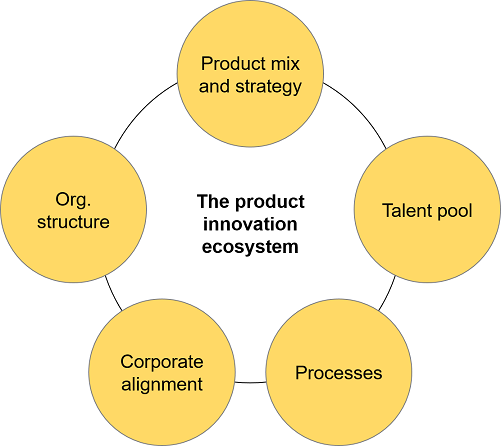
The product innovation ecosystem is made of the employees, customers, company processes, and strategies

An innovation ecosystem is very similar to a biological one — the employees, customers, company processes, and strategies are all part of the complex set of interactive relationships among the resources within the marketplace, creating a living, breathing ecosystem in which one tries to innovate. It is core to an innovation strategy that product leaders fully grasp and understand the portfolio of products a company offers and its ecosystems.

Pillar 1: The innovation ambition matrix
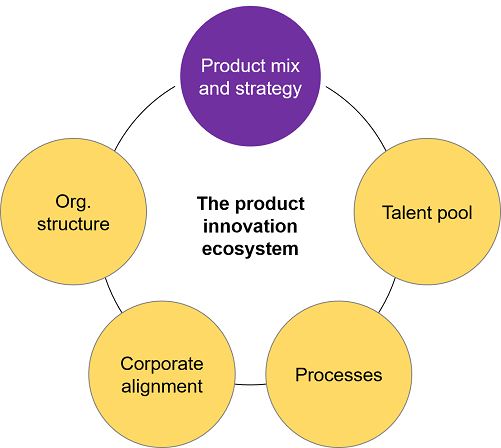
The innovation ecosystem: the product mix and strategy — the innovation ambition matrix

The ‘Innovation Ambition Matrix’, developed by former Deloitte partners, Bansi Nagji and Geoff Tuff, is a map that helps companies measure the novelty of their offerings in the market. This matrix segments three types of product offering:
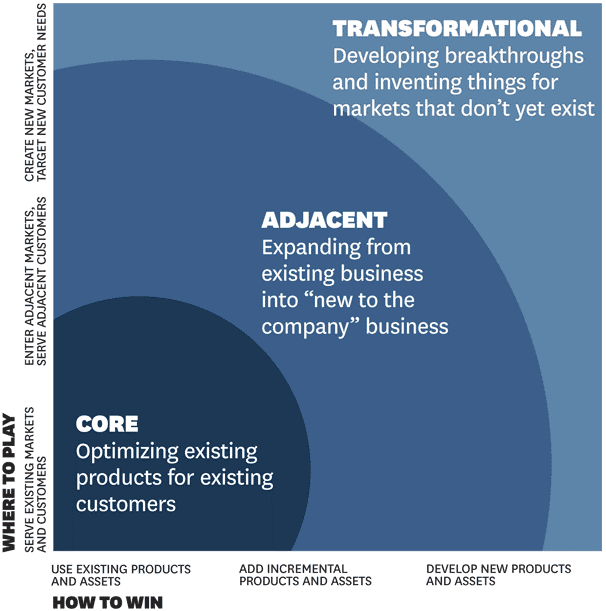
The innovation ambition matrix — Source: HBR
  • Core — considers small changes to existing products with inroads to new markets. An example of this can be Pizza Hut’s stuffed crust pizza, taking pizza to the next level with cheese in the crust. This offering was introduced in 1995 and by the end of the year, it became one of Pizza Hut’s best sellers and increased sales by 300 million dollars
  • Adjacent — refers to what a company already does well but uses novel solutions to draw in new customers. For example, P&G tapped into adjacent markets in oral care by expanding its Crest brand beyond toothpaste to include new products such as whitening strips, electric toothbrushes, and flosses
  • Transformational — focuses on creating new offerings to serve new markets. For example, how Starbucks did more than just introduce more coffee flavors and brewed up a disruptive in-store experience by using digital and mobile technologies

Using the ‘Innovation Ambition Matrix’, product leaders can identify, map, and position their company offerings, up or down on the y-axis based on the target customer or market, and go left or right on the x-axis based on the use of the products and assets. Companies that outperform their peers have a mix of 70% core, 20% adjacent, and 10% transformational offerings. Keeping tabs on your company’s matrix will help you manage total innovation across a portfolio of products.

Pillar 2: Building an internal innovation talent network
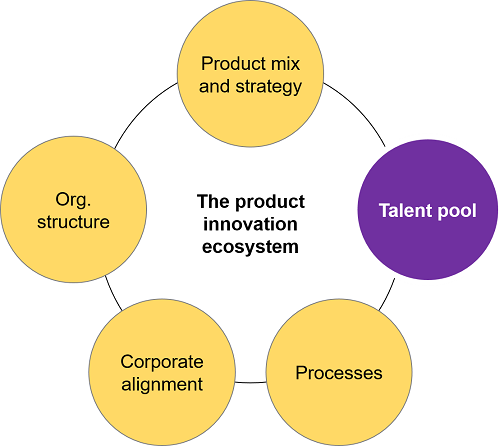
The innovation ecosystem — building an internal innovation network: the talent

To create and drive innovation we need innovation-focused people to come together. For this to happen:

  • Understand your company’s organizational chart — this will allow you to identify influencers and create an internal innovation network. Dissect charts into smaller groups of individual departments or redraw them based on people you meet or find on LinkedIn.
  • Identify the influencers to create your internal innovation network — that will grow, evolve, and be made up of people who could help you move innovation forward. Innovation influencers don’t rely on a title for power but utilize communication and relationships to persuade others without formal authority. They are the catalysts in moving innovative ideas forward. One way to spot them is to look for charismatic people who are mentoring others. Look for people who have moved big ideas or made changes in the organization.

Once identified, start a conversation, ask questions about how they see the organization changing, get their perspective on the current innovation processes, and see whether they’re willing to continue the conversation and become part of your innovation network. This process will take time and evolve, but creating a network within the organization’s structure is one of the most important steps toward creating a support system to navigate a product or service innovation ecosystem.

Pillar 3: The need for innovative processes
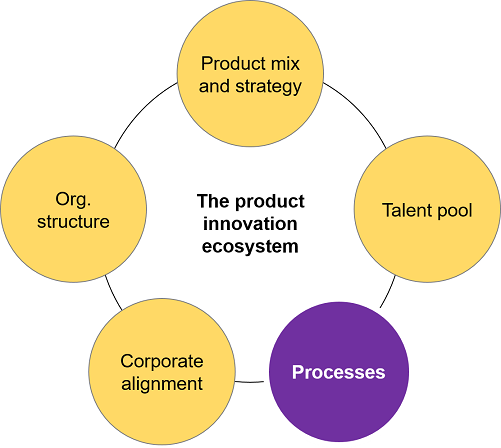
The innovation ecosystem — the need for innovation-centered processes

When innovators have a self-regulating, evidence-based “innovation pipeline, they have the map to curate “and prioritize problems, ideas, and technologies — Steve Blank

Innovation does not hinge on a singular spark of genius but rather is built on a solid foundation of implementable processes. An innovation journey starts with identifying the right innovation processes that fit within the unique context of the company. The most common and leading innovation processes include:

  • Design thinking
  • Rapid prototyping
  • Lean innovation
  • Open innovation

While innovation processes go by different names, they have a lot in common. Where they differ is the emphasis the process puts on certain phases. For example, design thinking focuses on understanding customer needs, rapid prototyping on solution experimentation, and open innovation on the interchange of ideas from anyone and everywhere. Irrespective of which process is used, product and service innovators need to consider the following two points:

  • Utilize a process that already has buy-in and approval at your company — this is a template to hit the ground running. It probably has management buy-in and demonstrates an established innovation culture. However, if an innovation process does not exist, then you’ll need to incorporate one. This will require multi-level stakeholder buy-in and freedom to test models and identify what is best for the specific company.
  • Incorporate the main phases of innovation: discovering, creating, testing, and scaling ideas — ask the following questions: Where / when do we talk to the customers to identify problems worth solving? Where / when do we generate ideas and select the best ones to move forward with? Where / when do we prototype ideas and leverage technology to build an MVP or prototype? Where / when in the process do we identify readiness for scale and generate a viable/scalable business model?

Utilizing the right innovation processes and identifying the phases will better equip the company to navigate the complexities of fostering innovation.

Pillar 4: Aligning corporate objectives and resources
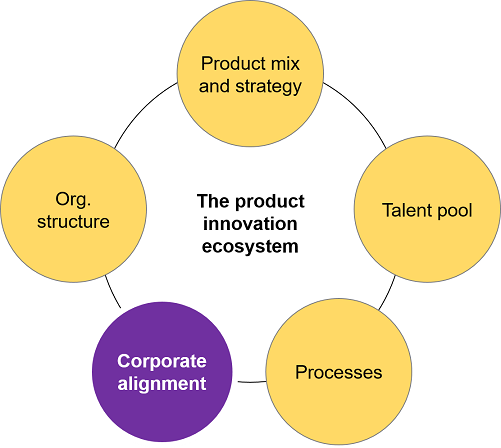
The innovation ecosystem — corporate alignment: business objectives and resources

Before starting to innovate we need to understand the company’s business objectives and its ability to meet those objectives. There are three major places to look for insights:

  • Financial health — the P&L statements can be a starting point. Reviewing P&Ls can highlight business objectives across the organization and the realities of getting innovation efforts funded. For example, if a company is struggling to obtain healthy profit margins, the leadership may resist radical offering innovations or even cancel all projects.
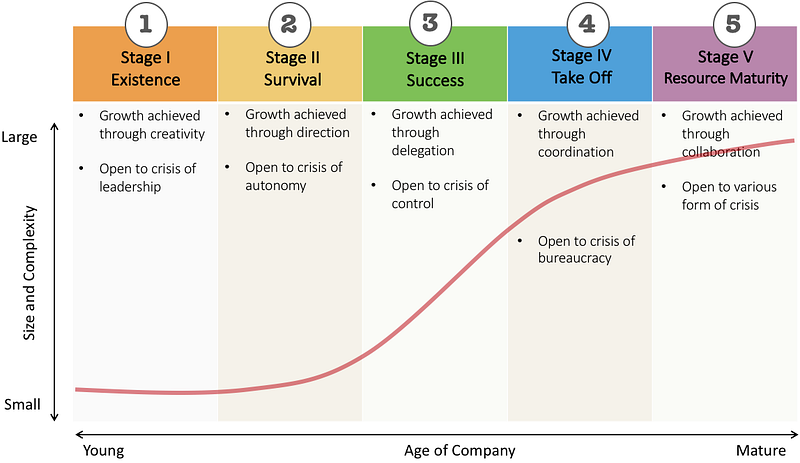
The development phase — stages of business growth — image by Meeting of Minds
  • Development phase — identifying a company’s current development phase will help identify how innovation plays a role in achieving its growth objectives. Companies often go through the following stages: existence, survival, success, take-off, and maturity. For example, in an early-stage startup, heavy investment in radical innovation could be warranted to attract media attention, investors, and customers. However, companies in the growth stage may favor protecting and growing the core products, therefore preferring incremental innovation.
  • Competitive positioning — this can help determine the appetite of a company to take big risks or be risk-averse. For example, in the late 1990s, the personal computer industry was ruled by Dell, IBM, and Compaq, and Apple was no longer a technology leader. To turn tides, Apple took radical innovation initiatives, including the iTunes platform, and the bets paid off, otherwise, it would have been bankrupt (i.e. Apple’s positioning fed its appetite for radical innovation).

Pillar 5: The organizational structure
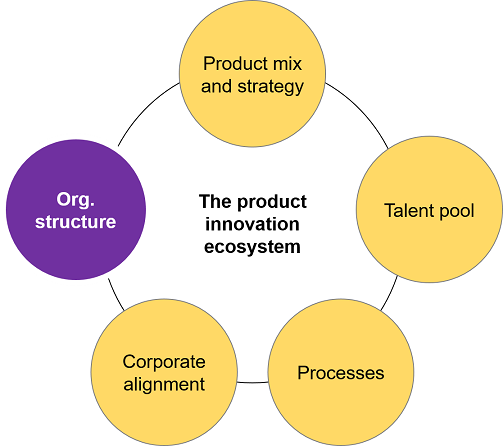
The innovation ecosystem — organizational structure

Who should own innovation at the company? Where should the responsibility for innovation lie? Generally, there are four more common internal structures for innovation:

  • Centralized — in this organizational structure decision-making is controlled and driven by top management. In this structure, usually, the innovation team conducts R&D and passes the framework for new products to other business units for development and launch. The disadvantage of this structure is that employees outside of the innovation team may feel disconnected from innovation, fostering a feeling of apathy or resentment. One approach to improve morale and diversify ideas is to encourage collaboration across departments by inviting others to join brainstorms.
  • Decentralized — here, the power shifts from senior executives to mid or lower management to allow teams to be nimble and responsive without requiring constant check-ins from top management. The disadvantage of this model is that it can weaken the team’s ability to take risks given the lack of authority or smaller budgets. To combat this weakness, communicate frequently with top management to get further backing when it’s time to take bigger risks when needed.
  • Hybrid — this structure blends the centralized and decentralized models. Here, innovators might be positioned into a temporary cross-functional team to work on a specific project and when done, return them to their centralized teams. The disadvantage of the hybrid model is that it’s hard to operationalize a process when there are moving pieces of centralized and decentralized structures. To create stability and overcome the weakness, use the company’s innovation process as a north star to guide the team and keep it on track.
  • Incubators — here, ideas are born inside the company, developed, and then spun out with the incubators focusing on sectors relevant to the parent company. The disadvantage of this model is that there’s a lack of coherent consensus around defined goals. To overcome this challenge, innovation teams need to recognize all the involved stakeholders and understand their goals, bring consensus around these goals, and create alignment around the program’s vision.

The organizational models that support innovation are unique for each company with varying levels of formality and complexity. If your company lacks one, then it is an opportunity for you to begin looking for a solution that could be implemented. Organizational structure for innovation is a prerequisite for creating innovative products.

Hope you enjoyed reading this article! :)

If so, then:

Product Management
Innovation
Design Thinking
Product Development
Ux Strategy
Recommended from ReadMedium