
Managing Healthy Conflict
Dads’ Survival Guide: Parenting
The world is embroiled in conflict.
Russia’s invasion of Ukraine is the latest. Most frightening. With innocent bloodshed. And the potential for escalation. Of catastrophic consequences.
Conflict is part of the human experience. Since the days of Cain and Abel. Across every era and empire. Disagreements. Disputes. Feuds. Wars. Throughout civilization. Uncivilized behavior has been central to our heritage.
Even so, conflict feels worse nowadays. Especially here at home. Political polarization. Clashes over mandates. Personal rights and freedoms. Climate change. Policing. School curriculums.
People seem more entrenched in their positions. Increasingly divided. Colleagues. Friends. Neighbors. Even family members. Unwilling to listen. Or consider alternatives. Causing heightened levels of rancor. Scorn. Disdain for those who don’t agree.
For us Dads, this is extremely disturbing. The possible impact of such harsh societal discord on our children. And the lessons they may be taking away.
But what’s a father to do?
Conflict is inevitable. At work. Home. In our community. The question is not how to eliminate conflict. It’s how to manage conflict. And for us Dads, how to set the example for doing so in a healthy manner.
The Conflict Continuum
People deal with conflict in different ways. Some are conflict avoiders. Trying to navigate away from confrontations. Others love the clashing. Interpersonal cage fights. Feeding their competitive fire.
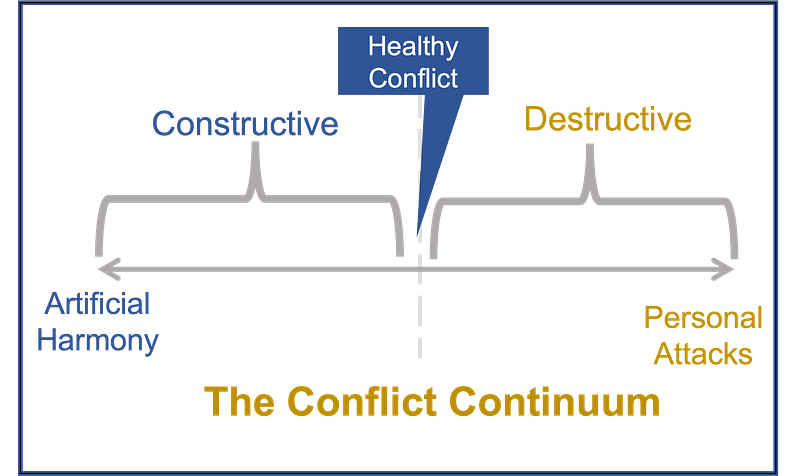
As depicted in the chart above, conflict runs along a continuum. From constructive to destructive. Yet, neither of the extremes are optimal.
The workplace tends to fall at one end. People handling conflict professionally. Politely. Which oftentimes is just a façade. Saying one thing, while meaning another. Artificial harmony. Designed to hide one’s passive-aggressive behavior.
Today’s public square is at the other end. People are outright hostile. Manipulative. Bullying. Prone to personal attacks. Evidenced by the rhetoric of elected officials. The media. Or Twitter feeds.
Superiority Complex
We shouldn’t be surprised simple that disagreements spiral into confrontations. Our attitude is the source. The perspective we carry into conflicts.
According to Robert Greene, in The Laws of Human Nature, everybody starts with an over-inflated view of ourselves. An innate bias. Believing we’re better than most. More rational. Logical. Practical. Principled. Moral.
One doesn’t have to be a math major to figure out that we can’t all be in the top twenty percent. Yet, each of us insists we’re up there.
Meanwhile, we assume others are near the bottom. They’re the unreasonable ones. They’re emotional and impulsive. Self-centered. Egotistical. Easily conforming to the moods of the mob.
No wonder conversations turn into clashes. Confrontations go off the rails. With both sides assuming a superior view of ourselves. And an inferior view of others.
Hmmm.
Good and Evil
Baseball is locked in a major conflict. Jeopardizing the season. Owners and players wrestling over how to split the money. Parsing up their pot of gold. Among the millionaires and billionaires.
Seems so petty. A trivial squabble. In the grand scheme of things. When Ukrainians are defending their freedom. Literally, choosing which hill to die on.
Yet, this is the nature of humanity. For those involved, the stakes are real. Make or break. A zero-sum battle. Between good and evil. Each side believing they are good. And the other is evil.
As a member of the Red Sox Nation, I can understand this. Our team is good. And the Yankees are evil. Simple as that.
People prefer to frame conflict as battles between heroes and villains. White hat and black hat. Us vs. them.
Right and Wrong
“We basically treat everyone as a foe,” notes neuroscientist Dr. David Rock, “Until proven otherwise.”
Too often, amicable resolutions are not the goal of a conflict. We’re out to win. Period.
We’re not interested in listening. Hearing other’s arguments. Weighing their reasoning. We’re completely and totally fixated on convincing. Persuading. Switching them from the dark side. To the light.
No matter the conflict or confrontation, we think we’re right. And they’re wrong. Especially us Dads. We’re always right. And others just need to come around to that truth.
Healthy Conflict
I’m better, they’re worse. I’m good, they’re evil. I’m right, they’re wrong. These are the ‘facts’ everyone brings to a conflict. And why so many get out of hand.
Acknowledging our own predispositions is the start of more healthy conflict. And Dads can take the lead.
We can begin each conflict with a humble attitude. And an open mind. A willingness to listen. To hear what others have to say. A genuine desire to find the best solution. Not necessarily our solution.
Acknowledging others’ viewpoint is important. While we may not agree with them, we can make an effort to understand where they’re coming from. And treat their ideals and approach with proper respect.
In all conflicts, we must be able to manage our emotions. Not take things personally. Escalate tensions unnecessarily. And remember to focus on solving the problem rather than fixing the person.
Every Dad is capable of managing conflict in a healthy manner. And setting the best example for our kids.
Go, Dads. Go.


