
Making Zines — Stress-Free Art, Just for Me
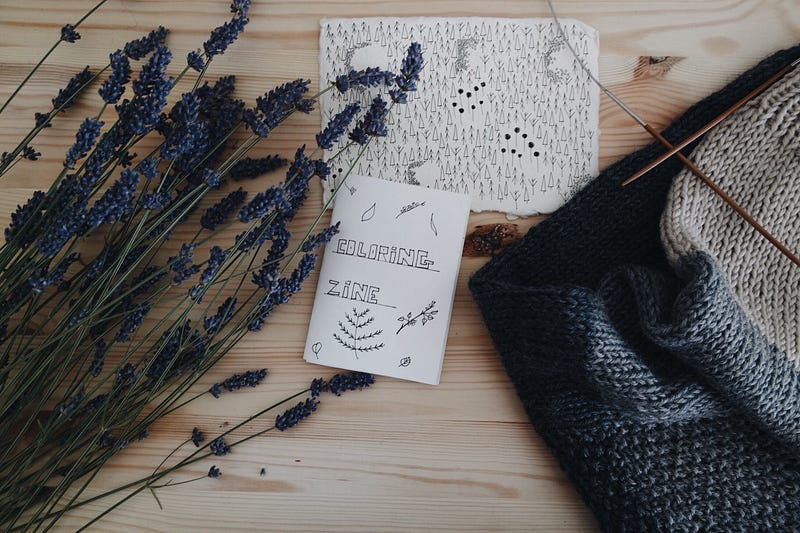
On my bookshelf sits a tin box. Its hinged lid is printed with pictures of oil, olives, and a bushy green tree. In the past, it housed soaps that I bought as a souvenir from France.
Now, it’s a storage container for my favorite secret hobby — zine making.
Zines are miniature, hand-made magazines that were being made as early as the 1930s in Chicago. They were self-published and circulated in small circles.
Over time, they developed into a format that artists used to showcase small bits of their work in an affordable way.
Zines today are still being made by artists and writers. They are sold at conventions, exchanged among friends, and can even be found on Etsy.
Most importantly, they prove that an artist can make a meaningful, tangible work in a short amount of time. One afternoon of relaxed focus can result in a completed project — something that can be held in your hand, duplicated, improved, or put away until you want to reminisce.
Handcrafting a zine is a relaxing way to spend an afternoon. A piece of printer paper makes eight small pages that don’t take long to fill. Unlike a journal, a zine requires you to fit your thoughts into a small space, forcing you to get at the core of what you want to say.
When I make a zine, the pressure is off from the very beginning. This is a handmade item meant for me alone.
Folding and cutting the paper leaves uneven edges. I might center the title incorrectly, I might put things out of order. The pages are small, so my writing is punctuated with hyphens and squished words as I attempt to fit everything together.
Each lovely imperfection adds to the charm.
Normally, this lack of precision would startle me. But when I expect to make mistakes, when I relish in my inelegant but honest expressions, when I take the smallest of risks and see that they work, the stress of creating a ‘good’ thing vanishes.
Instead, I am left with the delightful knowledge that who I am and what I’m doing are the good things.
I fill pages with lists of favorite songs and meaningful quotes. I recount dreams in colorful detail and illustrate them with a child-like hand. Sometimes I pretend I’m Virginia Woolf. Sometimes I write in lowercase letters, sans punctuation.
They are enhanced by ink blots and crossed out words, and peppered with beautiful scraps of writing that may never make sense to anyone but me.
The very nature of a zine is abundantly creative, and I feel ease in taking license with, well, everything.
When I’m finished, I add the zine to the tin. It’s satisfying to see the pile grow, to reread these snippets of my thoughts and feelings, and to remember that I can, in fact, create something just for the sake of having fun.
I add to my little booklets whenever I have a spare moment. They get stuffed into pockets and folded into bags and used as coasters. The creases and stains become a part of what they are. They are a delightful memory of the places I’ve been and the person I was while making them.
I am reminded that the process of creating can be just as important, if not more important, than the finished product.
Zine-making is the one thing that I will always keep to myself. I don’t need another person to read them. If I really want to share, I make a photocopy. This usually results in degrading the quality further and making the process all the more entertaining.
Humans are inherently creative and social beings. We want to share the things we make, but there’s nothing wrong with keeping some work to ourselves. It’s liberating to reflect on yourself in private, without being watched, safe in knowing that you can make mistakes and grow without being judged.
Zines, and the creativity they afford, have become a part of my life. I look forward to trying new themes, to adding art to my writing, and to ending a few hours of work with a completed project that I can hold in my hand.
If you ever have a moment and want to try something new, consider a one-paged zine. Make a comic out of a pretty sentence that’s been bouncing around your head. Write eight messy lines of poetry. Portray that story you’re writing with a few stick figure doodles.
Know that you can keep this all to yourself. The approval and validation of your art only needs to come from you. Tuck your writing in between the pages of a book. Fold it neatly in your wallet. Or maybe, place it gently into a small green tin on your bookshelf.


