
Making Your Order at a Restaurant Is Your Understanding of What They Provide and You Agree — Consent.
After having a meal and having fun with an app, my mind has switched to thinking about having a bit of sweets.
Before the meal, I stretched my arms and legs, doing my first indoor exercise for about one hour.
Then the quick and healthy bowl felt so yummy. Of course, the ingredients used were fresh with simple seasonings to bring the good taste out of them.
Close to one hour of slow and simple exercise made me hungry.
Right after slight hungriness started making me think about what to eat, my mind began to search for the best-fit menu for the meal.
Vegetables Herbs A small amount of meat Seasonings
Should I go for a piece of bread or rice? I asked myself.
I imagined.
I decided and made my move.
But, before getting too hungry, I sip the warm milk. That was what I had prepared for making a good cup of coffee.
Both hot milk and my coffee plus that milk were tasty!!
Avoiding getting too hungry is necessary. It would help me and anyone to avoid gobbling foods without chewing much.
Then it occurred to me.
One of my landladies used to do it, and her husband seemed to keep pointing it out — eating fast, so slow down.
The last reaction I knew was this, she chopped off his request, “There is nothing to chew!!”
Chewing 20 times is probably better than two times. Depending on when you brush your teeth and how many times you chew over the years, teeth may get worn out sooner. So I guess, like many other things, moderation is good. Besides, I thought that was from their cultural differences — the cultures where they grew up and where they worked. I always felt one hour of lunchtime was insufficient unless a restaurant or food court was within the premises.
Needing time to get fresh air, a clear mind, get sunshine, walking to somewhere for lunch + order the dish and wait for it (which is critical depending on how well the restaurant handle and how popular it is) + enough time to chew and eat food + have fun conversations with coworkers + walk back to the office + brushing my teeth, I felt at least 1.5 hours is necessary.
Anyone could develop a habit of eating fast after starting work for a company in a city. I felt I eat somewhat faster than when I was a child.
She might have also developed the habit throughout her career.
It did not seem he had that kind of experience throughout his life, so I felt for her. Poor guy — he did not suspect those working cultural differences and had no better way of saying it.
When you think about what you want and how you want to eat, I think that is a precious fun moment you look forward to. That is your plan.
You may have an adventure sometimes, but usually, you want to stick with your precious plan. You would be disappointed when you see what you cooked did not turn into the dish you want to eat. That would be a bummer when you got the food you did not order at a restaurant and not to mention getting a bad stomach after having it.
This happen to the husband a few years ago.
The spicy take-out food he and his family ordered at a restaurant and brought back home to eat wasn’t something he could bear physically.
He denied to be the food he endured to eat and thought it could be COVID-19.
The situation seems to be the food you want to eat is the plan, and the actual menu you order at a restaurant is consent. If you can only take one chili pepper in your dish, and the restaurant side thinks the more chili peppers they put, the better it becomes and healthier for customers, they ignorantly put 20 chili peppers.
That would not be what you ordered.
You did not agree to take 20 chili peppers.
If the order was one chili pepper for one dish, but they put 20 instead, that’s completely different from the menu/order unless someone wants to hurt customers.
He insisted to eat and finish the food holding it in his hand even though he was suggested to stop eating it. He refused to stop eating it. It turned out that was something he could not bear — pale face, red eyes as if after crying, and so on the next day. Those were his bad judgments. I wonder if someone praised his behavior of doing that in the past or if he was hiding something.
Making your order at the restaurant is the agreement between you and them regarding the menu.
They say they cook the list of things for customers. After you understand what they provide, you agree and order it — Consent.
One day I was surprised to know that he did not think getting consent was necessary in a medical situation.
I was astonished by his point of view; that is, he holds the view that doctors can use whatever methods to experiment on patients. Really?! Is that because doctors don’t have many cases to practice and you just want to feed doctors?
I wasn’t sure if I could make the ordering food and his experience after eating the food to make my point of how wrong judgments affect someone’s health — not valuing consent affects one’s health negatively. A patient’s rights are ignored such as the right to know and the right to receive good care and the prospect of health are ignored.
I did not think it was the right time to speak of that matter when he had thought he might have COVID-19. I wasn’t going to exhaust his brain to think and exacerbate his health at that time.
Even if I did explain to him later time, I wonder if he would change his thoughts as he exhibited more and more controlling behavior (such as taking an object out of someone’s hand without asking, telling others to do certain things that were unrealistic that another older man had to shoo him off, etc.) and other weird behavior (such as telling someone would die knowing the person was going to have an important surgery. Then flipped his lips up and down several times with his right index finger and said “bad joke, bad joke.”).
Especially the latter behavior, I wonder, what kind of influence was he under?
With these things above, I refrained from making the analogy to him.
I wondered if all these weird behaviors he failed to conceal and carried out in recent years had made the wife notice something, so she searched for housemates, hoping and making them stay longer. This way could have extra money and create a win-win situation. She often said life is scary.
Do you think he was able to know the importance of consent, especially when talking about health through the experience of ordering and eating the food?
Although he had been affecting his wife and daughter a lot, it seems his daughter and wife have been the breaks of his actions during many things.
People can change their minds. Who knows, he may feel to change his thoughts at some point. I think that would perhaps be their child’s effort.
That was just a thought.
I’m sure you’ve had, heard, or seen conversations and situations in that you feel awkward. Sometimes those you hear on the street, in malls, and coffee shops are too funny that you can’t hold yourself not to laugh.
It has become a long piece. Thank you for reading or listening up to this point.
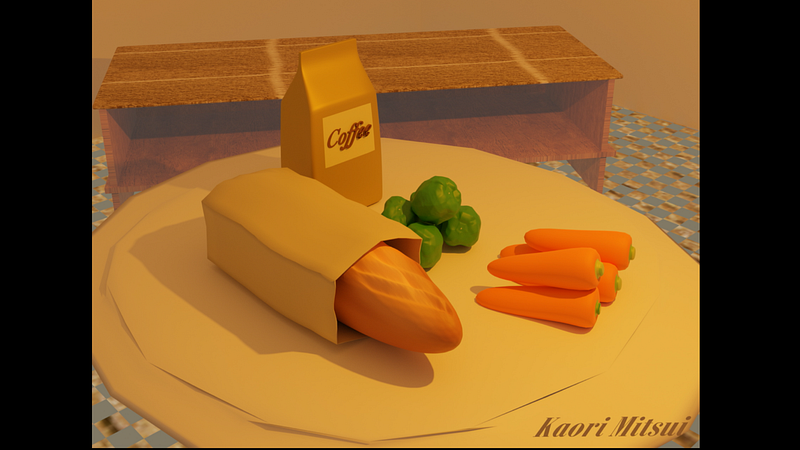
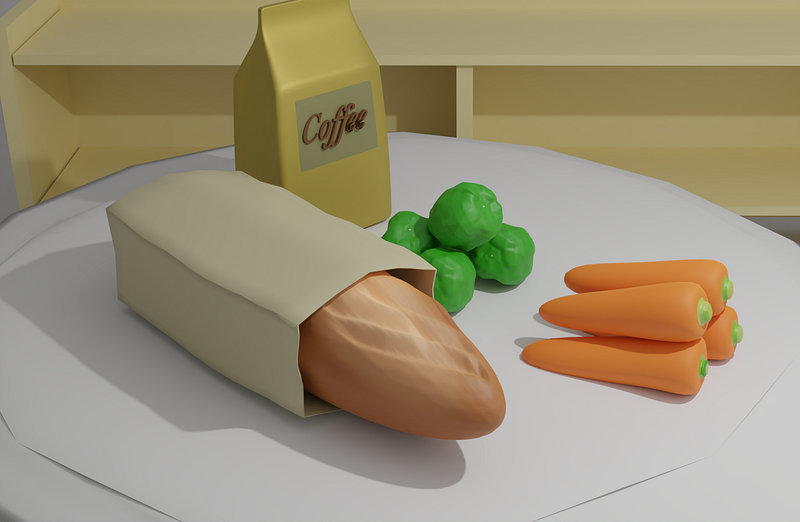
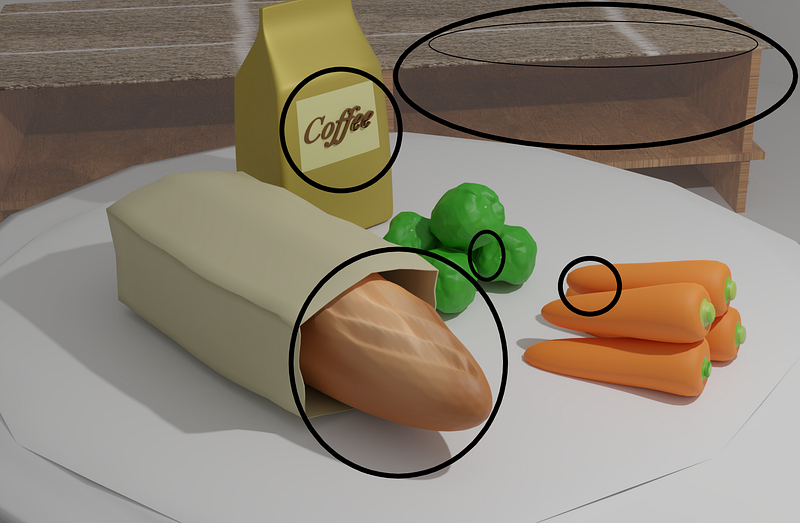
Here come the long-awaited answers to the last question — Where Are the Five Differences?
- The color of the sticker on the coffee package is different.
- There is a hidden carrot in the right image.
- The size of French bread is different — the one in the right image is thinner.
- Then here comes the difficult one, which is the position of the green pepper. The tiny dent and dark part are noticeable because the angle has changed slightly.
- Since the 4th one was hard to find, you may spot the cabinet color as one difference AND the cover on the top of it as another difference — it is a bonus!
I tagged some writers who may be interested in reading this piece. Mona S Gable, Susan Wheelock, B.R. Shenoy, BETTER EVERY DAY ✨🌈☀️
I hope you enjoyed it.
Stay tuned for the next one!
Hi, I’m Kaori. I use the open source called Blender to create 3D objects on my PC screen, then output them as PNG, JPEG, or animated ones once in a while, like GIF. If you enjoyed a story like this, subscribe or support me through my Ko-fi page.
Thank you for reading and listening!


