
Making Sense Of The 2020 Stock Market
Entering Phase 2 – Three Reasons This Bear Market Is Far From Over
Friends, the bear market rally we’ve been riding may feel remarkable, but in fact it is completely normal. We’ve seen bear market rallies repeated time and time again in past economic recessions and we will experience them again in the future. We are experiencing nothing more than a run-of-the-mill bull trap.
Stay disciplined and wait – phase 2 of the 2020 stock market crash is rapidly approaching.
“We don’t have to be smarter than the rest. We have to be more disciplined than the rest.” — Warren Buffett
According to DOW theory, markets have three phases. In phase 1, the ‘smart money’ exits the market. In phase 2, the trend followers finally catch on to what’s really going on in the economy and start selling. Phase 3 begins when selling volume peaks, average investors finally capitulate, and trend leaders start buying again.
Trend followers are starting to catch on.
3 Reasons This Bear Market Is Far From Over:
- The past – this bear market rally is strong, but not exceptional – previous bear markets analyzed
- The present – the world economy continues to weaken – unemployment, bankruptcies, and an escalating trade war
- The future – Infections continue to flare up and will get worse this fall – what the scientists are telling us
The past — everything, eventually returns to the mean
The pandemic stock market of 1917–1920 is very interesting. Although the initial sell-off was much slower than today, there are some remarkable similarities.
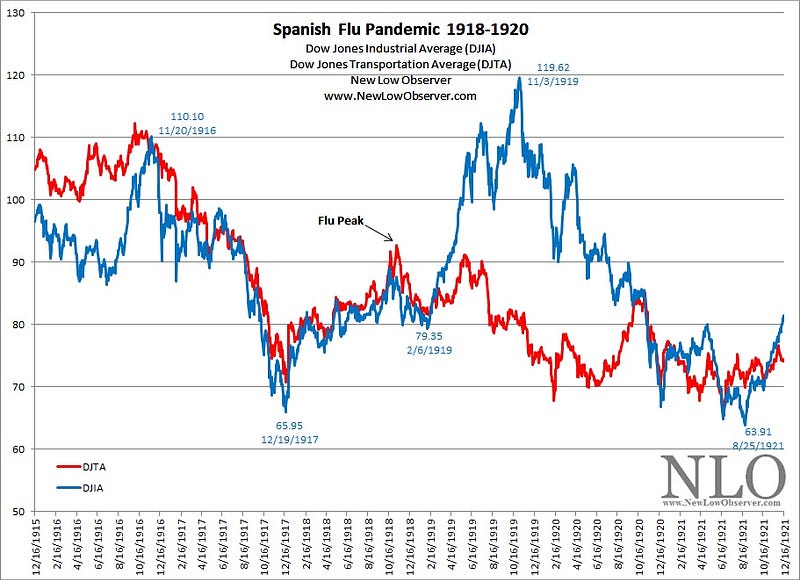
It took over a year to hit the peak of the bull trap. However, shortly after the pandemic peak – ironically at the height of the bull trap – the DJIA (Dow Jones Industrial Average) and the DGTA (Dow Jones Transportation Average) wildly diverged from each other.
The Dow rallied so strongly, the index even managed to surpass the highs set pre-WWI and pre-Spanish Flu.
DJIA peaked in November, 1919 and started a long, painful slide back down. In the end, both averages tested and finally fell to new lows by the summer of 1921. A terrible W-shaped recovery that I think we may be repeating again, today.
Trains and trucks and airplanes were the breakthrough technology of this era. Trains, in particular, were dependable and well-established technology, much as the Internet is a dependable and well-established technology today. The war was over. The Spanish Flu was beaten. The world needed transportation to rebuild the country and the world. Surely, railway stocks would ‘go to the moon’.
Transportation companies were badly needed for the country to rebuild, but they weren’t needed as badly as the stock market predicted. Just like people overbought toilet paper, beans, and rice during this pandemic crisis, the investors of the early 1920’s overestimated the need for transportation companies – and therefore over-estimated and bid up the value of those companies. This is an excellent lesson from history — no company escapes a recession unscathed, no matter how important it might be to the economic recovery.
In 2020, now we hear about ‘pandemic-proof’ businesses. Let me say this as clearly as I can, one more time – nothing survives a major recession unscathed. Not Amazon, not Facebook, and not Tesla. Although one might argue technology is the ‘last domino to fall’, all businesses will eventually feel the pain of a multi-year pandemic and economic downturn. All companies and indexes, sooner or later, revert to the mean.
The present — somehow, markets still have hope
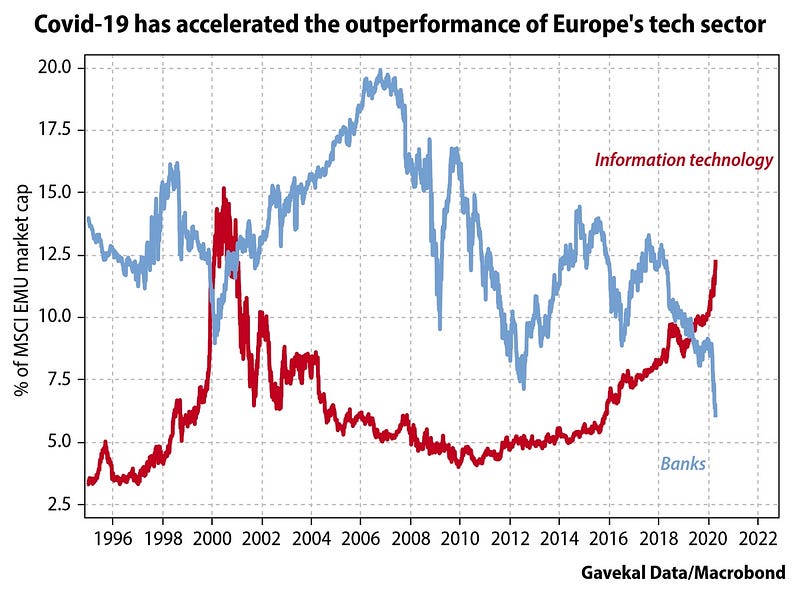
In fact, we are currently in the middle of one of the biggest divergences between bank and internet stock prices since 1999. Like in 1999, banks are signaling that technology is way overvalued – just like the technology of 1919 became wildly overvalued.
Just like 1919, just like 1999, the market will revert back to the mean. It’s not different this time.
It’s not different this time. Science is real and math is real, no matter how many times Republicans denigrate it. The world isn’t flat and Warren Buffett isn’t washed up as an investor, and eventually the bulls will understand their horrible, horrible mistake.
Forbes says, ‘Warren slipped up on airlines’. Really? Forbes is betting airlines will be back to 2019 levels in a year? In two years? Earth to Forbes – how many airlines will restructure or cease business operations before this virus-inspired downturn is over?
The world economy continues to weaken. The Fed throwing more cash on this economic bonfire is a temporary fix. Some say, ‘Don’t bet against the Fed.’, I say; don’t bet against the economy — you can’t stop a financial tsunami.
Unemployment
Unemployment rates around the world have spiked to depression levels not seen since the ‘dirty 30’s’. Let that sink in … the dirty 30’s.
Some have speculated these numbers will rebound in Q3 or Q4. I agree as restaurants and shops reopen, many people will be able to return to work. However, we are now facing the second wave of unemployment as companies like Hertz are forced to restructure and fire thousands of employees, world-wide because of the massive, sustained slump in business.
Retailers are getting slaughtered. Shoppers remain scared, even though economies are opening back up. We are scared of too many people in the shopping center. Scared of waiting in line, even though there are lines indicating social-distancing appropriate places to stand.
People are now reluctant to spend money. Who wants to book an expensive holiday, buy a new car, or finance a new home with unemployment rapidly rising? Who needs to buy a new shirt or tailored suit if telecommuting becomes the norm? How far up the value chain will unemployment reach if the pandemic stretches into another year?
The following link is not 100% up to date, but the mounting unemployment numbers are staggering. What economy can sustain such damage for more than a couple of months without causing long-term systemic damage?
Bankruptcies
Even Las Vegas is bending to the overwhelming power of this pandemic. What happens to a city where there are no locks on the front doors of the casinos because they’ve never been closed – ever – in 50 years. Could casinos start filing for bankruptcy? Will Las Vegas go bankrupt due to a lack of tax revenue? Will New York? Even before the crushing costs of the pandemic, New York was in financial trouble.
According to the Wall Street Journal, millions have already defaulted on credit card and car payments. Already, commercial real estate is in deep (and rapidly deepening) quicksand. Millions of renters already cannot pay rent and millions more are unable to pay their residential mortgages. Airbnb is laying off employees and property owners are selling empty properties in a panic. Uber has pulled financial guidance for 2020. The gig economy is under threat, around the world.
Brazil is now the 2nd most infected country in the world and is struggling financially under the weight of the pandemic. However, Brazil is not the only country to struggle financially. Many countries around the world are at serious risk of defaulting on debt in the next 12–18 months. Countries that entered 2020 with weak balance sheets will inevitably start defaulting on debt.
An escalating trade war
Trump continues to ratchet up the trade war with China. China’s not an honest actor and the world needs to stand up to them. But is the ham-handed way the Trump administration is handling the situation helpful? Even Japan (China’s 3rd largest trading partner) is paying Japanese companies to move out of China. Is it really necessary to escalate a trade war?
Why not act quietly and slowly bleed China to death? Why let them know it’s coming? This is one of the biggest problems with Trump. He’s too incompetent to know he doesn’t know what he’s doing. Like it or not, the Trump administration will screw up this trade war, like everything else they touch. Like it hurt the markets in 2018, a botched trade war with China will only deepen the coming recession.
Japan has already technically entered a recession — and Q2 numbers haven’t been reported yet.
The future — scientists say, all bets are off
What are scientists telling us? It’s not great news.
Making a vaccine is extremely expensive and time consuming
Sure, there are pharmaceutical companies like Moderna trying to juice their stock price by releasing the test results of a handful of people in their phase 1 clinical trial. Markets went wild and Moderna tried to issue stock based on the news. Completing a phase 1 study is a great start, but getting from phase 1 to the end of phase 3 is exponentially difficult.
That’s the sad thing. I’m very afraid pharmaceutical companies will continue to announce ‘breakthroughs’ to the public, with the public not understanding what a tiny step has actually been made.
It’s true, there are a record-breaking number of compounds being trialed to find a vaccine for this pandemic and as of this publication, there are 10 human trials currently ongoing. There are even more compounds being tested to see if they have any clinical value to treat patients who have already contracted the virus. However, all of these studies will take a year or even years, to be approved for public consumption.
Even Donald Trump’s inexplicable Hydroxychloroquine pet project is a tiny window into how difficult it is to find an effective drug. Just because a couple of people got better taking a drug means nothing. There are so many variables, only a large, random study can ultimately determine if a drug is going to be effective and safe for the general public or not.
I’m afraid the general public has been partially misled about how soon we will see a vaccine created and how long it will take to produce enough doses to vaccinate the world. I understand scientists don’t want people to panic but I think there should be a duty, to be honest with the public too. For example, flu vaccine efficacy ranges from around 10%-60% from year to year.
If a 60% effective vaccine is developed in a year or so, things could get a lot better quite quickly. If a 10% effective vaccine is developed, it will provide very little help in controlling the spread of the current pandemic. As more people become aware of this fact, it will start sinking in how long this economic situation could last.
- It now appears possible that patients can relapse, even after testing positive for anti-bodies and the WHO has publically stated that there is currently “no evidence” that people who have recovered from COVID-19 and have antibodies are protected from a second coronavirus infection.
- Dr. Fauci predicts infection numbers will rise sharply again in the fall.
- The State of Georgia opened for business a couple of weeks ago, even though the infection curve had only flattened. It appears infection rates may be already rising again.
Conclusion
I understand, many investors feel the worst is behind us and the world is getting back to normal. With CNBC in one ear and the Trump administration in the other, insisting ‘everything is normal, it will all just go away’, I can see how investors are swayed.
I’m afraid this fundamental misunderstanding of basic science, history, and math has caused Main Street and Wall Street to temporarily diverge. However, like the bull trap of 1919, we are quickly approaching phase 2 of this bear market, meaning this bear market is clearly, far from over.
I think the question investors need to ask themselves, is how badly do they want to be invested so early in a world-wide recession?
- The science is not clear
- The mid-term unemployment rate is not clear
- The effect of the financial stimulus is not clear
- The cost to the economy caused by the financial stimulus is not clear
- The length of this recession is not clear
- Whether we will remain in recession or desend into depression is not clear
- The fear level of the consumer is not clear and therefore the spending power of the consumer is unclear
- The worldwide death toll is rising and the end of this disaster is completely not clear
I believe we are at a nexus. Either, for the first time in history ‘this economic situation is different’ and the stock market will continue up from here in a V-shaped recovery, or like every other time in history, this bear market rally will finally fail, the stock market will catch up to the economy, and revert to the mean.
Disclosure – I hold approximately 98% cash as I publish this article. Please seek professional advice before making any investment decisions.
I’m Edward Iftody — If you’d like to learn more about disruptive investing, I encourage you to read more at www.blockchainin.asia


