
Making Poetry More Accessible #5
Structural Design Processing

In the same way that a poem’s title can be easily overlooked as a useful source of information, so too can the poet’s use of structure. Structural choices stand out the most when they defy convention — usually to draw attention to some feature or relationship within the poem.
Structure is one of those elements or expression that, when “done right,” can appear invisible and boring. When ignored though, it can make for an uncomfortable experience for the reader.
While structure is a broad and generic concept that pulls in countless directions, I want to focus on three main components of structure — punctuation, lining, and stanzas.
Punctuation Marking
Poetry is often performed or delivered orally to an audience, in which case the punctuation is more of a guide for the reader than anything. But on those occasions when we are sitting down to read a poem for ourselves, the punctuation serves as a set of instructions for us to recreate the pacing and emphasis the poet intended.
With this idea of punctuation as pacing guide in mind, there are many elements of punctuation that I will disregard for now. The four types of punctuation I usually address are commas, periods, dashes, and ellipses.
Commas are pretty simple. Aside from the customary placement separating clauses or nonessential phrases, commas in a poem can also function as you might see them used in narrative dialogue. Commas indicate where the poet wants us to pause, either for clarity or emphasis. Nothing super exciting, but certainly missed when they aren’t used.
Periods (and other end punctuation) conclude a complete thought. They are the signal to the reader that a stopping point is reached and to prepare for a new idea. Look at how Tony Hoagland uses the run-on sentence in “America” to build pressure and anticipation to the point of a panic-attack. He almost holds the reader hostage waiting for that first period to finally arrive.
“Buried alive, captured and suffocated in the folds Of the thick satin quilt of America”
We’re trained to stop to take a breath when the end punctuation comes, and the longer we’re forced to wait, the further we’re pulled into this heavy, suffocating quilt that Hoagland weaves for us. Through punctuation, he instills in the reader the same sense overwhelmed distress going on in the speaker.
While periods designate an ending, dashes break our attention, redirect our expectations. We think we’re building in one direction, gradually steadily, then — wham! — we’re smashed into from the side. The surreal dream the speaker conveys is offset and commented on in dashes. It’s a lateral move that redirects the crescendo of energy in the poem without decreasing or stalling it. The dashes are immediate and unexpected.
Compare this immediacy of dashes to the use of ellipses (…) which indicate an omission of content or of time. Langston Hughes uses ellipses to great effect in “Dream Variations” to contrast the speed and intensity of the start of the second stanza to the exhausted calm that follows. Almost out of breath from the rapid, exclamation-filled commands to dance and whirl, the ellipses signal a slow-down, a decrescendo to the “tender” dark of the evening.
A final note on punctuation addresses a poet’s decision to omit punctuation. This is usually done in an all-or-nothing fashion, though there are poems whose turns hinge on a transition to or from an un-punctuated style. When a poet omits punctuation, it can convey a stream-of-consciousness style in which the images and senses move without the mediation of punctuation. The decision can also convey a connectedness between the ideas that may feel too sectioned-off by marking boundaries with punctuation. Other poets omit punctuation to capture a sense of liberation or wildness. William Carlos Williams’s famous “The Red Wheelbarrow” uses no punctuation in its smooth depiction of a single scene, with a slight pan from the the titular wheelbarrow to the accompanying chickens. Whatever the case, a poem written without punctuation sends a strong signal to the reader to pay attention and be ready for anything!
Boundary Lines
Another structural choice poet’s use to direct attention is lining or line breaks. Often a line will break at a “natural” pause, perhaps even accompanied by the use of punctuation. The most familiar use of line breaks is to create a consistent rhyme or metrical pattern. But even when the line breaks don’t overlap with the poet’s use of punctuation, rhyme, or meter, there may be more going on.
Take a look at the line breaks in Gwendolyn Brooks’s “We Real Cool.” As if the lining weren’t obvious enough, hearing the poem read aloud reiterates the off-kilter pacing that comes from ending each line with the repeated first word of each new sentence. The poem sounds off-beat, discordant. In the same way that the poem’s title misaligns with the actual message it conveys, the poem’s use of lining further emphasizes this disconnect, this wrongness.
Revisiting Ocean Vuong’s “Aubade with Burning City,” we also see how the chaos of the scene is depicted through the seemingly chaotic line breaks. But is the lining truly chaos?
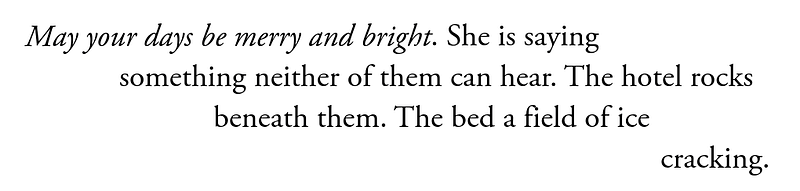
The girl’s words, which neither figure can hear, are interrupted by a line break. “Beneath them” stands closer to the bed than to the hotel, directing our attention. The “cracking” has cracked off into its own line. The two figures are moving together and moving apart in a complex dance that the line breaks help us navigate. What may have appeared as chaos at first reveals an underlying pattern designed to direct our attention and emphasize thematic elements of the poem.
Load-bearing Stanzas
Similar to the way lining directs our attention to relationships and connections, stanzas can also reveal a deeper structure going on within a poem. Stanzas, being larger units of structure, generally reflect larger patterns.
If a rhyme scheme changes, it tends to change with a new stanza. Perspectives can shift, just as a shift in perspective brings a new paragraph in narrative storytelling. Time and setting may change. Repeated elements come back again.
Taking a mental step back, stanzas tend to reflect a poem’s concept of scale. Monolithic? Fractured? Consistent? Examining stanzas can be like taking aerial photographs or satellite imagery (which surprised many people by revealing the prominence of clouds to the Earth’s appearance).
Taken together, these small, medium, and large elements of structure help us examine the whole work.
Understanding the structure of a poem is a lot like taking a look at its blueprints. Seeing how its parts fit together reveals larger patterns and moves us in the direction of talking about its themes and big ideas.
Some wonderful poems that make use of their structure to deepen our understanding:
Donald Justice’s “Pantoum of the Great Depression”
Elizabeth Bishop’s “Sestina”
Edwin Brock’s “Five Ways to Kill a Man”
Have some favorite poems that make the most of their structure? Drop a link and share what you like. And don’t forget to suggest topics for future posts!