
How I Made Peace With My Inner Critic
And saw him for who he really is
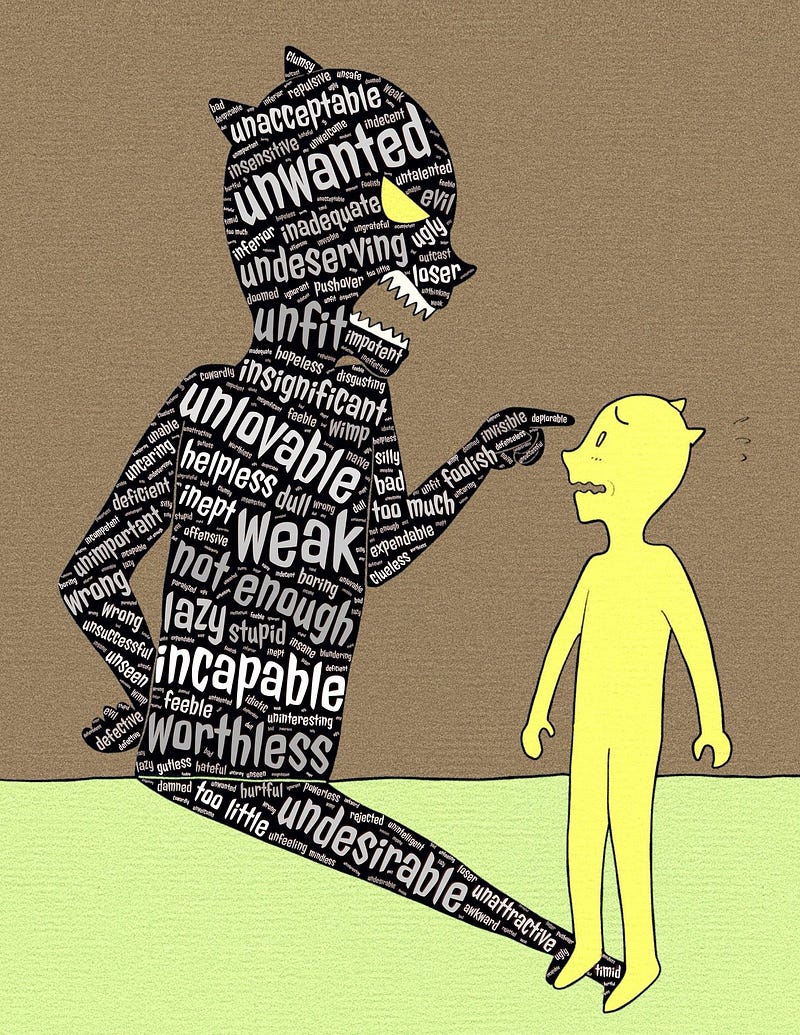
As a writer and a shrink, I’m intimately familiar with the inner critic, both my own and others’. You might expect us to be natural enemies. Most of my clients come to me complaining about their inner critics and asking me to silence them. If only they didn’t have this voice in their head constantly demeaning them, they would be happier than they are.
I would caution you from taking up arms too quickly against your inner critic, much less enlisting a therapist in the battle. You already have one critic; you would not be better off with a second. One’s already criticizing you for everything you do, the second would end up criticizing the first for being too critical. They will not get along.
My Own Inner Critic
I’ll use my own case as an example. Whenever I write, I have an inner critic whispering in my brain that my work is garbage, no one will read it, and I’m just wasting my time. For decades, I called myself a writer without ever completing anything because of this constant discouragement.
I tried starting a private journal where the standards could be lower. It didn’t help. All I did in my journal was scold myself for not writing. The critics multiplied. I had to consider the problem in a different way. Since I knew people get persistent when they don’t think you’re paying attention, I started paying attention to my critic to see if it might shut it up. I heard what it was saying, but more importantly, I discovered who the critic was.
Some of its criticisms were sensible. It policed my use of grammar and spelling to the best of its ability. A good inner critic can stop you from committing many foolish things. It’ll help you pick out the perfect outfit. It’ll make sure your fly is zipped when you leave the dressing room. No matter what you try, it’ll help you learn from your mistakes. A good inner critic is like a personal trainer, a portable therapist, a life coach, and a father confessor, all rolled into one. In my case, it tried to be an editor. You should thank your stars you have an inner critic. It might save you from public humiliation. But you need a good one.
A lot of what my inner critic said was less than helpful. “No one will ever want to read this stuff,” was a thought that frequently came into my head. Sometimes, I would ask the critic why, what’s wrong with my work? If it said something like, “No one will ever want to read this stuff because the title is not intriguing,” then that was an intelligent point of view I could consider. Maybe it’s right. Maybe it’s wrong, but at least I could reason with it. When the inner critic didn’t do anything more than declare that no one would want to read it and didn’t give any reason, then it was no different than those bullies who taunted me on the playground. Its words were hollow, its arguments specious. I could dismiss its claims because it had nothing to back them up, but that only made it more insistent.
I began to realize that my inner critic was not who or what I thought it was. I had assumed it was like my tenth-grade English teacher; someone who was not impressed by my metaphors, but demanded I master the semi-colon. I was thinking of it as an authority, an expert, someone I had to please if I would ever be successful. But my inner critic was not as helpful as my tenth-grade English teacher tried to be. I rarely got productive feedback.
The True Identity of My Inner Critic Is Revealed
For a long time, I couldn’t describe the inner critic. Then, one day I was with my kids on a playground and witnessed something that showed me who it really was. There were two siblings at the playground without their parents. The younger one was a shy, awkward little boy who stuttered. The other one was his big sister, ten years old, who spoke for him, bossed him around, and never let him climb the monkey bars.
“You know you can’t climb the monkey bars,” she’d say. “The last time you tried, you fell and cracked your head.”
That’s what my inner critic was really like. It was not a respected expert, possessing vast knowledge with the power to give me a bad grade. It was like a sibling, barely older than I was, and given too much authority without knowing how to use it. The inner critic had my best interest at heart, it was only trying to protect me, just as the big sister was trying to protect the little brother from embarrassing himself by speaking and hurting himself on the monkey bars. But the big sister should have shown him how to climb the monkey bars, not just tell him he couldn’t do it. She should have helped him speak, not prevent him from talking. Like the sister, my inner critic was immature. It didn’t know how to help me, so it just bossed me around and took over.
A little later, a third sibling appeared to complete the picture by showing me what happens when a critic of the critic enters the fray. The third sibling was a little older than the big sister. He saw his sister bossing his little brother around, told her to cut it out, and ordered him up on the monkey bars. Pretty soon the two older siblings got in an argument over how to treat the little brother, who stood there, frozen, not knowing what to do. He was afraid to both play on the monkey bars and not play on the monkey bars. He was divided, just like I was when I both attacked my writing and attacked myself for not writing. The awkward, stuttering little brother didn’t have a voice in the matter. No one was listening to what he wanted. If only the two older siblings would just shut up and stop trying to control him, he might just master those monkey bars when he was ready.
What the Inner Critic Fears
I started to wonder what that little brother represented in me. What was the voiceless part of me that wanted to write? If it were to write, what would it have to say?
I can tell you now, when I first invited this part to speak, nothing it said was particularly brilliant. But I knew it was inarticulate because it never got to use its voice. You learn to climb the monkey bars by climbing the monkey bars, so I let it fumble around till it got the hang of it.
This is what I found out. It wants to play. Its play consists of trying things it’s never done before, pretending to be someone else, making make-believe. It’s always looking for new experiences, new thrills, and beginning foolhardy adventures. No wonder it needs a protector assigned to it. My inner writing critic, which is part of a whole league of critics following me around, has been trying to keep me alive and shield me from humiliation. The only problem is that they defend me from humiliation by humiliating me. They keep me alive by snuffing out the very thing that makes me feel alive. Clearly, my inner critics have not thought things through.
For that playful part of me, writing is all about telling new stories, going somewhere conceptually where I’ve never gone before, and experimenting with new forms. When I’m writing non-fiction, such as this essay, I’m like a little kid, dying to tell you everything he just learned about dinosaurs. This is a type of play, too, pretending to be a teacher. Plus, when I explain things to you, I better understand them, myself.
When I’m writing fiction, it’s my way of living a different life. Writing fiction has given me the opportunity to be, among others, a black man in the Witness Protection Program, a brittle old biker, an attractive barista, and an estranged father, toying with suicide. Seldom do I write what I know. I’ve always been more interested in writing what I can find out. The joy of creation consists of having something emerge that I barely knew was there.
When I realized this about me, I understood it would be impossible to write well in my first draft; for when I’m starting a project, I know little about it. Therefore, I secured an agreement with my inner critic to stand aside during the first draft. I did so after acknowledging that what I was doing was uncertain and it was only trying to protect me. I praised it for being there for me and promised to let it help if I started to get into trouble. Thus mollified, the critic allows the playful part free reign over first drafts. We follow his lead, even if he does sometimes fall off the monkey bars. The inner critic is there to catch him in all the subsequent drafts.
What Makes the Inner Critic So Stubborn
I wish I could say the inner critic never speaks up during the first draft. It still does, but now I know what to say back. When I do, it goes quiet till it speaks up again. The critic is very stubborn. Why won’t it just do what I want? It’s because I created it that way.
I created the inner critic for the same reason a meteorologist will program a simulated climate into a computer. He sets up a model of the world climate. Then he runs different scenarios, so that if the temperature in Ecuador goes up two degrees, he’ll know how many polar bears will die in the Arctic. The elements of his model should have a strong resemblance to the actual world, but it’s easy to get it wrong.
For example, probably everyone has an inner father. When you were a child, it was in your interest to be able to predict what your father would do in every circumstance. If you thought about swiping a cookie, you needed to know whether he would smile, yell, or beat you bloody. You constructed an imaginary character you called your father, based on your father. The more accurate a representation of him it was, the more useful this construct could be. This inner father is not your father, it’s a simulation of your father; but it needs to be a good simulation.
Here’s the thing. You must also give these simulations free will. The inner person must be able to operate on its own, without too much input from you. It does you no good to hand a script to your inner father and tell it how to respond when you swipe a cookie; you need it to respond autonomously so it can tell you how your real father would. This is why the inner critic must have a will of its own. You give it one so its behavior can be like the free will behavior of actual critics. You can’t just have your inner critic do what you want it to do.
Also, the simulations also must go on running when the actual person is not around. Just because your father has left the room, it doesn’t mean you don’t need the simulation. You need to know how he would respond to the missing cookie when he returns. Just because you haven’t seen the actual person in months, doesn’t mean you won’t see him again. Just because he’s dead and buried, doesn’t mean you won’t come across people like him someday.
These simulations get repurposed when you come across someone new who somehow resembles them. When you meet a new boss, for instance, you may use the model of your father upon which to construct a simulation of your boss because they both have something in common: they are important, powerful people in your life. This way, if something comes up in which you don’t know how your boss will respond, you run the contingency through the father program, so at least you have something to go on. You may easily get confused about who you’re dealing with. Many assumptions about your boss may come from what you have come to expect from your father. You may also confuse the inner person with the actual person. You may think you know them when you don’t. If you do confuse them, that’s because you’re a good author and have such developed rich, well-drawn characters, they seem real.
In my case, I had created a critic to simulate what I thought actual critics might have to say about my writing. The reason my inner critic was so immature, pre-adolescent in its comments was because I was immature and pre-adolescent when I began writing. When my tenth-grade English teacher came along years later, I hated him for the way I thought he stifled my creativity. In truth, I never got to know who he really was because I had him confused with the simulation of a critic I had created before him.
Many of these parts never aged with the rest of me. The playful part didn’t mature because the protectors had it locked up most of the time. The inner critic never mellowed because it never got feedback from its actions. Since I never did any writing, it could just sit back and spew inane criticisms without ever being accountable.
The All-Encompassing Self
Since I began to understand the true nature of my inner critic, I’ve been able to complete some writing projects. I’ve had a stretch of extraordinary productivity. The inner critic still does its thing, but it mostly encourages me to listen to my proofreaders and editors. It still does some bullying after a rejection comes in or I look up my Amazon ratings. Then it speaks up to say I told you so.
There certainly are conflicts between the parts of me, but they exist for conflict. I now enjoy a fragile balance of power. My inner critic, the playful little boy, and the critic of the critic have a tenuous relationship of conditional respect, orchestrated by another being I haven’t mentioned, the All-Encompassing Self.
I would have to write a whole book to explain the All-Encompassing Self. For now, you could know it as whatever holds all the parts together, like a conductor of a band of headstrong, self-absorbed musicians. All the different parts, the playful boy, the inner critic, and the critic of the critic have claimed to be the Self; but they are not, they are only parts of the All-Encompassing Self.
I have learned to recognize the All-Encompassing Self as the state of mind I’m in when I am firing on all cylinders; when the joy of creation is balanced with disciplined craftsmanship; when all the parts are playing together harmoniously, rather than bickering over what to do; when I feel centered. I recognize this state of mind when I’m competent, secure, self-assured, relaxed, able to listen, and respond to feedback.
The All-Encompassing Self does not assume authority over my protective inner critics by force. It does so by valuing their contributions and earning their trust. The squabbling siblings can step aside because they know the All-Encompassing Self has everyone’s interests in mind. It will not let the awkward, stuttering parts of me fall off the monkey bars.
Other shrinks have claimed that the All-Encompassing Self has been there all along, an innate part of the human psyche. To them, it’s like a stage-managing playwright that later accepts a part in the production when the original actors don’t get along. Religious people point to the All-Encompassing Self and say it’s none other than God, dwelling within. Indeed, the All-Encompassing Self’s relationship to the parts is like that of a Creator God to His creation. I won’t make claims about any of that. The All-Encompassing Self could just as well be an advanced, more mature simulation, based on a role model of a high-functioning person.
I don’t think we’ll ever know; but, when I am in the All-Encompassing Self, I’m OK with not knowing. The All-Encompassing Self doesn’t need to have everything explained. It’s fine with there being some mystery and uncertainty, for it can trust the process. This way, I can have a ball writing spectacularly bad first drafts because I know my inner critic will help me clean them up afterward.
Keith R Wilson is a mental health counselor in private practice and the author of three self-help books, two novels, and innumerable articles. A third novel, Who Killed the Lisping Barista of the Epiphany Café? is currently being published one chapter at a time.


