
Making a Case for Degrowth
Why we need to decelerate our economy
When measuring progress, it is no secret that our economic systems are unequivocally focused on profit margin, with the calculation of GDP. This is a failure in considering advancement by any meaningful standards for human or environmental well-being. It’s time for an alternative proposal, focused on the opposite of growth based, environmentally destructive systems; Degrowth.
Over the past century, GDP has acted as the be-all-end-all measurement for how countries are developing, with higher GDP measurements equating to better progress. GDP (Gross Domestic Product) itself is the measurement of what was produced and sold in a year in a certain country, serving as an indicator of a country’s economic health.
What is concerning about this index is that it doesn’t measure much other than production and consumption. According to Investopedia: “It counts costs and waste as economic benefits — GDP counts all final private and government spending as additions to income and output for society, regardless of whether they are actually productive or profitable.”
This whole system of accounting for progress is organized around perpetual growth, ever-increasing levels of extraction, production, and consumption. It is a system that has to expand regardless of pollution, emissions and waste.
One of the most common methods to increase output is to make the processing of goods cheaper. When products become more easily and cheaply available, there is a higher turnover rate and consumption increases. In fact, there is a direct link between industrialization and higher consumption with the dairy and meat industry being a prime example. This directly impacts the environment, as production is ramped up. The only year in the past two decades where there has been a slight decline in emissions is in 2009 when the global economy hit a massive recession, and economic growth unwittingly slowed down.
GDP growth isn’t even directly proportional to economic prosperity for a majority of the population. For example, as the United States’ GDP skyrockets, the bottom fifth of Americans’ wages remain nearly stagnant. Conversely, the top 5 percent of earners have seen a significant increase in earnings that correlate to GDP.
As researched by Grist, GDP also results in the privatization of industries. Since GDP is measured by how much profit is made, resources need to be packaged as something to be bought. This is how we end up with privatized water and the astronomical prices of necessities such as patented medicine. This is encouraged by governments for the sake of growth, which is necessary for economies that revolve around it. The reason for this is that it is a binary: growth-based economies need to either grow, or else they will collapse. The system is intrinsically expansionary. “The growth at all costs mindset divides surplus production into wasteful individualistic consumption and reinvestment for growth to make an even bigger surplus next time.”
According to an anthropologist at the London School of Economics, Jason Hickel, “Capitalism needs to grow by a few percent per year, which seems not much but it is an exponential curve — 3% growth per year means doubling the economy every 20 years or so; over a single human lifetime it multiplies by a factor of 10.”
A sustainable model caps resource use at 50 billion tons per year globally, and we have already been exceeding that, at 100 billion tons per year. It is clear then that growth is unsustainable, and that if we are to survive as a species, we need to slow our metabolism. This is where Degrowth comes in.

Hickel defines Degrowth as: “A planned downscaling … of resource and energy use (to bring the economy back into balance with the living world and to do that in a safe, just and equitable way).”
The concept of Degrowth really took off in 1972 with the publication of Limits To Growth Report by the Club of Rome. This, along with The Entropy Law and the Economic Process by Nicholas Georgescu-Roegen, triggered a conversation where the possibility of halting growth was discussed in a serious manner. A core number of arguments for why Degrowth was needed were put forth:
- The resources humans extract are often dependent on the balance and ecological health of ecosystems.
- The ever-increasing extraction of resources risks collapsing these ecosystems, jeopardizing the long-term survival of our, and many other, species.
- Infinite growth in a finite world is unfeasible.
The primary objectives of Degrowth are not, however, focused merely on shrinking GDP, they are focused on creating a society in which equity and just systems are the norm for society, nature, and development. Degrowth emphasizes the importance of self-organized community, social care-work, localism, commons, autonomy, work-sharing, and societal happiness and well-being.
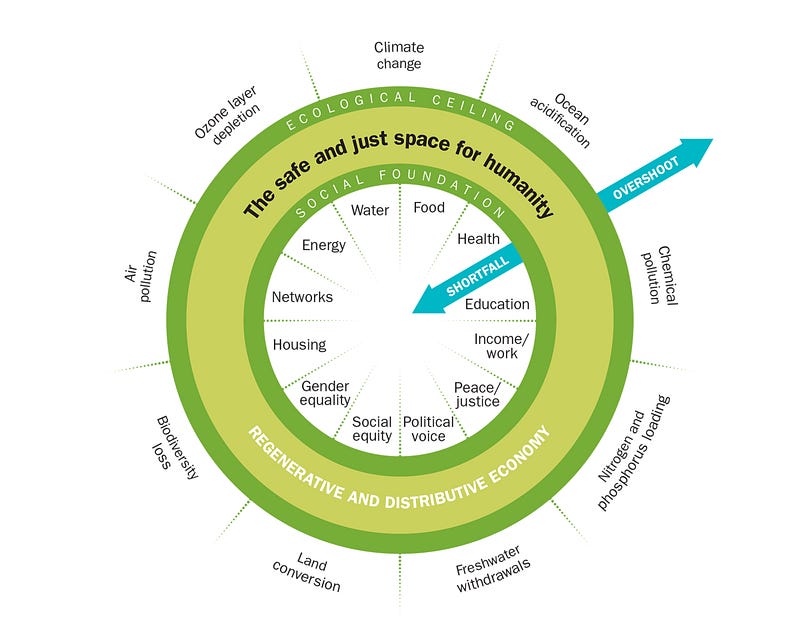
With Degrowth comes new ways of measuring progress. Positive development will be measured using indicators other than GDP. Such indicators already exist, such as the Human Development Index (HDI), and the Doughnut Economics Model. The HDI is a statistical index that measures education, life expectancy, and per capita income, then ranks countries in four tiers of human development. Meanwhile, the Doughnut is a visual model for sustainable development that accounts for both human and environmental boundaries, between which lies the ideal space for the Earth to thrive. These and future models emphasize human well-being and environmental protection.
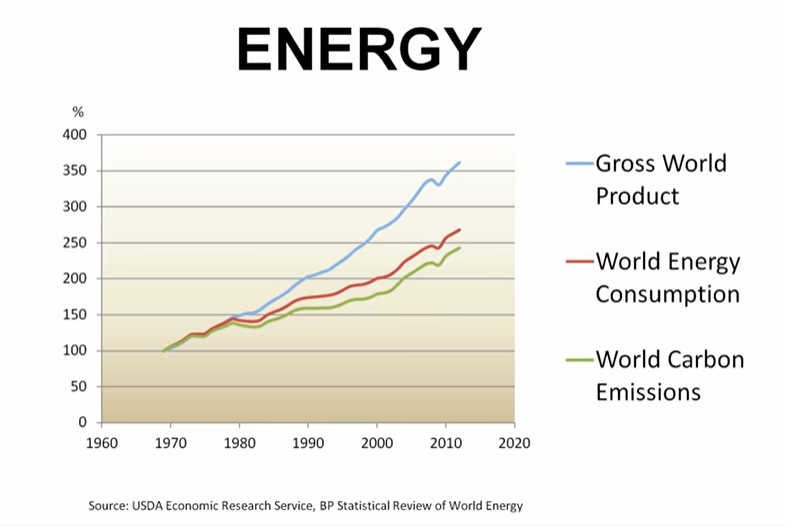
Much focus when discussing a green future is spent on renewable energy. And while that is necessary, scientists have made it quite clear that a growing economy requires an ever-increasing supply of energy, which is when we run into issues. When the need for energy outpaces our capabilities of providing said energy, the shift to renewables will be made exponentially more difficult.
The strain is also thus put on developing nations, who pick up the slack in order to ramp up production ordered by developed countries at a lesser cost. The case for Degrowth extends to the consideration of other nations and our shared environment. Once nations find it too costly to “grow” economically through the extraction of local resources, they branch out to other places, creating deeply neocolonialist systems.
Neocolonialism is the economic, political, or cultural pressures put on other nations for control, whether it be for resources, labor, political power, etc… which results in the colonized countries providing to the colonizers at a much lower profit margin than is required for minimum human living standards. Since growing GDP and capitalism require continuous expansion, globalization and by extension neocolonialism seem an inevitable consequence. While there are benefits to globalization, at a lower level, workers do not benefit from the profits from trade. Degrowth then is a form of decolonizing, as it removes pressure on developing nations and allows inward focus on building self-sustaining systems.
There is a crucial demand for global justice — shifting from an economy focused on extraction and exploitation to an economy based around reciprocity and human care. “High-income nations need to scale down the material economy — the less energy we use, the easier it is to transition rapidly to renewable energy,” says Hickel.
While many solutions for countering the issues with infinite growth propose resource caps and limited permits, this fails to address the root cause of this need for infinite growth. Placing resource caps when there is a starving population only serves to ensure illegal means through which resources are extracted as people do what they need to make ends meet.
Hickels’ proposals include fixes that require an uphaul of economic systems:
The first step to Degrowth is to let go of GDP as an objective. Targeted objectives are a much better solution, focusing the economy on what needs to actually be improved. The second step is to actively scale down ecologically destructive and lower-necessity industries. The third step has to simultaneously occur with the second, which is to ensure that the people are well taken care of through the redistribution of labor & wealth, decreasing the workweek, expanding universal public goods (universal healthcare, free education, public transportation, clean energy, etc.), and de-commodifying the parts of the economy that are necessary to fulfill basic human needs. The more easily we have access to resources that are needed to thrive, the less we need private income in order to live.
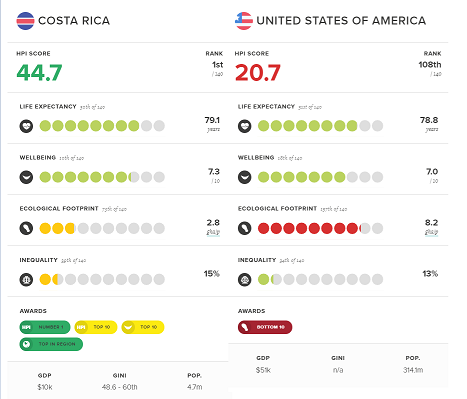
There are already examples of places that are flourishing without a focus on GDP. In fact, Costa Rica has 80% less GDP per capita than the U.S. and yet they have higher happiness and well-being levels in addition to better social indicators, and longer lifespans. All this is done by building up an economy that is centered on basic human needs, social security, and a per-capita ecological footprint that is one-third of the United States (they run on nearly 100% renewable electricity for 300 days of the year¹).
So what exactly would a Degrowth society look like, and how do we get there? In an ideal world, we would have enough time and resources to tear everything down and build anew. As it is, we have neither, and our efforts need to be bottom-up, not top-down. The most feasible way to achieve Degrowth would be to localize economies, limiting the carbon-intensive global trade systems, which we know are unstable.
Local economies would need to build around self-sustaining principles, such as organic farms and community trades. Taking cues from Cuba, we can repurpose current infrastructure and create urban solutions. As Adam Grubb says, “Eat the suburbs,” with urban permaculture gardens, sustainable watering systems, and community-based social care systems. A low-energy lifestyle would be the norm, with reduced working hours and increased leisure time. We would have fewer things and income, but more time. Importantly, we would have a livable environment. We would be rich with the things that matter, one might even say. As Hickel states, “We don’t have to devise eco alternatives that accommodate growth, instead, we can focus on improving the quality of life.”
There is much to be gained through Degrowth. We can manage our communities and ecosystems better, first by changing what our definition of progress means, and then setting better goals to achieve it. Need-based systems are the future, for the sake of our planet and its inhabitants.
Notes:
1 — Not to be confused with 100% renewable energy, as electricity only makes up 30% of Costa Rica’s total energy use.