
Make Your Organization to “Work Wikily” — The Power of ONA.
What does matter more — the formal hierarchies or the real workflow?

Over the last years the ONA(Organization Network Analysis) has become a big trend as a new technique to analyze the relationships and the data among the workforce with a final goal; to measure the performance and to optimize the employee experience (EX) (more important than ever during the Covid-19).
In this article, I would suggest 2 new approaches to leverage the ONA in the world of digitalization and connecting it with a D&I strategic goal. Finally, through this new approach, you will make your organization to “work wikily” in a productive way and with the data that you need to achieve long-term success.
What is the ONA (Organization Network Analysis)?
The Organization Network Analysis(ONA) is a set of tools and approaches that help the organization to map all the formal and informal relationships and collaborations inside and beyond the teams. In other words, with the ONA every organization can easily understand the frequency and the quantity of the data-information that teams exchange (email, instant messaging apps, Microsoft Teams, and internal platforms ). Also, through this new approach, every organization can identify and reward the “hidden champions”, all these employees who always know the right answer in every colleague’s question.
Why do we use ONA?
Up to now, we tend to use the ONA as a tool to answer some key questions inside the organization. For example :
· Which units are collaborating well?
· Do we have silos inside the organization?
· Who could be at risk of burnout?
· Who are the critical employees at critical roles?
· Who is the “hidden champion” to reward them but also to make their work easier?
· Who are the influencers within and across the teams?
All these questions are very helpful, and the answers are playing a key role to create, retain, and develop high-performance teams.
But are these questions in the right context? I would try to identify why we have to use the ONA now!
A different approach on the use of ONA
#1 ONA in the era of Digitalization
The era of digitalization introduces two new models of organization design; The Meta-organizations and the Actor-Oriented architectural scheme.
The Meta-Organization Design (Gulati et al. 2012, SMJ) proposes a new network of individuals without a formal structure or authority inside the organization. In these organizations, the networks are not bound by authority but by relationships. All the actors have the same system-level goal and the focus is the same; ONE common goal.
In this type, in the meta-organization, the ONA could play a critical role. Through the ONA we can identify the frequency, the commitment, and the amount of effort that every actor puts. Especially, the ONA could be very important to optimize the EX and to personalize the collaborative tools more productively. As in this type there are no immediate pecuniary incentives, it is very important to make the collaboration easier for all the actors but also to find a new way to measure the performance of the team without changing the core idea of this new form. One example of the meta-organization is Wikipedia (written collaboratively).
The Actor-Oriented Architecture (Fjeldstadt et al. 2012, SMJ) is another design for digitalization based on the openness of the value creation in processes. Again, in this type, there are no hierarchical mechanisms, but the collaboration plays the key role and orchestrates all the processes while all the actors are self-organized and willing to share the resources. This type of organization is based on transparency, shared values, and trust.
What questions can we identify through ONA?
· Who shared the most useful resources?
· Who contributes more?
· What is the speed of the action-reaction of an actor?
All these questions are important for a large-scale project in which all the actors are intrinsically motivated and the performance must be controlled. Both forms of digital ecosystems would allow the actors of the ecosystem to stay autonomous while at the same time collaborating and contributing to the ecosystem’s goal. On the meta-organization, the focus is on the coordinative role of the form while on the actor-oriented the focus is on the protocols and processes.
In both cases, the ONA seems to be a useful tool to manage the performance of the team and to identify the collaboration patterns.
#2 ONA in the era of “bold action” in D&I .
We read a lot over the last periods that all companies must take bold action to fight against the biases, achieve a Diversity and Inclusion Strategy, and create equal teams. Even though in the selection we have already the norm of the ‘adverse impact’ and the companies try to overcome the unconscious bias while maintaining a diverse but productive workforce, the ONA gives us a new way to identify collaborative patterns.
As I always was a supporter of ONA I am sure that NOW is the time that can prove its power! If we think it twice the ONA is a silent way to keep an eye on our employee relations.
· Who we will prefer to ask for a question?
· Who will be the first to whom will be offered a new project?
· Who employer or which team is in silos?
· Is anyone abandoned by their team?
· Do they all have equal opportunities?
All these questions are easily answered by the ONA and their ties beyond the actors. The answer is in front of our eyes and the bold action is the bold ties that we can identify in the Network.
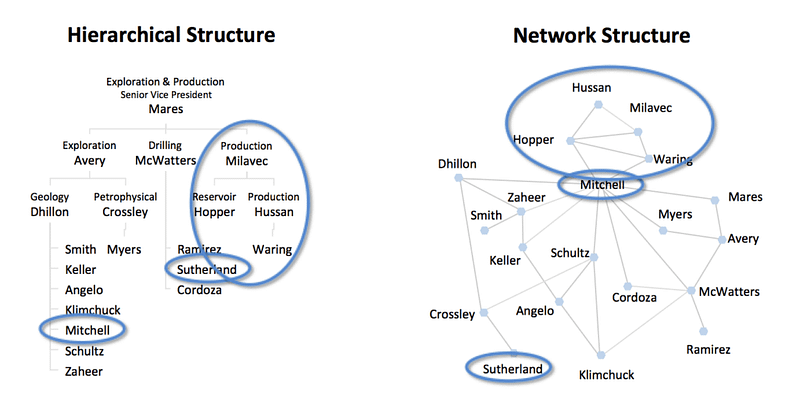
The need — Network Leadership.
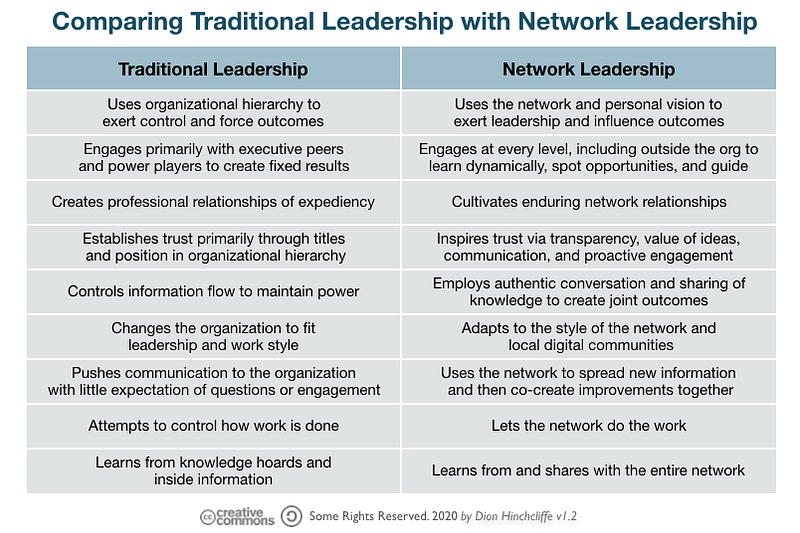
If you choose to view your organization as a “Network” and not as structured silos then you will be in front of the new definition of the leader. After all, it is very obvious that the new era (digitalization and D&I ) demands a new type of Leader. This Leader should be equipped with greater openness, transparency, decentralized decision-making, and distributed action. I introduce you to the Network Leader, in the opposite side of the traditional leader. The Network Leader uses the network to share new information and then co-create improvements together with the network.
In the following table, you can identify the characteristics of the Network Leadership!
Conclusion
The ONA is a new way to tell organizations all these secrets that they are unable to identify. The new era of digitalization and the need for a D&I strategy enhance the demand for this new tool. In the end, the ONA is the map of the organization without hierarchies. What does matter more; the formal hierarchies or the real workflow?
One suitable approach is the Network Organization. In this approach, the winner is not the people on the top of the ONA but the one with the more bold connections!