
Make the Other Mistake
I’ve managed, coached, and helped quite a lot of people in my years at FB. This is an amalgam of over 100 real conversations that my coworkers told me really helped them grow.
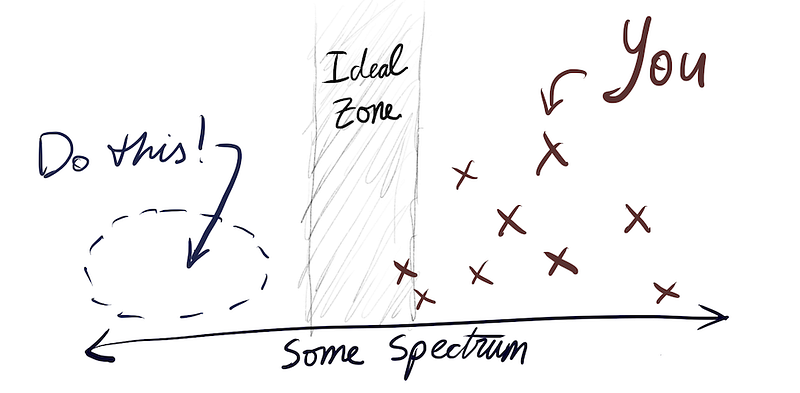
What mistake do you keep making that you just can’t shake?
What rut are you stuck in?
Maybe you talk way too much in meetings, or maybe you know a lot but rarely say something. Maybe every day you practice “brutal candor” with people and for some weird reason it turns out badly — or, you know you need to tell your teammate about their habit that ruins your life, but you don’t because you fear their reaction. Or it’s simpler: that thing you always say you really need to spend more time on, while everyone around you nods vigorously, and yet you somehow never get to it (strategy? posting your thoughts? recruiting? diversity?).
You probably try to make small changes, but still you’re in the crazy loop of doing the same thing again and again and hoping for a different result. Stop the insanity. Stop it now. Make the other mistake.
The Fear Wall
But, when you visualize actually doing that opposite thing, there’s probably a mental wall there. It’s really hard, or you would have done it already!
Here’s some common blockers:
- Doing that other thing doesn’t seem morally right. You might think it’s shameful or wrong to be a self-promoter — so how can you post that update on that hard project you recently finished? Or, it’s unfair to make others pick up after your sloppy work — so even if your team begs you to hurry up, how can you possibly ship that thing that feels at best 80% done? Won’t you become the thing you hate?
- Your self image or public identity is based on not making that mistake. You might be known for being super nice and kind, and are afraid of ever losing that label. Or you’re really proud that you have a 100% no SEV track record, and you don’t want to lose your identity.
- You think that other mistake is super damaging or ineffective. You just think it’s terrible to do it or that most people who do it are a little bit incompetent.
- You tried it once or twice. It didn’t work. You’ve learned your lesson — you’re not a dummy to try that stupid stuff again!
All of these are little fears — of not doing the right thing, of looking bad, of failing.
The Breakthrough
So how do you break through those blockers? By realizing that you shouldn’t fear that other mistake as much as you do.
- Don’t fear going too far. Given your proclivities, I bet you probably can’t easily make the other mistake if you tried! Try it — I dare you. You’ll push yourself hard, you’ll think you way overshot but if you ask some friends they’ll disabuse you of that notion. Remember: if your natural calibration was spot-on, you wouldn’t be reading this right now. A story from a work friend: “There is a PM I used to mentor who basically whispered, and they were super hard to hear. I asked them to shout at me at every meeting. The next day, they said “okay. i am shouting now.” and I said — “No. That’s a normal voice.””
- If you err, you’ll survive. Let’s say after a few tries, you’ve finally crossed the line and made a boo boo on the other side. Honestly, I’m pleasantly surprised you did it! Sure, this will make you uncomfortable and will make you doubt yourself. But, you should also have a feeling of pride and excitement that you did something new. Just knowing you can do it will give you the glorious feeling of growth and progress after a long time of the same slog. A funny way to make yourself feel better: think of your coworkers (you must have at least one or two) who are your opposites. All they do, all day is make that other mistake. All day every day. And yet, they go on, and they do OK!
- Ask for help. Go to your peers and friends for help — you won’t surprise them. They already know the mistake you always make. And they’d love to help you. People are always into getting someone to do something new and different, especially if they think it’s good for you — think of people making you taste new food. As with food, they’ll tell you to not be afraid, that others do it, that it’ll be fine, that it’ll be fun, and that they’d love to see it.
- Fight fear with fear. Make it scarier to not do it than to do it. A common way to do this is making commitments to others. Promise your friends you’ll make that other mistake at a concrete time — in the next meeting, or maybe at least 3 times this week. Or, tell your team via whatever (Slack channel, e-mail list, at a meeting) that you’re trying hard to work on this. Your fear of letting people down will balance your fear of doing something different.
Fine-Tuning
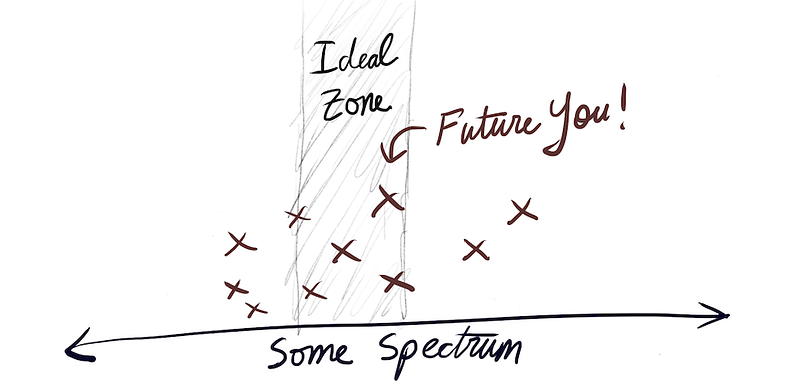
Ok, so now you’re capable of making both mistakes. You’re far from perfect, but you’re landing on both sides of the ideal occasionally. I have good news for you: you’ve done the hardest part, which is showing yourself you can. You’ll feel a big weight off your chest. Why? Because, now, your work will be a lot easier. You’re not trying to break through, you’re only trying to adjust and find a better mix. Now, all you need to do is work over time to narrow down your behavior into the ideal middle. This is about a hundred times easier than doing new and scary things. Keep working on it like we work on anything — do it, collect feedback, adjust your approach, rinse, repeat. It doesn’t take a lot of cycles to get it pretty damn good.
Be Inspired by George
I’ll leave you with this: You can do it. Even George Costanza, our lovable Seinfeld loser, once had an epiphany about the power of doing the opposite, and put it into action:
George in an epiphany: “My life is the complete opposite of everything I want it to be. Every instinct I have in every aspect of life — it’s all been wrong.”
Jerry: “If every instinct you have is wrong — then the opposite would have to be right!”


