
Make or Fake Eye-Contact to Enhance Online Connection
And improve the quality of your teaching, meeting, and social interaction

This week I started teaching again. Many of my colleagues at universities around the world scrambled to turn in-person to online-only courses in a few action-packed days in March. I was lucky my courses only began this week, so I had longer to prepare.
With the luxury of time, my transition to online teaching has been interesting and generally pleasant. Setting aside truisms about middle-aged dogs and new tricks, I learned a lot. And anyway, isolation provided the impetus to take my Evolution and the Modern World course online, something I have long intended to do.
There’s just one thing…
Looking back at the videos I record for the students has been confronting. Not because I sound weird or look older than I think I am. I got over those hangups years ago doing radio and TV interviews. This screengrab from a video encapsulates my problem.
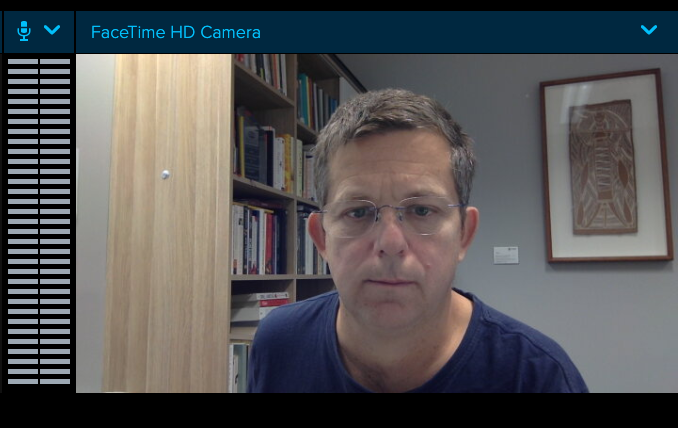
This view I recognize from conferences, as people strain to discern my name tag. In real-world interactions, it is the social cue of somebody looking at one’s upper torso. It isn’t the look I am going for in delivering my classes. I want to look directly at the students as I address them.
Of course, I’m not the first to notice this. Indeed it is not the first time I have noticed it. Since isolation began, all those meetings on Zoom, Skype, and Teams made the weirdness of people looking at their screens and not at their cameras a daily experience. Most of us have grown accustomed to seeing one another’s faces but missing out on the crucial cues that come with eye contact.
The importance of eye contact
Meeting one another’s eyes has always been an essential part of human social interaction. Baby and mother lock eyes while breast-feeding, their bonding abetted by eye-contact and oxytocin. Significant commercial and political deals get the final seal of approval with eye-to-eye contact and, until recently, often a handshake. Lovers get lost in one another’s gaze, the act of being seen every bit as important as being understood.
A paper published earlier this year achieved the formidable technical feat of studying what happens in the brains of two people when they make eye contact. One of the first things you notice when you look at an fMRI brain scanner is that there’s barely enough room for one person, much less two. The authors ingeniously rigged up two fMRI’s and a series of screens and video cameras to see what happens with virtual eye contact.
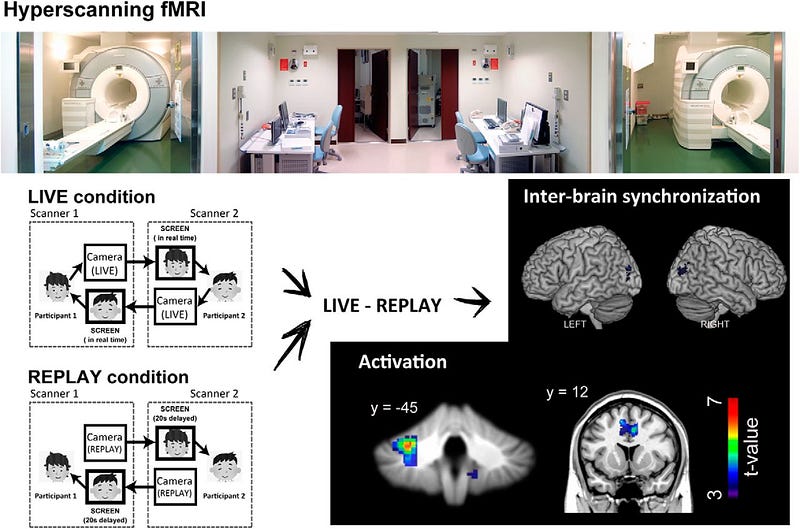
When people — each in a different fMRI brain scanner — made real-time eye contact, they mimicked one another’s eye-blinks and the same regions of their brains activated. When the video was delayed, or not presented, the synchrony stopped.
The research implicates the ‘limbic mirror system,’ a part of the primate brain important in empathy and social interaction. The study begins the process of resolving the physical basis of something people have long understood: that eye contact matters in social interactions. And it shows the way toward better video-conferencing experiences.
Back to Video
The problem with video is that to see one another we have to look at our screens and thus look away from our cameras. When we seem to be permanently looking down or to the side, we miss out on the synchrony of mirroring one another. Thus we miss our connection. Without that connection to me, my students don’t get much benefit from seeing my talking head on their screens.
So we perennially look down, or off to one side, depending on the position of our device’s camera. There exists no shortage of advice on how to fake eye-contact by tricking oneself to look at the camera and not the screen. But that doesn’t always work. To look at my slides and point with my cursor, I have to look down at my screen.
One needn’t be a futurist to see the COVID-19 pandemic as a digital watershed. Even when the need for isolation and distancing eases, people will spend more of their social time online. School teachers and university professors will provide far more of their instruction through live and recorded video. And in-person meetings will give way to Zoom conferences for good.
Whether those bullish predictions eventuate remains to be seen. The result will be far more satisfactory if videoconferencing companies can deal with the eye-contact conundrum. Sophisticated teleprompter or mirror-based solutions are already available, but only to fit corporate budgets. Both Intel and researchers at ETH Zürich have developed software that adjusts the image of the face to give the impression of eye contact. The videoconferencing platform that integrates such a solution first will enjoy a substantial competitive advantage in our new socially-distanced world.
An alternative, as yet unrealized, would involve integrating the video camera with the screen, so our conversation partners know precisely where we are looking. The eye contact will be real, not an optical or software illusion, and the social interactions will become altogether richer. A technical challenge to be sure, but since when have engineers not relished a technical challenge?
Join my mailing list for monthly updates


