
Science | Physics | Education
Make It Simple — The Double-slit Experiment (Quantum Mechanics)
The famous double-slit experiment explained in an easy-to-understand way
The double-slit experiment is one of the most famous experiments in quantum mechanics, yet it is described in a way that makes it hard for most people to even understand what is going on or why it’s so important.
But behind the complex science talk hides a very interesting “paradox” which I’d like to share with the reader. So let’s make it simple and take a look at what it is that got scientists so interested in shining a light through two slits.
Light waves vs. light particles
As you know from physics class, light consists of photons. You can look at photons like particles or really, really small balls. Light, however, is a wave, with different wavelengths for different colors.
And lightwaves behave much like waves in the water too. They can interfere with each other. If you shine a lightwave through two slits, the wave breaks up into two distinct waves that propagate from each slit.
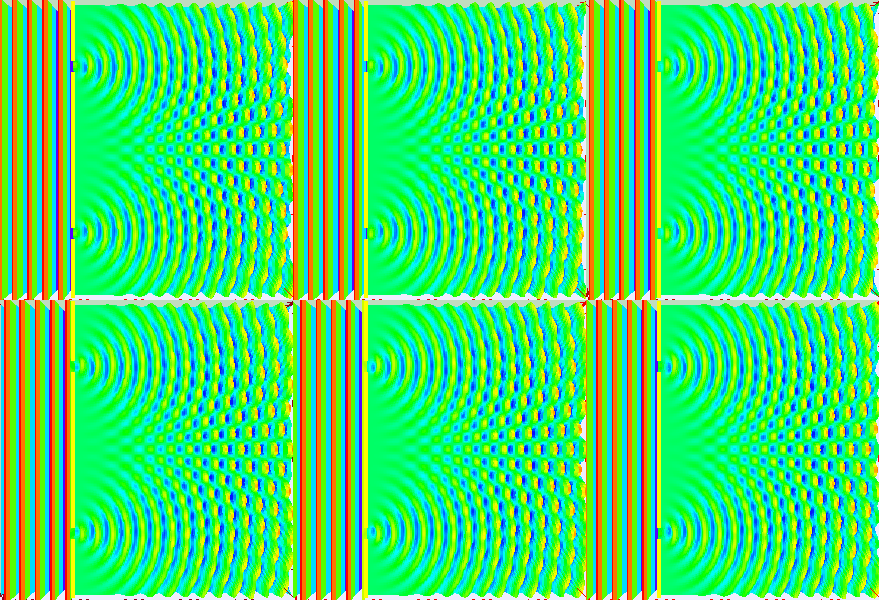
Where they cross, the light becomes stronger. In other places, the beams cancel each other out. If shined onto a wall, a distinct pattern, a so-called “interference pattern” will emerge:
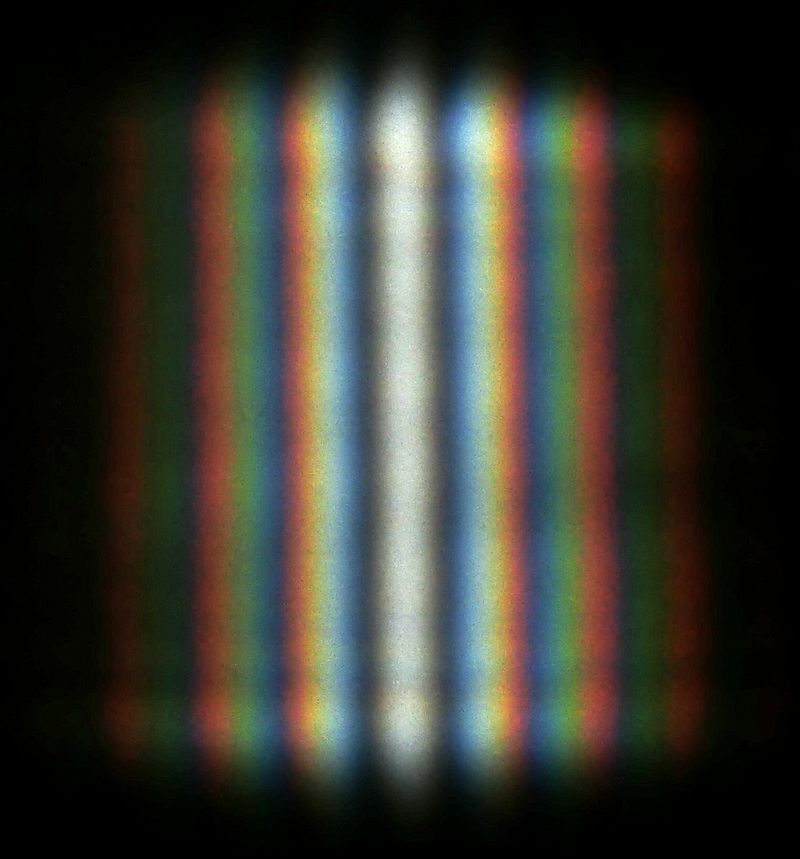
So far, nothing spectacular, right? We now know that light moves like a wave. The waves of both slits collide and only where they meet, this pattern is seen on the wall behind it. This would give us the “100% light is a wave, period.”-argument.

If light would consist of single particles instead of these waves, then they would not cross paths behind the slits and not interfere with each other. The result, much like if you were to randomly throw balls through each slit at the wall behind them, would look more like this:
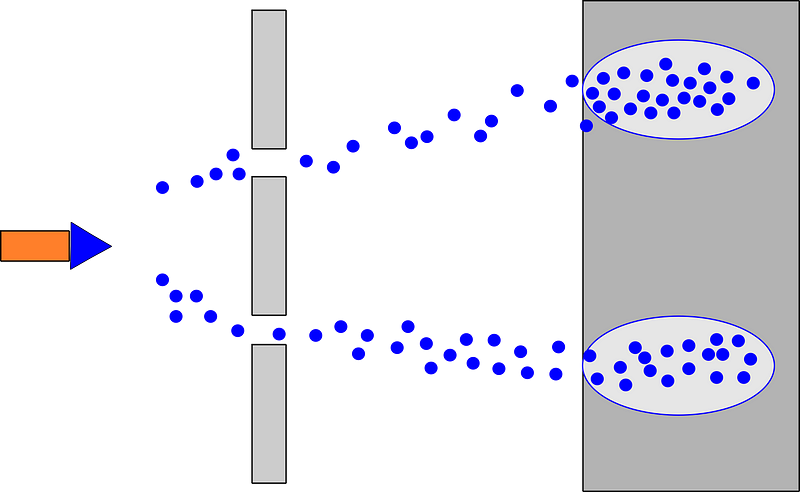
And this is where things start getting funny. Because scientists have started firing electrons through these slits one after another. So instead of waves creating the interference pattern from above, they expected single electrons to create an image similar to the last image above.
Here’s the result they got:
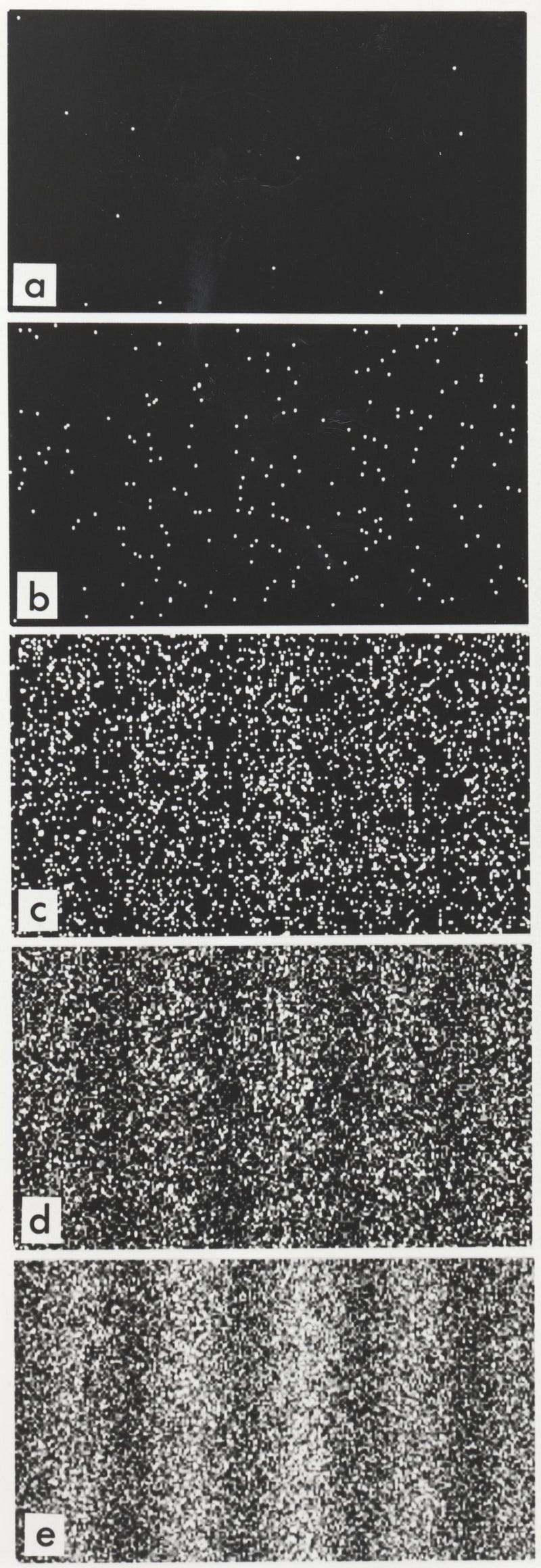
Even though they fired the electrons one after another (avoiding any waves to interfere with each other) the resulting image after firing 140,000 electrons is similar to the interference pattern created by a continuous stream of light.
In easier words: There are no waves to create this pattern. Just singled-out electrons flying all by themselves. Each electron can only fly through a single slit at a time. There can be no interfering waves. Unless a single electron somehow travels through both slits at the same time, creates waves at both slits, and then interferes with itself.
The results depend on whether you observe them or not
They are shot as particles but still behave like waves. This is strange enough, but it gets even weirder than that. Since the scientists only fire single electrons at a time, it would be simple enough to observe through which of the two slits each electron travels in order to see how this pattern emerged. So they’d set up a sensor that beeps every time an electron comes through the upper slit.
However, as soon as any equipment is used to record or observe the pattern, it stops. Electrons no longer behave like waves (and create no interference pattern) but instead behave just like if you were to randomly throw balls through each slit. You’d only get two distinct spots where electrons land.
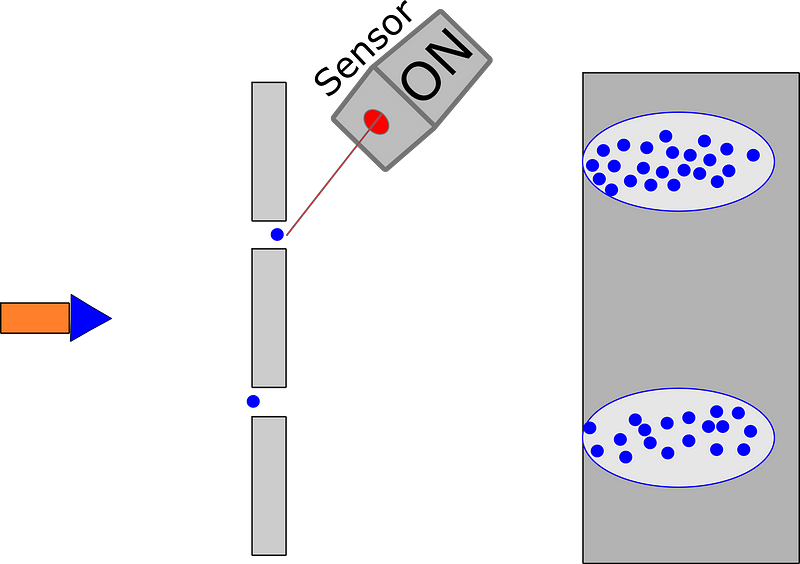
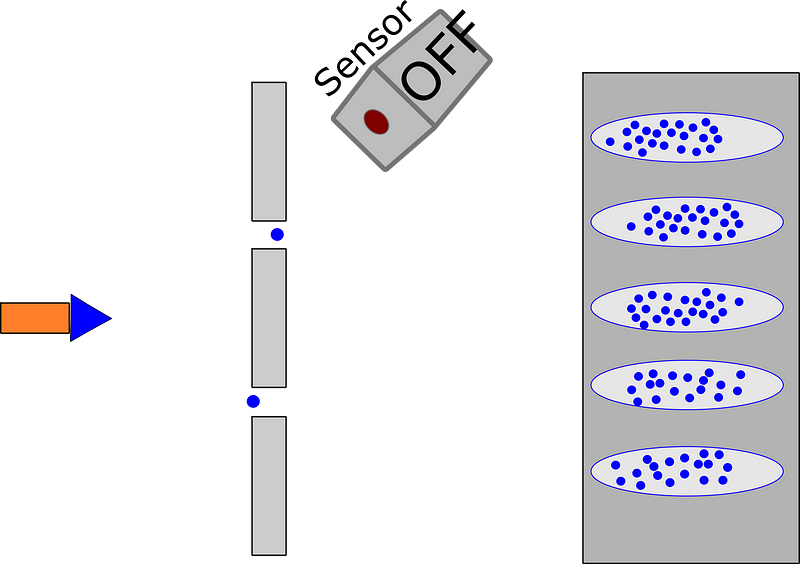
Now you can say through which slit each electron travels, but it will no longer add up to that interference pattern. Instead, they land on the two distinct spots behind the slits. Just like throwing balls, without any waves involved.
As soon as you stop the observation (for example turning off a sensor that counts electrons traveling through one of the two slits), the interference pattern shows up again.
How is that possible?
Schrodinger’s cat and superposition
You are likely familiar with the famous cat of Erwin Schrodinger. This was a thought experiment (no real cat got harmed) which was meant to demonstrate so-called superposition. The goal was to explain the simultaneous existence of two states. The cat, while unobserved, can be both dead and alive. So it’s said that it really is both dead and alive at the same time.
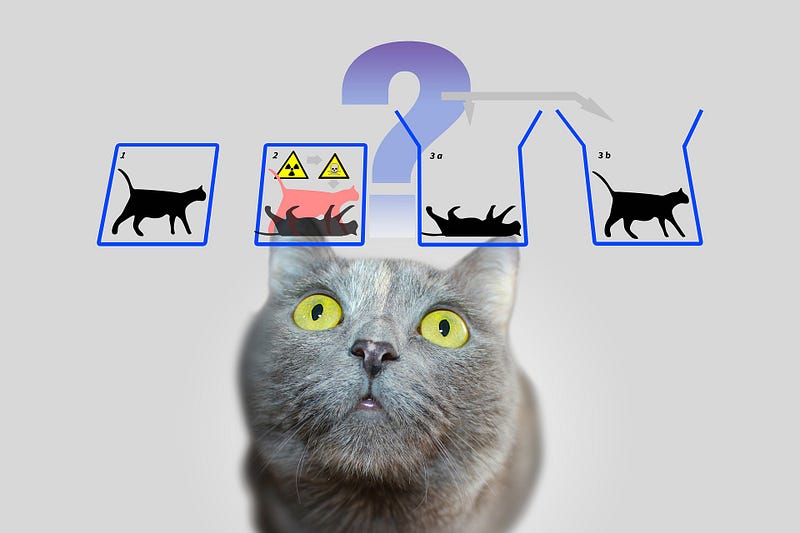
Only from the moment you observe it (by looking into the box), the universe selects one of the two possibilities, making it the only reality.
How does this relate to the double-slit experiment? We know that light behaves both as a wave and as particles. But we can never observe both states at the same time. As soon as we observe the light, it behaves like particles. But as long as we don’t observe it, it behaves like a wave.
This doesn’t even have to be visual observation by a human or another conscious lifeform. Simply by recording it, somehow the electrons behave like regular particles. As soon as the recording stops, they behave like waves again.
How do they know whether or not they are being observed?
Why does their behavior change simply by putting a passive recording device in the vicinity? Why does their behavior change back to wave-like behavior once that recording device is simply unplugged?
Apparently, a single electron interacts with both slits. But we can not observe it. Because if we do, it will somehow magically only go through one slit and the interference pattern is replaced by a regular “two entries, two exits” pattern.
This is a question that quantum physicists try to answer to this day. If you can logically explain why the pattern changes based on observation alone and how single particles start behaving like waves only if no one is looking, you might be able to win the next Nobel prize with your explanation.
And this is the famous two-slit experiment in a nutshell.
Kevin is an editor and writer for the ILLUMINATION and Polyglot Poetry publications. Follow him on Twitter and LinkedIn.


