
NATURE NURTURES
Make Friends With A Tree And Be Happy
It may sound crazy but it is not
My “relationship” with a particular tree species started way back in New Zealand.
At the time, I couldn’t even imagine liking this tree species, the Salic babylonica. Its common name alone, weeping willow, portends grief; its foliage resembling a metaphoric downpour of tears.
This particular weeping willow, a huge one, was located in the back garden of my sister’s house in Auckland. The garden ground was sloping; the house was on higher ground and the garden meandered on a soft descent.
A number of longer stems were overreaching the side porch, which was a few steps away from the kitchen. When the wind blew, these longer stems swung carelessly with the draft.
It was all well and good if the above happened during the day, especially on a humid, summer day.
But it was the exact opposite of what happened to me. It was winter, close to midnight, and my gloom was as murky as the bone-chilling winter temperature.
I was in my decade-old quandary (how to go about my wish to get a divorce), a hefty predicament to be sure. I was in this mental state when I went to the porch without turning on the porch light.
I wanted to breath, wanted to let go of the disquiet in my mind.
That was when gusts of wind blew, sending the stems of the weeping willow dance across my face. I was so shocked that I wasn’t able to react immediately — until I heard this weeping willow “speak”. To me.
I heard it through the gentle whiff of wind. It said goodbye to me not once but twice. I heard it in my mind. So terrified I was of this weeping willow that I must have run towards the safety of the house.
I assure you, I have no cause to make up this experience. The incident was the reason why weeping willows frightened me — but no longer.
Making friends with a tree
A dozen and three years on and sans the pickling plight in which that weeping willow in Auckland caught me, I found myself in a bright new world.
There were still work-related stresses, but the new love who found me (or was it I who found him?) was nothing like the cad or two I met in my previous life.
It was during this time that I started to make friends with a tree.
As it happens, it is with a weeping willow.
It wasn’t as if there were no other trees around the parks and nature reserves, or even in our own garden, that I could make friends with.
There were thousands upon thousands of trees that attracted me in our regular walks and local travels.
But it has to be a weeping willow. I needed to face my fear of this tree. I needed to unload from my system what seemed to be a mystical awe of this tree towards me.
And there’s this particular one, out of the many weeping willows I came across in countless occasions, that I dared make friends with.
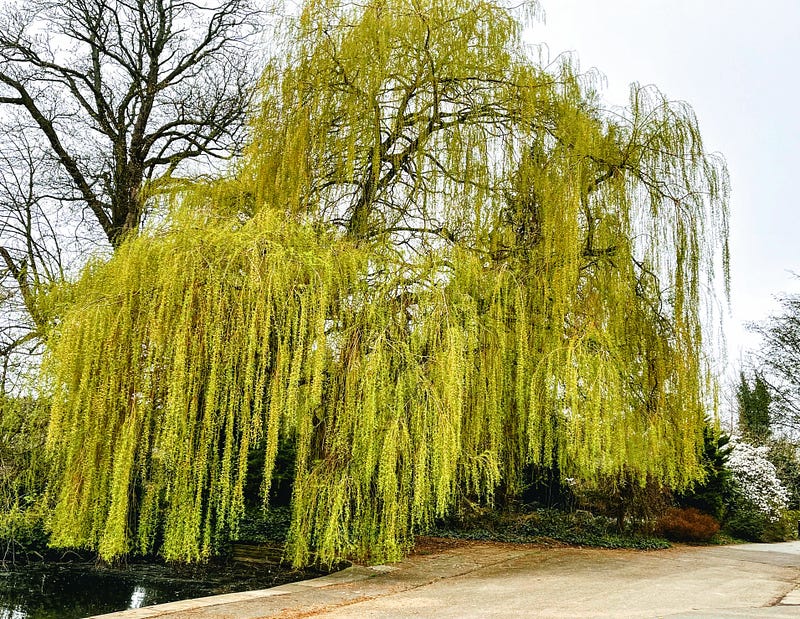
This weeping willow stood at the far end of a lake.
It was so huge that visitors to this 60-hectare parkland could spot the tree at a distance, sort of lording it above all the other old, old trees.
I started “befriending” this tree with an uncertain approach one winter. My husband, who had no idea at the time about my weird experience with a weeping willow in Auckland, was puzzled.
For a start, he was aware how I dislike muddying my shoes — and the two-meter distance from the path to the trunk of the willow was muddy.

But I overcame my fright of the weeping willow. I got close to the trunk, gingerly trying not to step on its fat roots. I touched its gnarled trunk, held its leafless trees, but stopped short, however, of hugging it. It was too stout anyway.
From then on, I visited the tree that I made friends with at least once a month. I stop before it, look up, check its stems gracefully moving with the wind, and touch its rough trunk — not minding the always damp ground from where it stood.
Between visits to say a silent hello, I did a lot of research about this tree. I even wrote about how helpful the weeping willow tree is in flood control, among other things.
After half a dozen seasons of making friends with this tree, not only did I get past my initial dread of the weeping willow, I also gained insights towards another path to contentment and happiness.
I see this tree in autumn, its leaves turning golden yellow, preparing to shed. It needs to hibernate and rest. Just like us, humans, we require rest to recuperate from our personal cares.
In winter, the weeping willow is leafless and skeletal like the other trees. It looks as if downtrodden, as if life’s challenges and worries are too much to bear, enough to just give up and die.
But it does not die. It is resilient. It does not fold in the face of woes. It just takes a rest and energize.
From late winter to early spring, its stems begin to show pulsing life, the leaf buds grow by leaps and bounds, its baby yellow catkins (or flowers) ushering a sure start to spring.
In full spring, the weeping willow is bouncing with life, with leaves, with flowers that bear its seeds for continuity of life.
It celebrates the triumph of hope after a winter of seeming bleakness.
And in summer, the beauty of its foliage compete with the other trees.
Like humans who rejoice in achieving their aims, the tree revel in completing a season of trials and challenges; as humans work hard to realize their dreams.
Life goes on
This is what my tree-friend has taught me. Worries come, worries go. Learn from it. Success will come, and it may leave but only if lessons are not learned.
The cycle in our life, just like the seasons in the life of a tree, consists of changes. The important thing to remember, just like a tree, is to remain grounded on what we want to attain.
No matter what challenge life chooses to throw in our face, we can overcome. Just like my friend, the Salic babylonica, we will not be beaten by the cold and darkness.
For as long as we stay grounded, i.e. in tune with and confident of our hopes and abilities, the cold and darkness would eventually make a hasty retreat.
Life goes on.
Recommended readings:
This piece by Hayden Moore is supposedly about trees, but not really. It goes much deeper than that. Enjoy the imagery in this article, which actually reads like poetry.
Jo An Fox-Wright Maddox writes about how she found nature more of a “problem” than a joy when she was younger than today. Do have a read to find out the context of why she shared this.
LinkedIn | WordPress | Twitter | Facebook | Instagram | Amazon Author’s Page | pinoypub.ph


