
Mahatma Gandhi’s Relevance in Today’s World
Gandhi’s Teachings for Peace and Sustainable Development
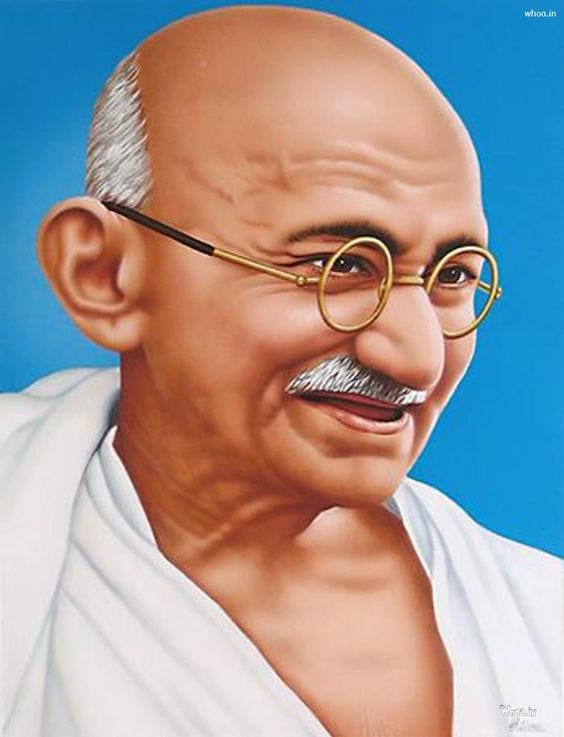
Globalization has brought interaction between different cultures and different countries and the world has become like a family. In this era of quick change is Gandhi’s philosophy relevant? How is it useful in the context of the present scenario? Should Gandhi’s philosophy and teachings be discarded or should it be used for peace and development?
Gandhian Relevance in Teachings of Peace
Gandhi ji quoted in his autobiography The Story of My Experiments with Truth,
“When I despair, I remember that all through history the way of truth and love has always been one. There have been tyrants and murderers and for a time they seem invincible but in the end they always fall-think of it always”.
(i) Relevance in India and different countries: Gandhian philosophy and teachings are his social ideas which he adopted were developed first in South Africa from 1893 to 1914 and then in India.
Gandhi Ji believed in truth and non-violence (Ahimsa). The word ahimsa by Gandhi Ji was used to bring out the meaning of active love. He believed that this was the most powerful principle for universal justice. According to him, human-beings could solve conflicts peacefully.
Today, the path and means used by Mahatma Gandhi have become relevant not only in India but also beyond the boundaries of India, to other countries wherever people have been suppressed or injustice has been institutionalized. The Jasmine Revolution in Tunisia.
It is an example of the Gandhian principle against social injustice. The common people of Tunisia tried to overcome unemployment, food inflation, corruption, lack of freedom of speech, and poor living conditions through a peaceful peoples’ movement that helped end the autocratic rule of president Zine El Abidine Ben Ali. The peaceful movement also spread to Egypt and other Middle East countries.
US President Barack Obama recalled how the revolution in Egypt that threw out a defiant Hosni Mubarak had the seeds of Mahatma Gandhi’s tryst with truth and justice.
When Mubarak was forced to step down, Obama recalled the non-violent methods of Mahatma Gandhi and Martin Luther King Jr as he praised the people of Egypt for their peaceful protests.
At a UN speech, Obama condemned the incitement against the Sufi Muslims and said that it is time to heed the words of Gandhi. “Intolerance is itself a form of violence and an obstacle to the growth of a true democratic spirit”.
War never brought a solution. A country cannot be developed unless there is peace. A war between Pakistan & India, China & India, Russia, Afghanistan, North and South Vietnam (America sent its troops), Cambodia, Libya, U.S., and Afghanistan only brought disaster through loss of life & terrorism. Some of these countries are under stress even now. The Indian Prime Minister, Modi is trying his best to have a peaceful solution with China so that the border skirmish ends. There has been utmost violence and loss of life from both sides in this war.
(i) Peaceful Conflict Resolution: Gandhi realized that conflict among people was due to the suppression of freedom, power politics, racial discrimination, inequality, and egoism. He had a positive attitude that conflict resolution had to be done through peaceful methods.
Satyagraha as a method of resolving conflict is appreciated even today and the UN charter of human rights provides dignity to human life. Gandhi believed in humanism as a philosophy. He provided a philosophy for conflict resolution through peace.
(i) Non-violence: Gandhi’s philosophy is universal and timeless. Although it is set in the Indian social context it is universal and relevant for all humankind.
A change in society is to be required it cannot be done through war or revolution. Gandhi Ji was full of conviction that a society based on non-violence will bring about peace.
In the current scenario, there is a condition of poverty, exploitation, Sickness, joblessness due to COVID 19, and environmental pollution. The moral and ethical standards of the people have to be improved to bring about the transformation in society and to bring about peace.
He regarded non-violence to be a dynamic force to oppose evil. He felt that non-violence was an active fight against human indignity.
The Relevance of the Gandhian Model of Sustainable Development
Gandhi’s teachings are relevant for protecting the environment and preserving the carrying capacity of the Earth. He believed in sustainable development emphasizing the role of society, economy, and environment. He believed that a materialistic lifestyle should be changed for sustainable development.
The Gandhian model considers sustainable agriculture, khadi and village industries, and simple appropriate technologies for development. He also believed in renewable sources of energy and tree plantation for the development of the economy. He said that no development is possible in the economy until every person in rural India has food to eat and poverty is eradicated. These teachings hold good and are relevant even today in India.
(i) Agricultural Development: Gandhi ji believed that agriculture should be sustainable. He wanted that people should not use chemicals and pesticides. Instead of these artificial sources, he was in favor of bio-manures and bio-pesticides. He understood that vermicompost and vermiculture were important and useful for providing good soil for plants.
In the modern world, scientists are stressing the need for chemical free crops to provide organic food. The harmful effects of chemical fertilizers and pesticides on human health have been tested and the relevance of Gandhi Ji's development of sustainable agriculture holds good even today.
(ii) Employment: Gandhiji’s prime interest was to bring about employment in rural areas. He projected the need for eco-friendly products. He promoted village industries.
This would have the double benefit of reducing poverty from the economy and promote small industries in which the people of the village had some skill or could easily learn the skill. He promoted khadi, hand-woven cloth, and products that were easily available in villages. Khadi is a form of employment and has relevance as an eco-friendly fabric not only in India but also in other countries.
(iii) Renewable energy sources: Gandhi Ji, had a vision beyond his time. He was in favor of harnessing solar energy for heating and lighting as it was available from nature and it was not exhaustible.
Coal and petroleum are non-renewable energy sources and in his foresight, he understood the importance of other sources of energy besides solar energy. He saw merit in water and wind which could be used for producing electricity. All these techniques are currently useful and relevant in the modern world.
(iv) Tree plantation: Gandhi ji also had the philosophy that trees should be continuously planted. According to him, as the population increased there would be a shortage of wood as trees would be constantly cut for the construction of houses. If more trees were planted the shortfall would not be felt by society. The best way according to him was to plant double the number of trees that were cut.
Gandhi Ji's teaching for the development of rural areas through agriculture, small-scale industries, tree plantation, and the creation of renewable sources of energy is relevant to the development of the Indian economy.
Gandhi Ji recognized the importance of rural development as a pre-condition to economic development.
The Relevance of Gandhi Ji's teachings is thus an immense contribution to the world and to India and other developing countries in particular.
Gandhi’s foresight was tremendous. He believed as the population increased and the use of technology brought about change and new technology people would have to live peacefully or development would not take place.
He was afraid of the harmful effects of nuclear energy as although there were benefits of such energy it would also have dangerous effects on human beings if not used carefully.
Hence he believed in simple technology. He thought of the future and was against the oppression and dominance of human beings.
He believed in the struggle for human rights. Resistance was necessary but in the form of Ahimsa (Non-Violence). In the quest of achieving world peace Gandhi’s philosophy & teachings should be seriously followed. Only when there is peace — Development will take place.
Finally, he believed in sustainable development by protecting the environment and the use of non renewable energy sources and plantation of trees for ecological balance.