PREGNANCY LOSS
Magnolia Blossoms Under Snow
A tale of great love and great loss
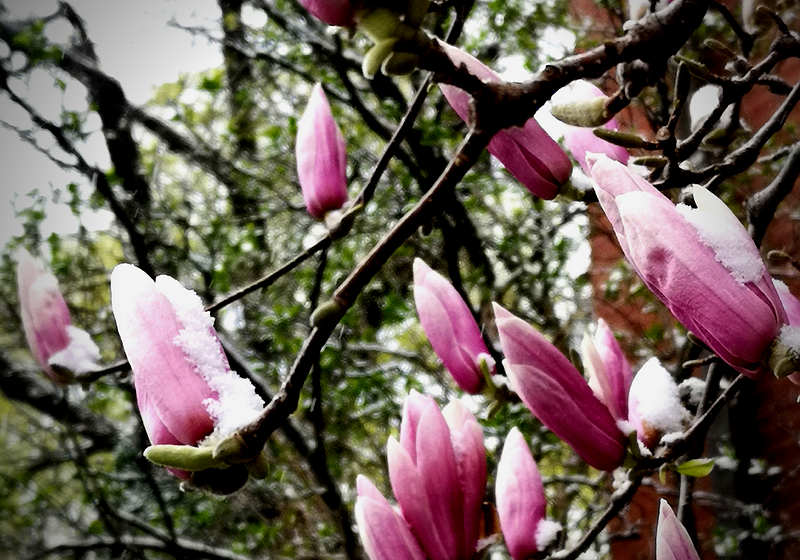
The sight of a magnolia tree, smattered with half-open buds, arms open wide to embrace the snow took my breath away this morning — so much so that I accidentally made a wrong turn on a one-way street that I drive past every day. The date is April 21, 2021, and I am in Montreal, but the sight of the tree — of spring embracing errant winter winds — transported me to another time, another place. My years in Illinois have taken on an almost mythical quality. It was there that I experienced so much love and so much loss. There I suffered, birthed and grieved under the light of fireflies and a canopy of pink blossoms. The memories blur into one another and cover themselves with a hot summer haze and the buzz of cicada song.
We bought our house there in 2016, and we moved in during the late summer when I was newly pregnant with our first child. My aunt and uncle came from Indianapolis to help us settle in, and my aunt casually mentioned how lovely it was that we had a magnolia tree in the front yard. Not being well-versed in botany, and having not inherited a green thumb from my Nonna (grandmother), I hadn’t noticed. But I agreed — it was nice. Magnolias are beautiful and remind me of my Nonna.
My pregnancy with my oldest child wasn’t easy. I developed the same problem my mom had had in her pregnancies: hyperemesis gravidarum. This meant that I threw up everything I tried to eat and drink, my own saliva and blood, bile and stomach acid over and over again. I lost over twenty pounds in the first few weeks, which was a lot for an already thin person. This ultimately landed me in hospital and eventually back home on TPN (nutrition through a PICC line). Every morning I tried to eat anyways, and every morning my body rejected it. The vomiting grew worse and worse as the day wore on.
My world contracted into my bedroom. I sat in bed trying not to throw up, trying to survive another second— for my child. That is how I managed it: folding one second at a time over another, focusing only on making it through the next vomit and thinking no further. When I could tolerate the light (and I often couldn’t), I opened the blinds of the north-facing window and feasted my eyes on the magnolia tree through winter. I was fascinated with how the blue-green velvet buds ripened throughout the fall and winter, like little cocoons, ready to explode into spring. It mirrored the promise of my pregnancy — all this suffering, this long winter of pain, would bear fruit one day and give me my child.
My baby was born in February, and one month after their birth, to the day, our magnolia bloomed. It was deeply satisfying, and 2016 was the best year of my life. I had survived the unsurvivable, with medical help. I had suffered pain that was unimaginable, but the universe had given me my reward: my firstborn child, the light of my life, the promised spring.
2016 flowed into 2017, and my baby began to walk. My thoughts turned to a sibling. I had always known I wanted more than one child. I desperately looked for reasons to believe that I wouldn’t suffer the same fate as with my first pregnancy, but the odds were against me. There was a chance I would experience a normal pregnancy, but most likely I would suffer again. I met with my OBGYN and formulated a plan for medications, hospital care and at-home care. We decided that I would try a feeding tube instead of TPN this time around because TPN came with the risk of infection and sepsis. Sepsis has a high mortality rate.
It took me a while to conceive my first child because of PCOS, so it was a great shock to me when we conceived our second child the first month we began trying. It was springtime.
Our magnolia tree began to blossom early that year. By now it had come to symbolize the promise of a difficult pregnancy to me. I smiled to myself knowing that this year we were planning to welcome another child. This time was different though. The magnolia buds had barely begun to open when a cold weather front descended on us from the north, bringing snow and cold. The few buds that were partially opened wilted and fell, and no more buds opened that year. Long after the events of 2017, I wrote this poem about it:
It was hard to explain the sadness I felt. I tried to brush it off, but it just didn’t feel right. Soon though, I was in the depths of another hyperemesis pregnancy, and this one was worse. The magnolia tree faded into the background as I fought a battle for my baby.
I was hospitalized by six and a half weeks pregnant. I remember my milk drying up in hospital. I had had to cut off my still breastfeeding 13 month old because I needed all the hydration and nutrition for myself and for the new baby. It was a traumatic weaning experience for both of us, and my child was afraid of the hospital, of the tubes coming out of their mother, so they suddenly stopped spending any significant time with me.
We tried the feeding tube. It was a fine thread of tubing that was forced through my nasal cavity, down my esophagus, into my stomach, and then later into my small intestine. I vomited through the insertion. A maxillofacial surgeon came and stitched it into my nose. I remember him and the resident laughing goodnaturedly because they had been called in to do such a mundane task, but by then I was a frequent flier on the antepartum ward, and my obstetrician wanted the best for me.
I was on continuous nutrition: a pump that allowed a few millilitres a minute of golden, nutritionally dense fluid to make its way into my digestive tract. This part was alright for a bit. I fell asleep. I will never forget waking up vomiting in my sleep, choking on vomit that was a mix of formula, blood and bile, and trying to catch my breath. The pump was set to flush with water every four hours, and the feeling of cold water rushing through the tube was intolerable and set me to profuse protracted vomiting.
There are some tricks to tube flushes. We switched to manual flushing and warm almost hot water and did them slowly over forty-five minutes. I vomited the entire time. We did this for two days, every four hours. One of the nurses told me it was traumatic for her, torturing me like that. I was unsure what to do with that information. I was, after all, the one being tortured.
Eventually, my vomiting displaced the tube into my stomach, and I started vomiting up most of the formula. The options would have been to pull and replace it (something that would likely need replacing often given the amount of vomiting I was doing) or move to TPN. My OB suggested moving to TPN again, and I was tired of the intense added suffering that the feeding tube was giving me. Eager to get back to only the suffering of hyperemesis, I agreed.
It took a couple more hospitalizations to get the TPN right. My home-care dietitian didn’t increase my calories and fluid as needed, and I ended up back in the hospital for liver failure at 9 weeks pregnant because of severe malnutrition and dehydration. I spent a week under specialist care making sure my liver enzymes stopped their rapid ascent. They did, and I got to go home.
Every week a nurse would come to take labs (keeping an eye on my liver, electrolyte balance and infection risk) and change the dressing on my PICC line. Proper dressing care was essential to minimizing my risk of infection. One week, when I was just over 18 weeks pregnant, they sent a new nurse. She was a travelling nurse who they had pulled up to fill staffing shortages. As she changed my dressing, I looked away, as I always did, to prevent breathing on the open wound and introduce a source of infection.
As she worked she told me how she had just gotten back into nursing after her husband lost his job. It was tough, because she had to travel, but she was grateful that at least she could work. I noticed that she messed up putting the dressing on after cleaning and reached into the box to grab a new one without changing gloves. I should have said something since I knew this was not sterile, but I didn’t.
When I looked back over at the site of dressing change, I noticed that the sterile gloves meant to be used to put on the new dressing remained unopened. She had done the entire dressing change with the non-sterile gloves she had used while cleaning the wound! I felt upset and violated, but I didn’t think anything terrible would come of it. Unfortunately, this wasn’t the first time a nurse had done something during a dressing change that put me at risk.
The labs from that day came back perfect. There was no indication of infection and though my liver enzymes were still elevated, they were holding steady.
I felt off the next day though. My older child and my sister (who was staying with us along with my mom to care for my toddler) had come down with some kind of cold or flu. I figured I was getting what they had. Just what I need, I thought. I had gotten influenza A towards the end of my first pregnancy, and that had resulted in another hospitalization.
When I spiked a fever at 8 pm that night, August 1st, 2017, I thought I had a cold, but I knew also that I was at risk of a line infection, and any fever meant that I needed to get to the hospital immediately. Every hour counts with sepsis. Sepsis has a whopping 28% mortality risk.
By the time my husband gathered up the things we needed, I was very sick in a way I had never experienced. I could barely stand. By the time we arrived at the hospital (a ten-minute drive from my house) I was vomiting pure blood and fainting from trying to sit up. I told my husband I was afraid, something I had never said before, despite my poor health. I knew I could die. I knew my baby girl could die. It is hard to explain to someone who hasn’t experienced it before, but there is a moment where you just know your body is starting to shut down: you can feel the process of dying.
In the ER they knew I was very sick. They drew cultures immediately to identify the source of infection, and based on labs and vitals told me I was septic, something I already knew by then. It couldn’t have been anything else. Sepsis is the systematic shut-down of your organs. It is your body failing you. I was afraid and begged them to check my baby girl.
When I saw her body lying still on the sonogram, I rationalized. Even though I felt the death all throughout my body, I couldn’t believe my precious daughter, who had survived so much with me could be dead. When the physician’s assistant told me she had died and how sorry he was, because his wife was pregnant too, I didn’t believe it. I was pregnant still, just like his wife. We were the same. I wasn’t a tragedy and she the epitome of maternal bliss.
When they gave me something to induce labour, I didn’t believe it. When the familiar ebb and flow of labour began I felt like I had betrayed her, that it was all a lie, and I had allowed them to persuade me she was dead but she wasn’t. They had shown me her body on the ultrasound several times, but how do you accept that?
Sepsis is an amplifier. Everything hurts in a way it never did before and never has since. I was reminded of the story of the princess and the pea as I laboured. The folds in my sheets below me felt like razor blades. I was labouring on a bed of nails.
Eventually, she came — my little magnolia in the snow. My spring blossom, touched by the unending winter of death. She came in August but was due in December. Her winter was too soon. She was born winking, with one eye swollen shut. She had fingernails and toenails the size of sesame seeds. She was perfect.
In the twelve hours I spent with her body, I could feel her presence, along with my own, floating in the void above me. I didn’t feel tethered to the body below fighting the illness that took my child. I felt that pain, but it didn’t matter anymore. I was somewhere else — dead, with my child. We were wandering among the magnolia trees, whose blooms poured snowflakes from them, but we didn’t feel the cold. Our bodies were broken, but we — we were free.
As my fever subsided I came back down to earth. I said goodbye to my little girl. I kissed her for the last time and sent her to the cold slab of the morgue below the twelve floors of sick and dying people housed in the hospital. I never saw her again.
I heard the sounds of other births echoing around me on labour and delivery — births with crying babies at the end of them. I stayed in the womb of the hospital bed for seven days. For seven days I waited for my new life to start, for the onslaught of everything from my old life to hit me, for everything and everyone to be oblivious to the fact that I was no longer the person who entered the hospital but someone else.
Three months after losing Chloë, I got pregnant again. I had hyperemesis, but it was my easiest pregnancy. I was able to survive with daily day trips to the hospital for IV fluids and meds. The dietitian wanted me on nutrition at one point, but I refused. I managed to keep a little down every day (a pregnancy first for me), and I didn’t want to escalate things further with a feeding tube. I refused to have another PICC line and had made a plan with a maternal and fetal medicine specialist and my OB to have a surgical feeding tube inserted should I need it. Luckily, I didn’t.
The pregnancy was complicated though. My belly stopped growing through the third trimester. By my 37 week induction, it was measuring 8 weeks behind. I had signs of preeclampsia and after a growth scan my baby was diagnosed with IUGR. I had borderline low fluid as well.
I was so certain that this baby too would die, that I was too fearful to announce my pregnancy. I hid it from everyone I could, and given how small I was, that was partially successful. If he had died, I would have told people, but I wanted to do it on my own terms and my own timing. The way that the news had been received by others of my daughter’s death was in itself traumatic for me. I knew I would need time to process before telling the world.
I was resigned to the death of my third child. It seemed there were so many checks against him. I never believed that I would get to take him home. But then something beautiful happened.
On July 1st, 2018 the evening I left for the hospital to be induced to deliver my youngest child, my magnolia tree blossomed for the second time that year, a feat I didn’t know possible but was just in time. Somehow I then knew — everything was going to be okay. And so it was.
Julia Marsiglio is a Canadian author who writes poetry, fiction, and non-fiction exploring topics such as trauma, grief, mental health, marginalization, and neurodivergence.