avatarCarolyn Hastings

Free AI web copilot to create summaries, insights and extended knowledge, download it at here

2595

Abstract

ription, non-steroidal drugs used to manage fever, aches, pains and inflammation. More recently, scientists have identified it as an anti-coagulant suitable for people at risk of cardio-vascular conditions such as heart attacks and thrombotic strokes. Case study data indicates that aspirin used as a long-term prophylactic is an effective treatment for reducing the incidence of gastro-intestinal cancers*.</p><p id="6649">I don’t know about you, but I now understand why willow trees have been a source of magical wonder and curiosity for me. Nature never stops providing for us. We have much to be grateful for. 🙏 💙</p><p id="04b9">* Primary source —</p><div id="91b8" class="link-block"> <a href="https://pharmaceutical-journal.com/article/infographics/a-history-of-aspirin"> <div> <div> <h2>A history of aspirin - The Pharmaceutical Journal</h2> <div><h3>c3000 - 1500 BC: Willow is used as a medicine by ancient civilisations like the Sumerians and Egyptians. The Ebers…</h3></div> <div><p>pharmaceutical-journal.com</p></div> </div> <div> <div style="background-image: url(https://miro.readmedium.com/v2/resize:fit:320/0*-E8aUVGW1zlUqJTi)"></div> </div> </div> </a> </div><p id="90ff">I’m contributing this piece to <b>Paper Poetry’s <i>Poemorama</i></b>, a global, month-long celebration of <a href="https://poets.org/national-poetry-month">National Poetry Month</a>.</p><p id="09f0">As I said earlier, the sciku was originally meant for another prompt — one by <a href="undefined"><b>R. Rangan PhD</b></a> about ‘science related to engineering advances’, but in checking back on it now, Medium tells me the story is unavailable. 😕</p><p id="b9c4">Wow, I really am late! 😆</p><p id="2b80">But, Rach, I did try. I did. 🙏 And as <a href="undefined"><b>Lilie Kaizen</b></a>, <a href="undefined"><b>Thalia Dunn</b></a> and <a href="undefined"><b>Jenine Bsharah Baines</b></a> will attest, it’s better to be late than never at all! 😅</p><p id="43ba">Calling on our chemistry pro, <a href="undefined"><b>Era Garg</b></a>, and resident scientist, <a href="undefined"><b>ScienceDuuude</b></a>, to join <b><i>Poemorama</i></b>, plus anyone else who has an inclination for science-themed poetry. You’ll find all you need to know right here –</p><div id="f5da" class="link-block"> <a href="https://readmedium.com/poemorama-8178c1f3bd99"> <div> <div> <h2>Poemorama</h2>

Options

           <div><h3>Paper Poetry’s panorama of poetry prompts</h3></div>
            <div><p>medium.com</p></div>
          </div>
          <div>
            <div style="background-image: url(https://miro.readmedium.com/v2/resize:fit:320/1*zEIbNVNIJ7q0YnQ4ZWQuQg.jpeg)"></div>
          </div>
        </div>
      </a>
    </div><p id="198c">And before you go, please enjoy these wonderful <b><i>Poemorama</i></b> contributions –</p><p id="4b49">from <a href="undefined"><b>Kimberly Hampton Nilsson</b></a>, <i>Winds of Change</i> -</p><div id="b94f" class="link-block">
      <a href="https://readmedium.com/winds-of-change-18394d2ab958">
        <div>
          <div>
            <h2>Winds of Change</h2>
            <div><h3>A nonet</h3></div>
            <div><p>medium.com</p></div>
          </div>
          <div>
            <div style="background-image: url(https://miro.readmedium.com/v2/resize:fit:320/1*SOITN07Hm10yooHt5RSRSg.jpeg)"></div>
          </div>
        </div>
      </a>
    </div><p id="d89d">from <a href="undefined"><b>William J Spirdione</b></a>, <i>A Chickadee Choir</i> –</p><div id="1b1a" class="link-block">
      <a href="https://readmedium.com/a-chickadee-choir-d51980b0345">
        <div>
          <div>
            <h2>A Chickadee Choir</h2>
            <div><h3>An American cinquain</h3></div>
            <div><p>medium.com</p></div>
          </div>
          <div>
            <div style="background-image: url(https://miro.readmedium.com/v2/resize:fit:320/1*[email protected])"></div>
          </div>
        </div>
      </a>
    </div><p id="af9f"><b><i>Thank you all for reading.</i></b> 🙏 💕</p><p id="a01c"><b><i>Thank you</i></b> in advance to David Perlmutter and Diana Meresc for their claps and highlights. David and Diana rarely leave comments, but they regularly clap and highlight my posts, and for that I am most grateful. 🙏 💙</p><p id="04bb"><b>✨ If you like what you’ve read and would like more —</b></p><p id="20eb">👉 <b><i>Subscribe to my <a href="https://carolynhaasp.medium.com/subscribe">email list</a></i></b><i> and be the first to receive my latest </i><b>Medium</b><i> stories directly to your inbox.</i> 📩
<i> </i>👉 <b><i>Use my <a href="https://carolynhaasp.medium.com/membership">affiliate referral link</a></i></b> <i>to become a </i><b>Medium</b> <i>member and have unlimited access to every </i><b>Medium</b><i> story including mine. </i>✨</p></article></body>

Poemorama at Paper Poetry

Magical, Medicinal Willow

A sciku
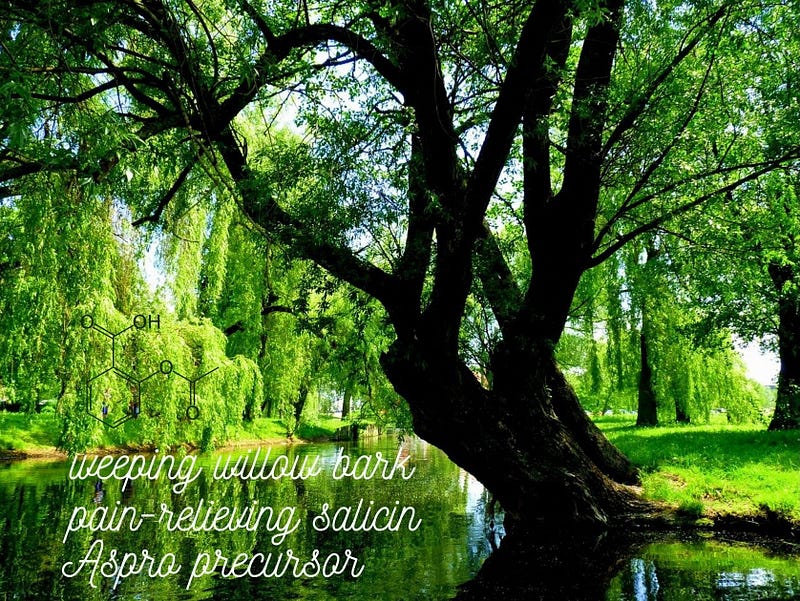
Image constructed by writer in Canva using photo by DeAngelis_Adam from Pixabay

Weeping willow bark Pain-relieving salicin Aspro precursor

© Carolyn Hastings 2021

This sciku comes with a long, convoluted story attached to it, a bit like the chemical bonds that go to make the C₁₃H₁₈O₇ salicin molecules. The cut-to-the-quick version is that it was written last year with another prompt in mind but never made it out of my notebook. I’ve just now rediscovered it!

It’s not the first time I’ve written about willow trees; in fact, I work them into my writings quite often. For all sorts of reasons, I find willows fascinating.

We all know that the willow is a water-loving tree often found lining riverbanks and waterways. Its wood is exceedingly flexible. Apart from making excellent cricket bats, willow wood is the wood-of-choice for witch’s wands and broomsticks!

Willow bark and leaves have long been associated with magical and medicinal properties. The Sumerians and ancient Egyptians, for instance, used willow extracts as an analgesic and anti-inflammatory and the Greek physician and ‘Father of Medicine’, Hippocrates, prescribed willow leaf tea to women to help ease the pain of childbirth*.

Many centuries passed before German chemist, Joseph Buchner, extracted the active ingredient from willow bark. He named the bitter-tasting yellow crystals, salicin*, a derivation of the genus salix to which willow trees belong.

In 1897, the German pharmaceutical company, Bayer, patented the process that chemically engineered salicin into acetylsalicylic acid. Two years later, they named this compound aspirin*. It would eventually bear the brand name, Aspro.

These days, aspirin is one of the most inexpensive and universally accepted non-prescription, non-steroidal drugs used to manage fever, aches, pains and inflammation. More recently, scientists have identified it as an anti-coagulant suitable for people at risk of cardio-vascular conditions such as heart attacks and thrombotic strokes. Case study data indicates that aspirin used as a long-term prophylactic is an effective treatment for reducing the incidence of gastro-intestinal cancers*.

I don’t know about you, but I now understand why willow trees have been a source of magical wonder and curiosity for me. Nature never stops providing for us. We have much to be grateful for. 🙏 💙

* Primary source —

I’m contributing this piece to Paper Poetry’s Poemorama, a global, month-long celebration of National Poetry Month.

As I said earlier, the sciku was originally meant for another prompt — one by R. Rangan PhD about ‘science related to engineering advances’, but in checking back on it now, Medium tells me the story is unavailable. 😕

Wow, I really am late! 😆

But, Rach, I did try. I did. 🙏 And as Lilie Kaizen, Thalia Dunn and Jenine Bsharah Baines will attest, it’s better to be late than never at all! 😅

Calling on our chemistry pro, Era Garg, and resident scientist, ScienceDuuude, to join Poemorama, plus anyone else who has an inclination for science-themed poetry. You’ll find all you need to know right here –

And before you go, please enjoy these wonderful Poemorama contributions –

from Kimberly Hampton Nilsson, Winds of Change -

from William J Spirdione, A Chickadee Choir

Thank you all for reading. 🙏 💕

Thank you in advance to David Perlmutter and Diana Meresc for their claps and highlights. David and Diana rarely leave comments, but they regularly clap and highlight my posts, and for that I am most grateful. 🙏 💙

✨ If you like what you’ve read and would like more —

👉 Subscribe to my email list and be the first to receive my latest Medium stories directly to your inbox. 📩 👉 Use my affiliate referral link to become a Medium member and have unlimited access to every Medium story including mine.

Sciku
Poemorama
Poetry
Aspirin
Willow
Recommended from ReadMedium