
Film Review
Maestro (2023) • Netflix — Bradley Cooper’s passionate, intimate tale of two Bernsteins
While Leonard Bernstein becomes a classical-music superstar, his private life is sometimes troubled…
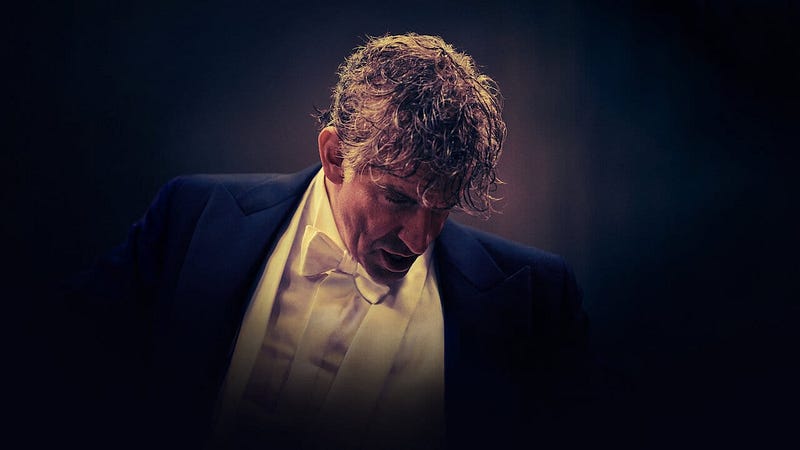


After Bradley Cooper’s directorial debut A Star is Born (2018) snagged the second-to-top spot on my annual best-of-the-year list (beaten by Paul Thomas Anderson’s Phantom Thread), I was encouraged to hear he’d be tackling a biopic of composer Leonard Bernstein — Steven Spielberg’s West Side Story (2021), with Bernstein’s music from beginning to end, had topped my 2021 list.
Spielberg himself, who ultimately became a co-producer, was once considered a potential director for Maestro. Yet it might be fortunate that it ended up in the hands of Cooper instead. For while his second movie is, as I also wrote of A Star is Born, “big, passionate, and just on the right side of melodrama”, he nevertheless delivers something a little more elliptical, and surely less sentimental, than Spielberg would have. Cooper’s Maestro makes its mission clear by quoting Bernstein’s assertion that “a work of art does not answer questions, it provokes them; and its essential meaning lies in the tension between the contradictory answers”.
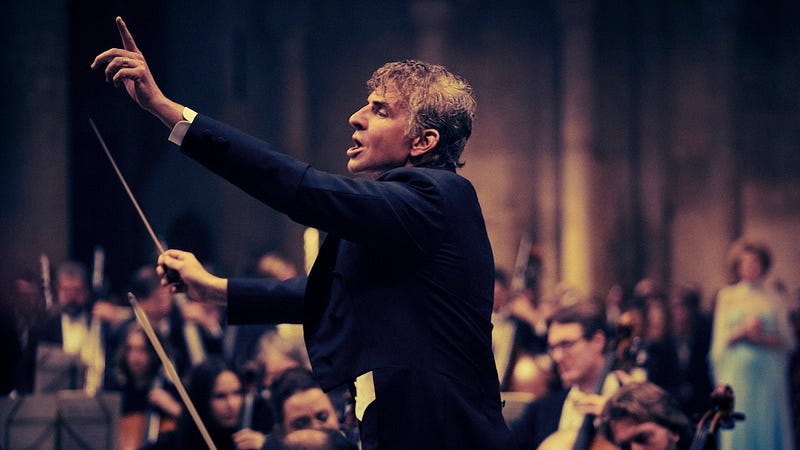
Like 2023’s other big classical-music movie, Todd Field’s Tár (which Maestro is exceedingly unlike in many other ways), Maestro opens with an interview. We see an elderly Bernstein (Cooper) seated at his piano, playing the postlude to Act 1 of his late opera A Quiet Place, and slowly realise that he’s being documented by a small camera crew. He speaks of “her” ghost, though we don’t yet know who “she” is.
The film now switches to black-and-white and hurtles back decades, to the mid-1940s. A much younger Bernstein is seen briefly with his boyfriend, David Oppenheim (Matt Bomer), before the famous phone call arrives, asking him to step in and conduct the New York Philharmonic at short notice — the occasion that truly launched him into the spotlight.
The film’s elegiac opening has given way to a much more exuberant mood. This shift is captured musically too, by the inclusion of the Symphonic Suite from On the Waterfront on the soundtrack. (The Suite dates from 1954, a decade after Bernstein’s 1943 Carnegie Hall debut; while Cooper’s movie remains faithful to the essential facts, it isn’t enslaved by the details.)
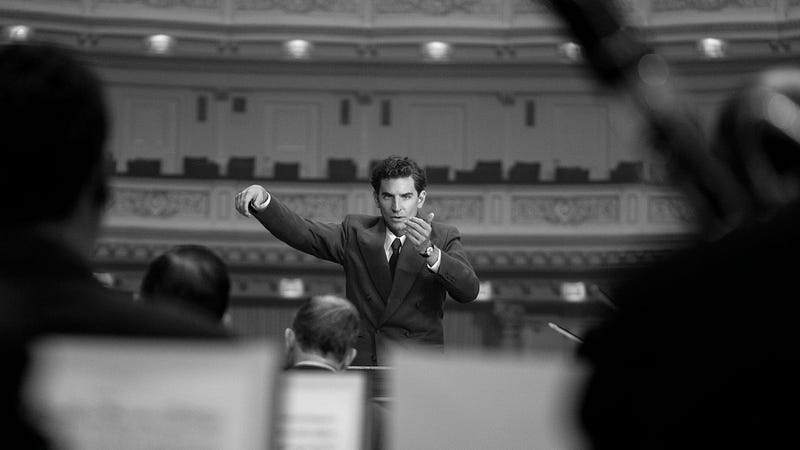
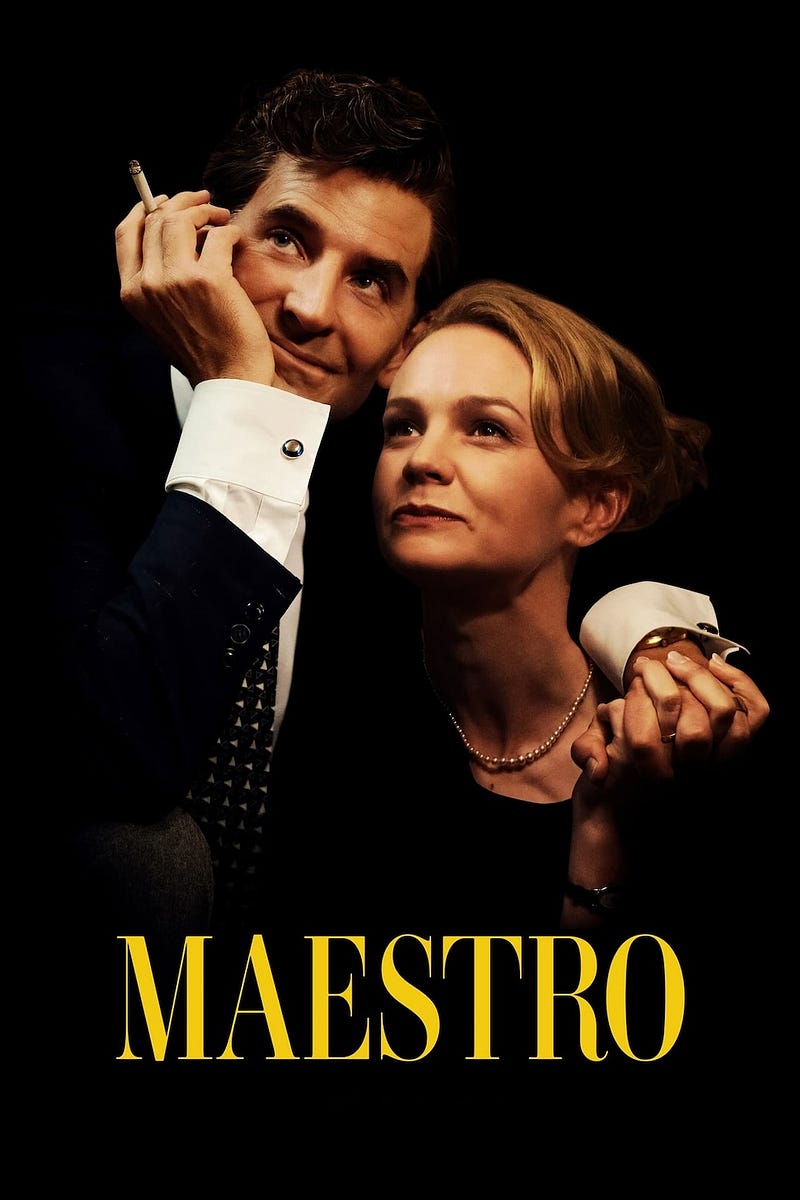
Before long, Bernstein also meets and falls in love with the young actress Felicia Montealegre (Carey Mulligan). The rest of the movie then provides snapshots of their lives, both together and separately, returning to colour roughly one third into the film’s duration.
Bernstein becomes the most celebrated American classical musician of his time, as both composer and conductor. Felicia’s career takes a more modest path but in their private lives, they have greater equality. They have children; Bernstein continues to have male lovers, notably Tommy Cothran (Gideon Glick). Felicia’s health declines, and perhaps Bernstein’s immense self-confidence does too. The Bernsteins host lavish parties for the elite and the intelligentsia, and indeed some of the film’s most telling moments come during these social events. Maestro’s focus, however, remains firmly on the central couple, making all other characters peripheral.
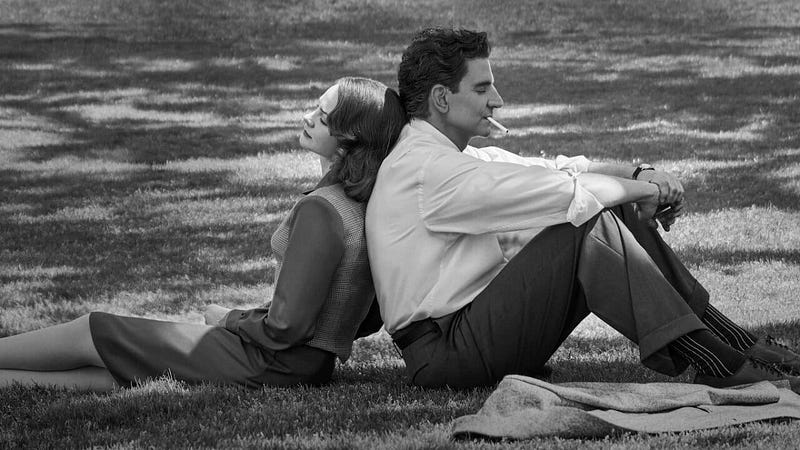
There is terrific chemistry between Bernstein and Felicia from the beginning, making the later partial souring of that chemistry all the more obvious, and both actors dazzle in very different ways.
Sporting a prosthetic nose and a delivery tinged with nasality, Cooper not only captures Bernstein’s appearance but also inhabits his essence across the stages of his life. His youthful portrayal brims with infectious, almost manic energy, and if it sometimes feels like he’s reciting lines that’s surely intentional, mirroring Bernstein’s penchant for performative pronouncements. As age mellows him, a calmer boyishness emerges, yet his ecstatic absorption in his conducting of music remains absolute.
He never becomes smaller, at least publicly; he just becomes, more and more, the dominant presence in every social or professional situation he enters. Felicia, in subtle contrast, quietly fades.
Cooper introduces her just like the movie star she wanted to be (approaching the foreground of the frame with a big musical theme swelling in the background, then pausing for the audience to admire her); and in her early relationship with Bernstein she is in some ways the dominant one. Felicia might be less excitable and quieter, but she has the measure of the young man and is tolerantly amused by him rather than awed. Later, though, some of her initial buoyancy turns to irritation and, eventually, to desperation. Perhaps Bernstein’s personal trajectory is not the unimpeded ascent it superficially looks like, but hers is more visibly a descent.
Playing a smaller role, Sarah Silverman shines as Bernstein’s insightful sister, Shirley. She serves as a valuable voice in the film, offering an outside perspective on his character through her perceptive yet detached observations. Maya Hawke (Stranger Things) also delivers a fine performance as Jamie, his slightly aggrieved daughter whom he lies to about rumours of his bisexuality. And Brian Klugman captures the essence of Bernstein’s close friend, the composer Aaron Copland, remarkably well. While Klugman’s physical resemblance to Copland might not be striking, it’s amazing what accurate hair and glasses can do…
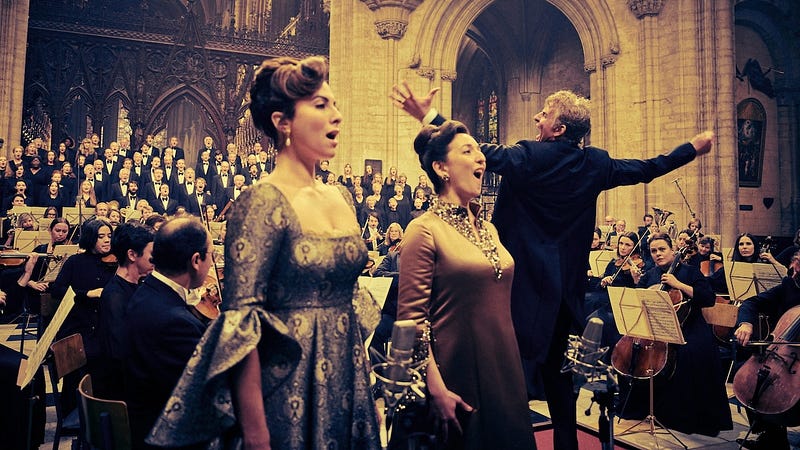
Bernstein’s music takes centre stage on the soundtrack, of course, though not entirely in expected ways. While there’s a fleeting excerpt from West Side Story, the film leans heavily towards his concert-hall compositions rather than his musical theatre scores. Even the chosen snippet from his very theatrical Mass opts for conventionality. Instead, the film’s most powerful musical sequence arrives when Bernstein conducts Mahler’s “Resurrection” Symphony at Ely Cathedral in England, in 1973.
Maestro avoids the Amadeus (1984) fallacy of linking a composer’s work directly to events in their life, and indeed largely avoids the process of composition itself. It also excludes a significant personal thread within Bernstein’s work: the Jewish-influenced pieces such as Kaddish, Halil, and the Chichester Psalms are not heard until the end credits.

This mirrors the film’s broader neglect of Bernstein’s Jewish identity. Apart from a few references to his father and a suggestion by conductor Serge Koussevitzky (Yasen Peyankov) to change his name to Burns if he wants to be successful in the United States, it’s almost unnoticeable. (Koussevitzky also proposes a “clean” life, implying pure heterosexuality.)
The de-emphasis of Bernstein’s Jewish heritage, alongside his prosthetic nose, has drawn some criticism. Yet Maestro’s core lies not just in contrasts, but also in deliberate omissions. The ironic final line spoken by Bernstein to the documentarians filming him (“any questions?”) reflects the way that we finish watching the movie with even more questions than we began with. This is not a film seeking clear-cut answers, but rather an invitation to delve deeper into the enigmatic man himself.
To Felicia, Bernstein describes himself as a “composite, which enables me to be many things at once”. To an interviewer in the 1950s, he acknowledges that his professional life is a double one, public-facing as a performer, and inward-looking as a composer. “I suppose that means you become schizophrenic,” he says, and the film is replete with dualities. This pervasive motif is brought sharply to life when Bernstein and Felicia play a “guess-the-number-I’m-thinking-of” game and the number is… of course… two.
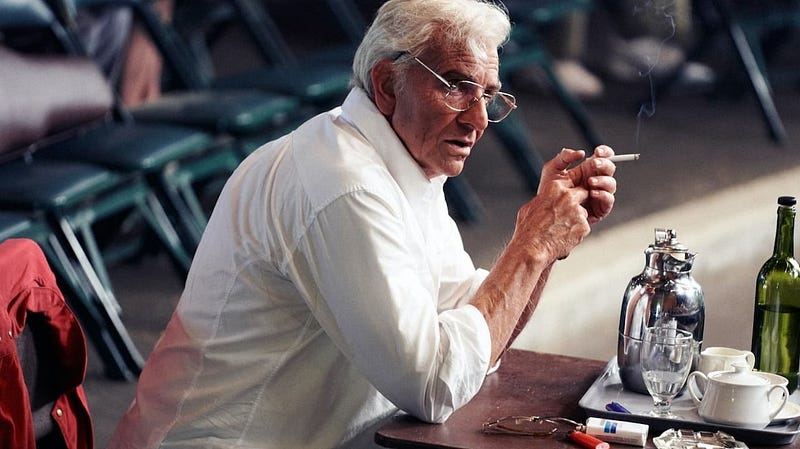
Structurally, there is the split between colour and monochrome: more conflict and unhappiness in the colour world, less of a sense of reality in the black-and-white one; perhaps it is a not entirely reliable memory?
There are contrasts in tone too. The first act can feel somewhat static, despite Bernstein’s infectious energy, passion and rapid-fire dialogue. But as the narrative becomes busier and more emotional — though never to the point that it excludes more reflective moments — he grows less frenetic and eager to impress.
Adding to the complexity is the obvious duality of Bernstein’s sexuality, presented as part of a voracious hunger for life and art in every form: “I want a lot of things”, he says, and though he’s surely referring to relationships he’s also referring to his desire to work in different musical idioms, to take on different roles as composer and conductor, and so on. The way that he happily mixes everything up is exemplified by a very telling late sequence where Bernstein gently and helpfully tutors a young conductor (Jordan Dobson) on the finer points of Beethoven, a grand old man of American music passing wisdom on to the next generation, and is then seen in the next shot boiling drunk with the same young man in a gay club.
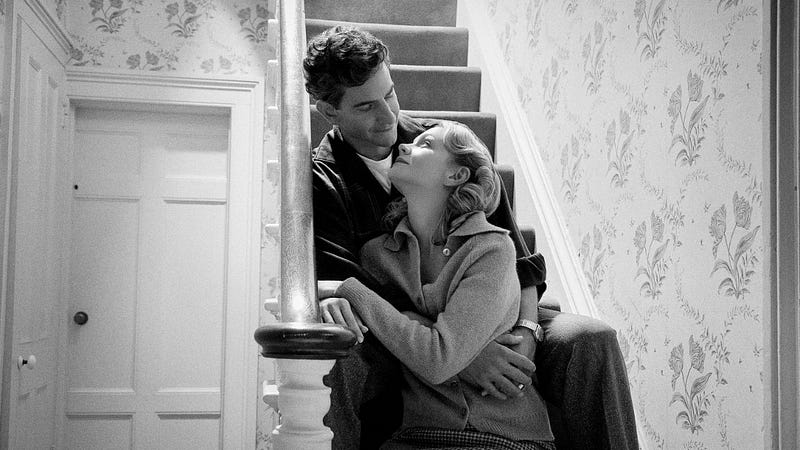
Some of these dualities are fleeting and inconsequential in themselves: for example there are two on-camera interviews, two instances of him piano-playing orchestral music and reflecting on the difference, and two rounds of the number-guessing game.
Yet these all hint at a deeper theme of duality, and of course, the whole movie is also about pairs: Bernstein and Felicia, public Bernstein and private Bernstein, young Bernstein and old Bernstein. As with the cut from the conducting class to the club, Cooper is much more interested in simply stating that these different things co-exist than in trying to impose a scheme of coherence
Cooper’s film is at times unusual in its pacing and texture. Changes in location and time are not always clear, and Maestro embraces occasional fantasy elements, such as a scene from Bernstein’s ballet Fancy Free seamlessly morphing into one from his musical On the Town: both staged in a vast, empty theatre solely for Bernstein and Felicia, ultimately involving them as performers too.
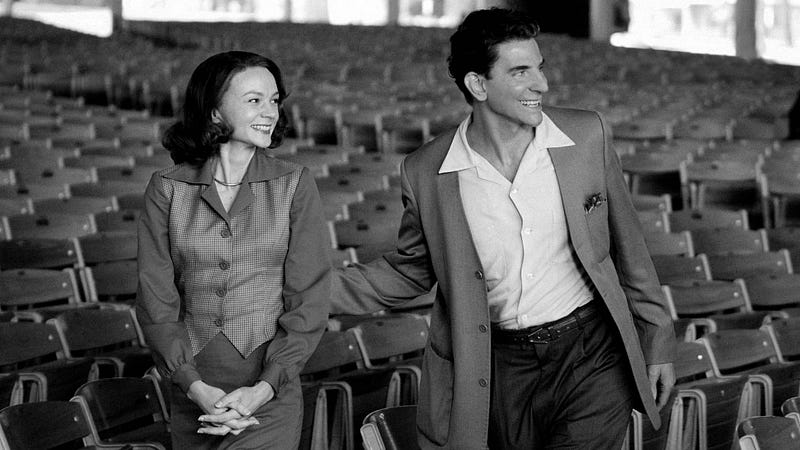
There are minor departures from the historical record, as well. For example, Bernstein met Tommy in San Francisco, not at the composer’s own house, and Felicia did not publicly reconcile with her husband in front of the Ely audience. They are, however, all rather unimportant in a film that is more impressionistic than plot-driven.
The film is far more enamoured of its subject than Tár (where he also briefly appears). However, it’s no hagiography: Bernstein certainly doesn’t come across as flawless, though no moral judgement is passed, any more than any grand explanation is proffered. While we may not fully grasp the nature of his relationship with Felicia by the end, the concluding image leaves no doubt of its profound reality, and that’s the important thing.
Maestro may not answer many questions, but it also seems to be saying that the music and the love (the two Leonard Bernsteins, public and private) are all we need to understand. Alongside them, the rest is mere trivia.
USA | 2023 | 129 MINUTES | 1.33:1 • 1.85:1 | BLACK & WHITE • COLOUR | ENGLISH

Cast & Crew
director: Bradley Cooper. writers: Bradley Cooper & Josh Singer. starring: Carey Mulligan, Bradley Cooper, Matt Bomer, Vincenzo Amato & Greg Hildreth.


Originally published at https://www.framerated.co.uk on December 22, 2023. All copyrighted images come under Fair Use doctrine in US & UK law.