MATURE FLÂNEUR
Madeira’s Micro-worlds
In a galaxy not-so-far away…
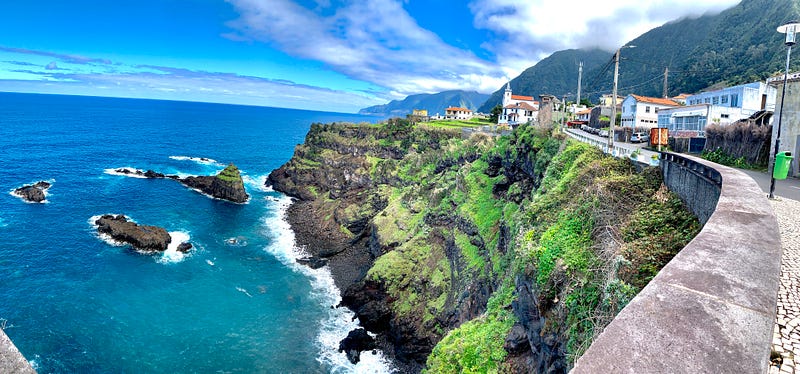
Madeira is a world unto itself. Or more precisely, “worlds.” The warm Atlantic winds swirl around the mountainous island’s many ravines and valleys creating a multitude of micro-climates.
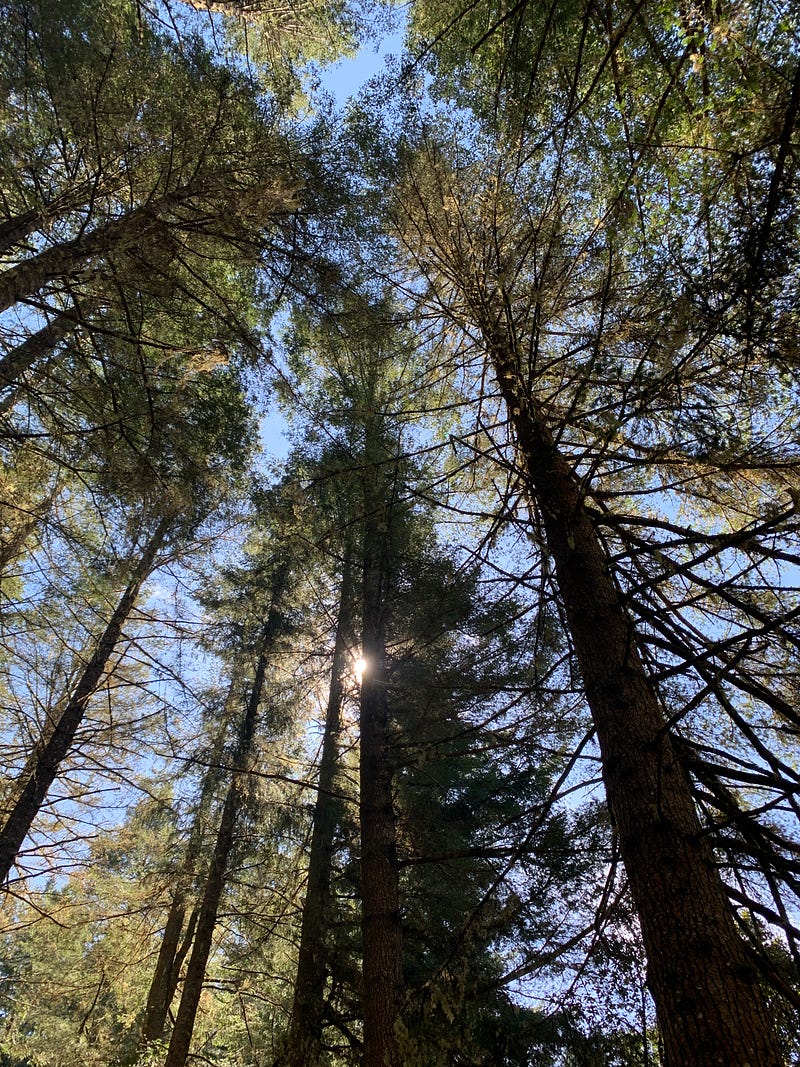
In some places, you find yourself in a cactus-strewn red desert; in others, a mist-covered forest of gnarled, black, ancient laurel trees. Around one turn of a winding road, you will find what looks like an English country garden filled with exotic flowers in a profusion of colors; around the next turn, grey cliffs drop into impossible green gorges that seem right out of Norway’s fjord lands. Here, a ritzy beach resort with people swimming in the oceanside pool in mid March. Is this Ibiza? There, a rolling hillside, purple with heather. Ach, are we in the Scottish Highlands? And now, a banana plantation — in fact, a whole banana belt! Oh, Now I get it, this must be the Caribbean! Ten minutes later we are lost in a forest of mast-high cedar trees. British Columbia, perhaps? …I’m not exaggerating about this, not at all.
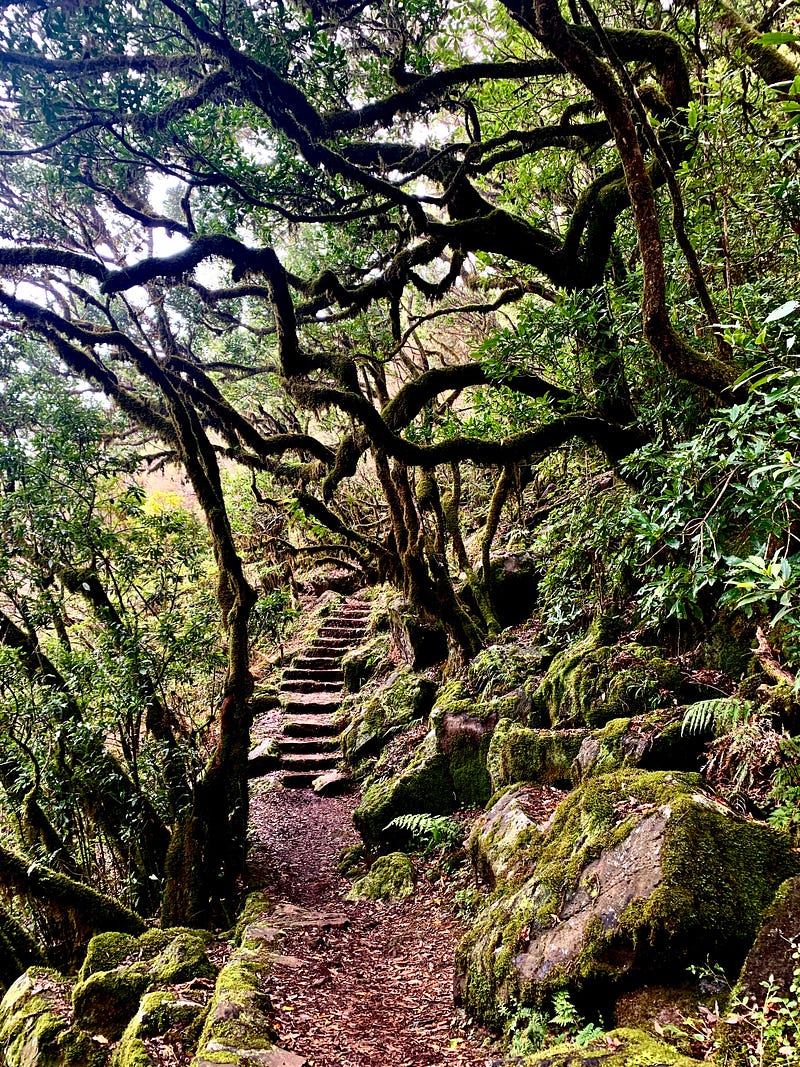
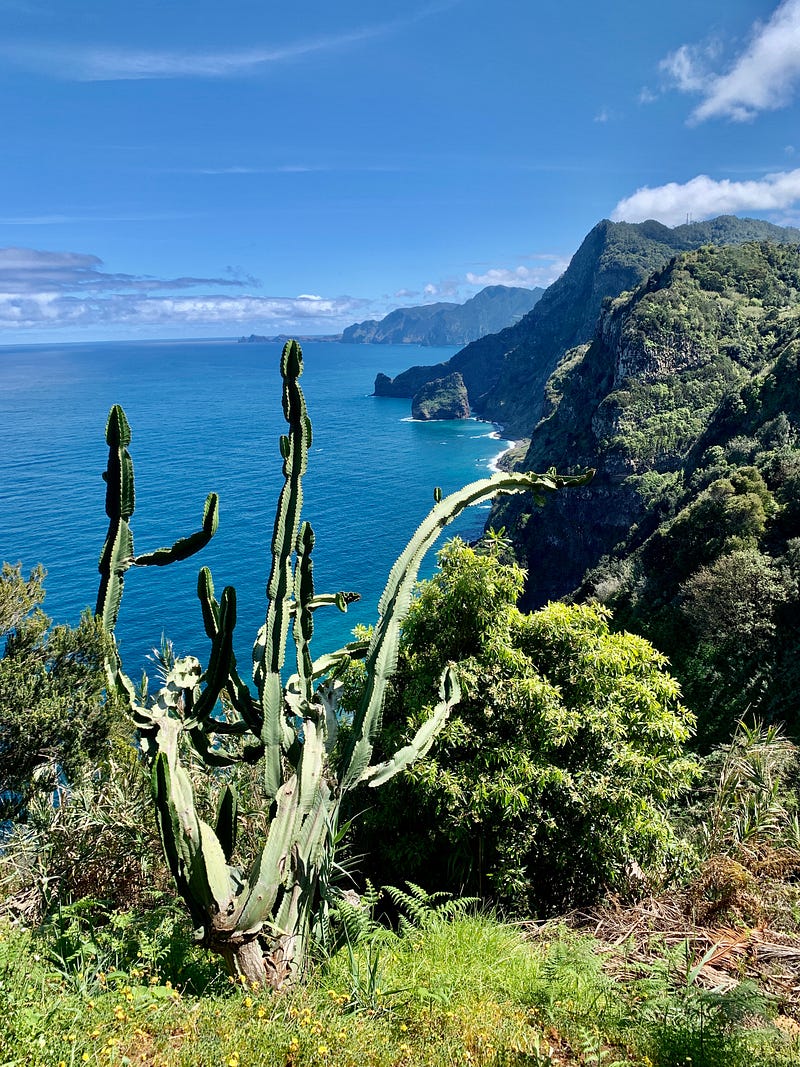
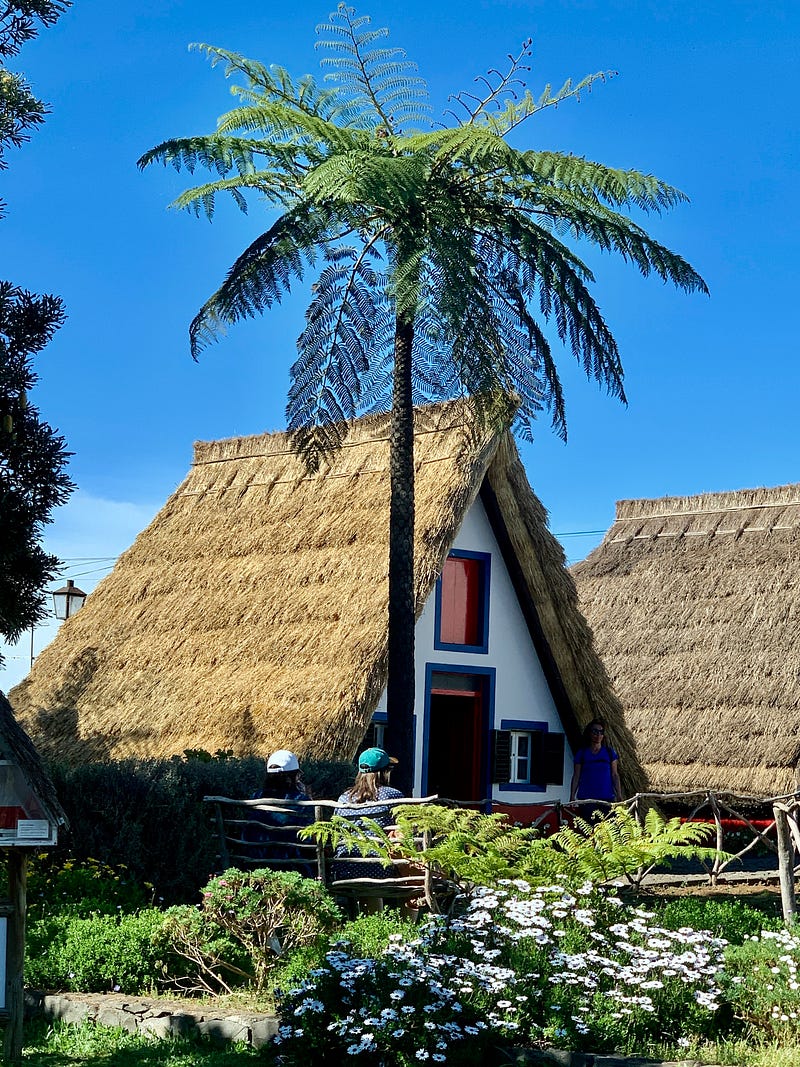
In fact, Madeira contains so many strange worlds, there is a Star Wars episode being filmed on the island this very week! (More on that in my next story).
Here’s how Teresa (my beloved spouse) and I flâmotored (i.e., flâneured by car) through several of these micro-worlds in just one day:
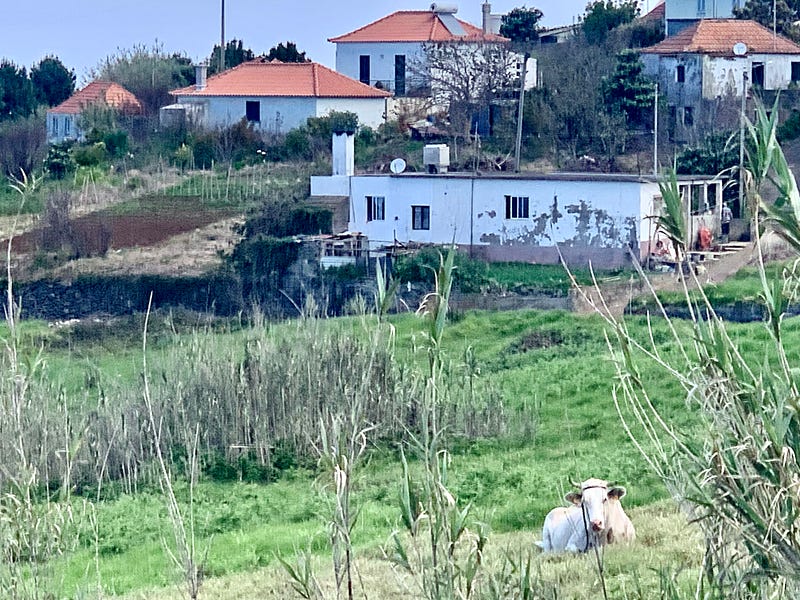
Our morning began in the pastoral little farming village of Ponta do Pargo, on the sparsely inhabited west coast. We woke up to a cow, mooing. She grazes in the green fields next to the little Air B&B house where we were staying and every morning shortly after sunrise she moos like our personal cow alarm clock. Beyond the cow, the tiered fields ripple out towards the steep red cliffs at a lighthouse at land’s end, reminding me of idyllic childhood summers I spent in rural Prince Edward Island.
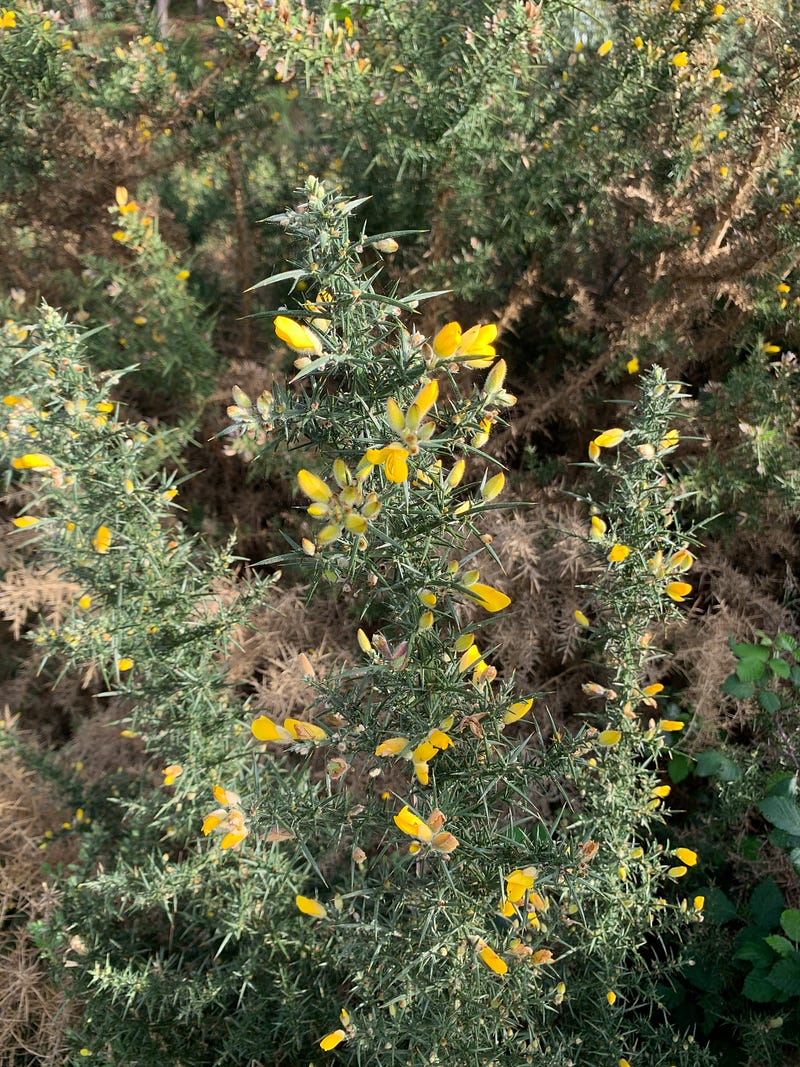
We drove up towards the island’s interior over a steep, winding road to a dry, bright-yellow moorland covered with dense thornbushes — common gorse — in full bloom. This is an invasive species on the island, and though pretty to behold, it chokes out all other plants.
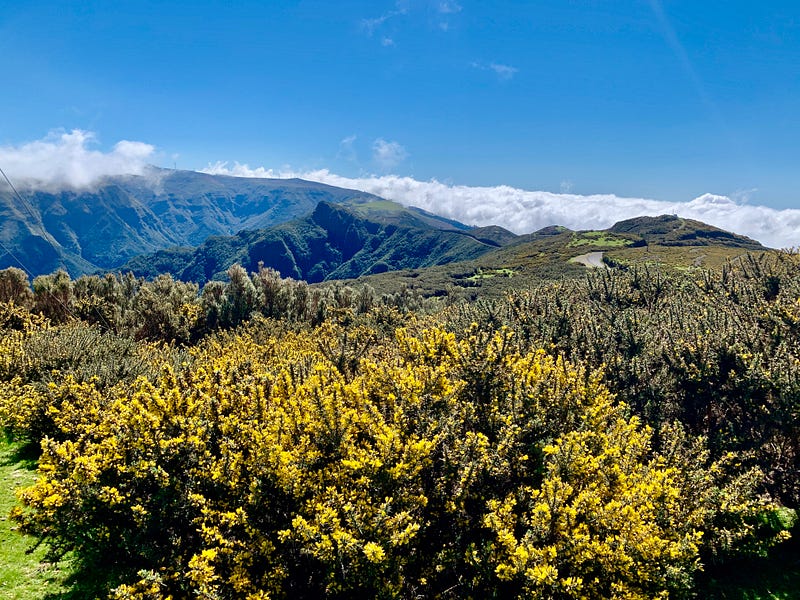
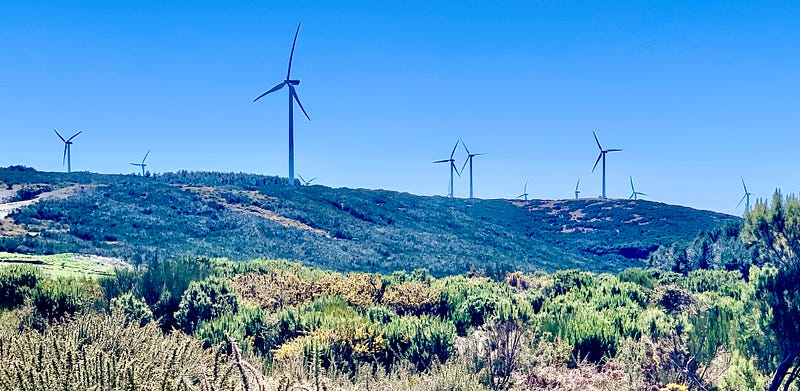
The R105 highway follows the ridge top that runs across the western half of the island. From the many roadside viewpoints, we could see across the upper valley of the Ribeira Janela where much of Madeira’s cedar forest remains uncut. The ridge merges into a high, flat plateau, formed out of one of the more recent volcanic eruptions several thousand years ago where nothing much grows. We passed an empty field newly planted with tree seedlings, but the real cash crop on the plateau now is — wind turbines. Dozens of them run in lines across the highest points of the plateau, as if some giant planted a garden of gargantuan white daisies. They make a low whooshing noise that fills the plateau.
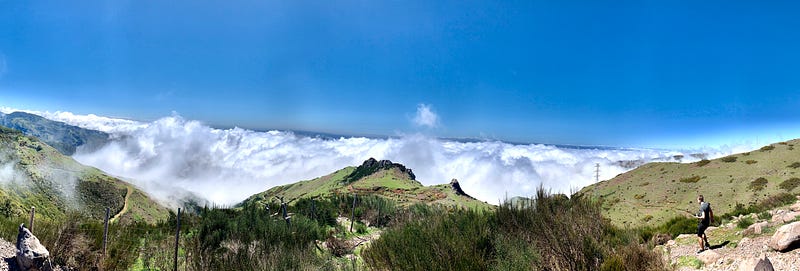
When Teresa and I reached the far lip of the plateau, the land fell away into a dramatic, impossibly vast gorge. Towards the south, it was covered with a swirling mass of mist that floated just below us. These mists form when warm air from the Atlantic passes through the cool river valleys, and then pushes up against the mountain ridges, condensing the moisture into low-altitude clouds, and producing a light rain of tiny droplets that turns parts of the island a lush green, and keeps the spring-fed rivers from running dry.
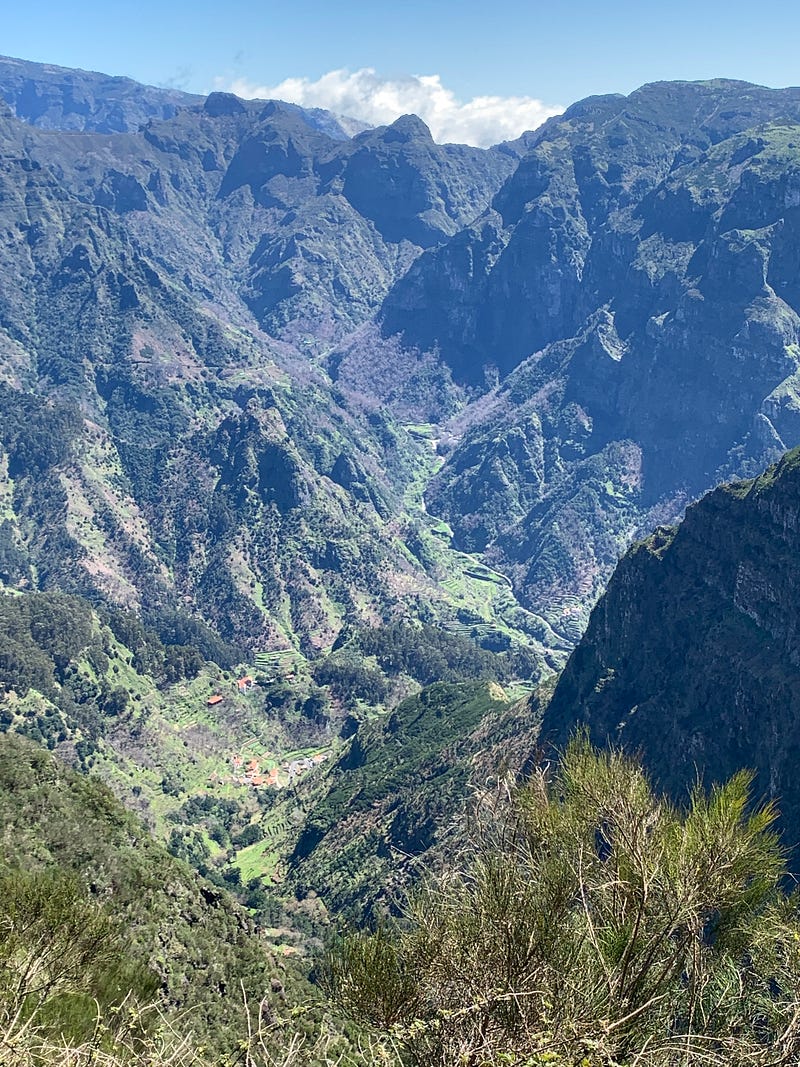
To the north, the view was clear, and vertigo-inducing, for we knew we had to drive all the way down to the bottom of a near-vertical Norwegian-style gorge. I can always tell we have gone from taking a drive to having an adventure when Teresa starts screaming and praying in the passenger seat. Nothing puts a smile on my face like her yelling, and I quote her verbatim here: “AaaiieeeefuckmejesusIcan’tlook!” I know she is truly appreciating both the gorgeousness of the moment and the preciousness of life. It really boosts my cortisol levels and helps keep me focused on steering around each hairpin turn.
The road finally flattens out at the Ribeira Brava (The “Wild River”) which runs north-to-south along a steep-walled valley that basically divides the island in two halves. We followed the expressway north through a tunnel and down into São Vicente, the main town on the north coast. We parked and strolled around the quiet old town. It’s just a few blocks of shops and cafes, with a big church and quiet park, like so many similar little towns we had seen all across mainland Portugal — except of course for the staggering green cliffs to either side of the river. Most of the community lives in little clusters above the river, wherever the land is flat enough for a house. As with other towns on Madeira, the streets connecting these clusters are fearlessly vertical.
We turned west at the ocean and drove along the VE2 expressway. This highway makes it possible to get from one end of the island to the other in less than an hour. Because Madeira is an eroded volcano, the coastline is a sequence of high cliffs and river valleys. The modern “VE” roads consist mostly of tunnels and bridges that link the remote little towns together in a more-or-less straight line. All round the island there are more than a hundred of these amazing new tunnels which must have saved millions of hours of driving, millions of litres of fuel, and probably a lot of lives and auto repairs, too.
“I hate these tunnels,” Teresa said, petulantly, as we whizzed along. “I know there’s spectacular coastline out there, but we are seeing none of it!”
Teresa very much wanted to take the old road, the Antiga RE101, touted by her guidebooks as the best way to see the coast. Built in the 1950’s, it used to be the only road around the northwest coast, and also had a reputation of being the most dangerous road on the island. Because it was built round the outside of the cliffs, it was subject to frequent rockfalls and erosion from the waterfalls. But, where ever we found an entrance to the Antiga RE101 it was barricaded shut with either chains or large wooden mobile fences. Pausing to consult the Internet, we discovered the old road is permanently closed — mostly. Behind the barricades and chains, we caught glimpses of rubble-covered and overgrown stretches of tarmac that were frightening to behold, like this one, below:
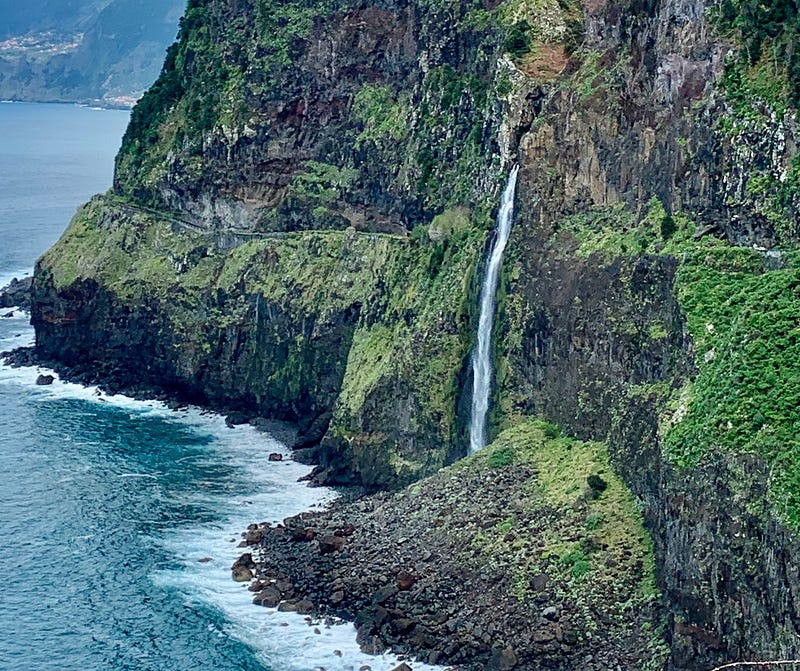
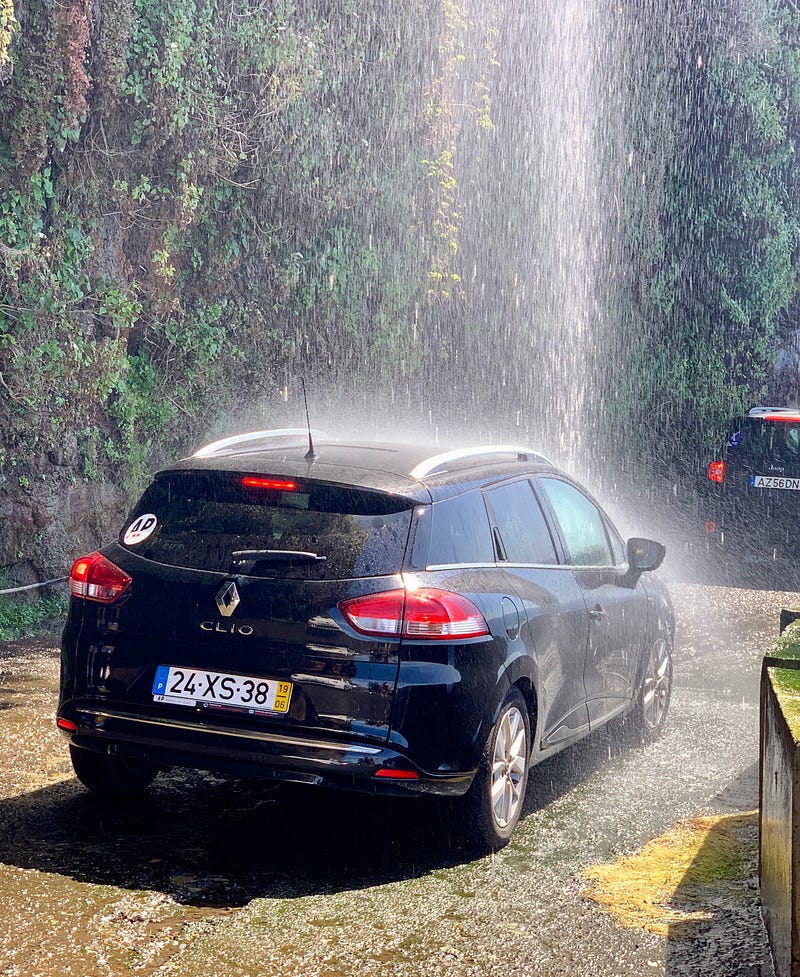
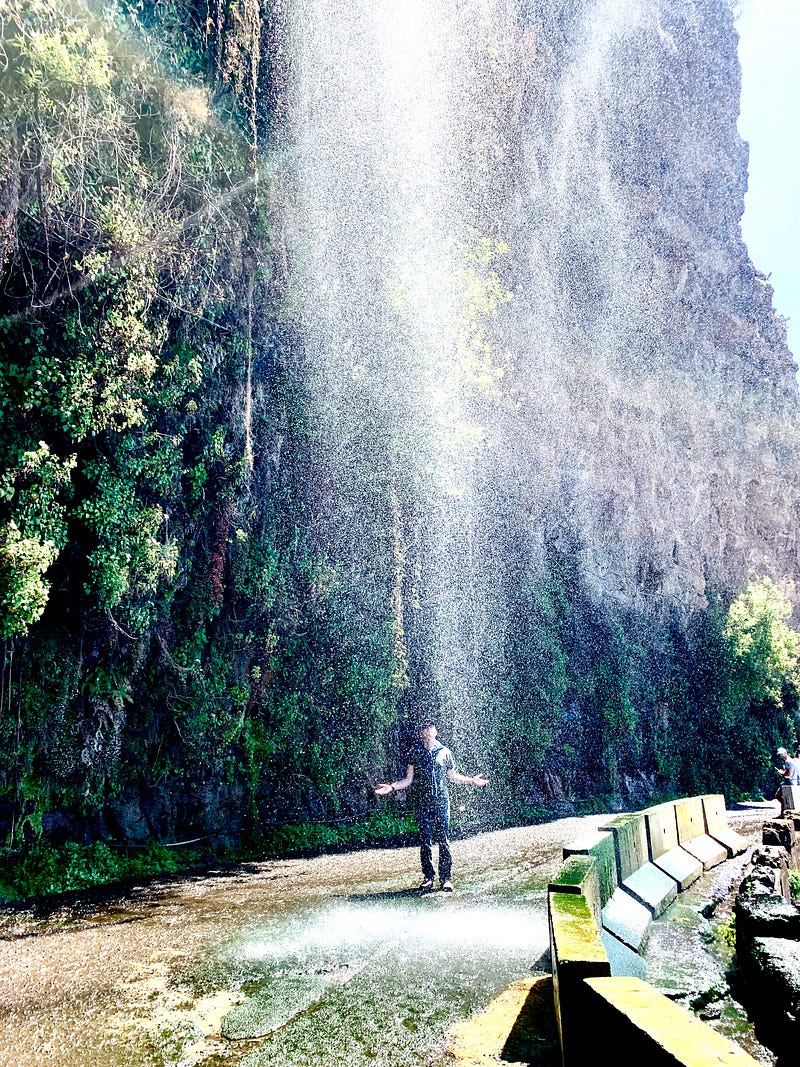
You see where the falls go right over the road, where there is an old hand-dug tunnel? These old tunnels are often wet inside. In some places, the waterfalls drop right onto the tarmac, like this one in the south at Ponto do Sol (below) which has a section open so that tourists can get their cars washed. (When we drove through, Teresa forgot to roll up her window, and so she got a free shower as well).
“Look! an antiga road entrance is open here! Turn, turn!” Teresa suddenly exclaimed.
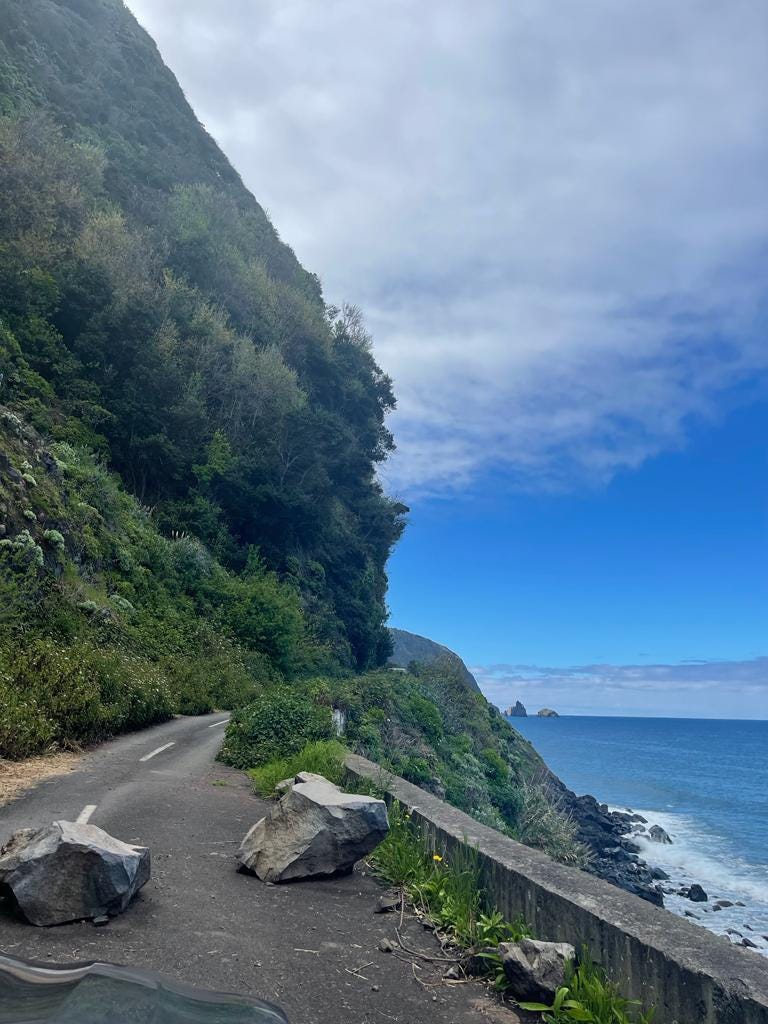
A patch of the old RE101 opened before us, and I dutifully veered onto it. Suddenly, we were driving on single lane pavement, strewn with piles of newly-fallen stone. The cliffs towered above us. “Don’t stop, keep moving,” Teresa said, anxiously, as we crept forward. We rounded a bend to find two massive rocks that looked like they pretty recently landed on the road. They left just enough room for us to squeeze past. Weeds now covered parts of the pavement. Ah, I could feel the cortisol surging again in my veins, helping me concentrate…on my prayers. Luckily, after a half mile or so, we found a side-tunnel that mercifully returned us to the VE2. That was our last adventure on the antiga road.
“I love the safe, happy feeling I get when I’m inside a big, dark tunnel,” I said.
At the hamlet of Ribeira da Janela — “River of the Window” — we stopped to admire two massive formations of hardened lava at the waters’ edge. A stone staircase leads up to a large hole in the lava. Even from a distance we could see light through to the other side — a window in the rock that seemed magical to behold.
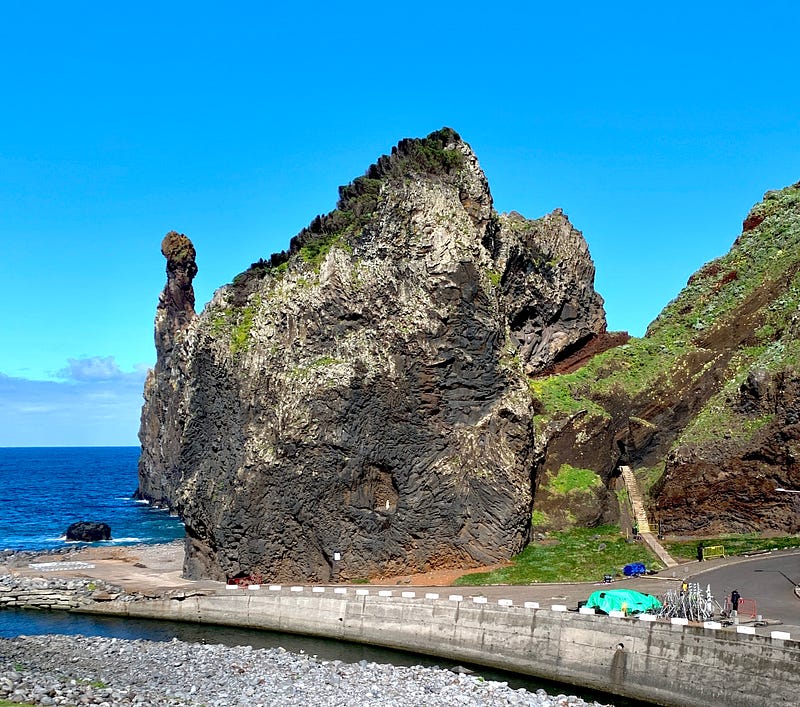
Unfortunately, we could not climb that staircase and peer through that magic window, because the path had been barricaded. A security guard also barred the way, while another stood nearby guarding a pile of aluminum lighting stands and other equipment. We realized we were looking at a film set for the Star Wars episode (apparently, a new TV series called The Acolyte). Sadly, we had left our light sabres back at our B&B, and could not hope to fight our way past the guards to that magical window. The Force was not with us.
Fortunately, the next and western-most town on the north coast, Porto Moniz, has plenty of lava formations for tourists to explore. In fact, the ocean lava pools are the town’s main tourist attractions. They reminded me of lava formations we had seen in Iceland. The raw lava looks as if it has been thrown straight from the mouth of the volcano, hardened in mid-air, and landed at the waters edge in weird, dark shapes. The pools themselves reflect the blue of the sky. They were filled with bathers, and we could only imagine that on this sunny day, the lava rocks had warmed the bathing pools.
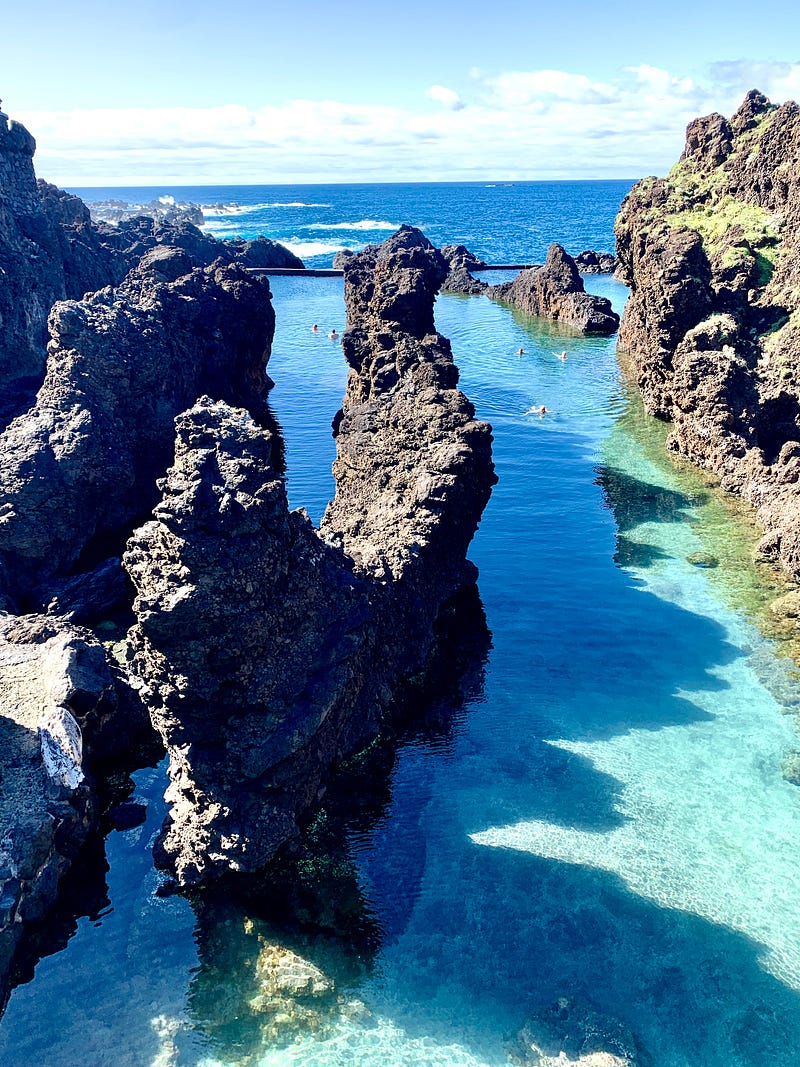
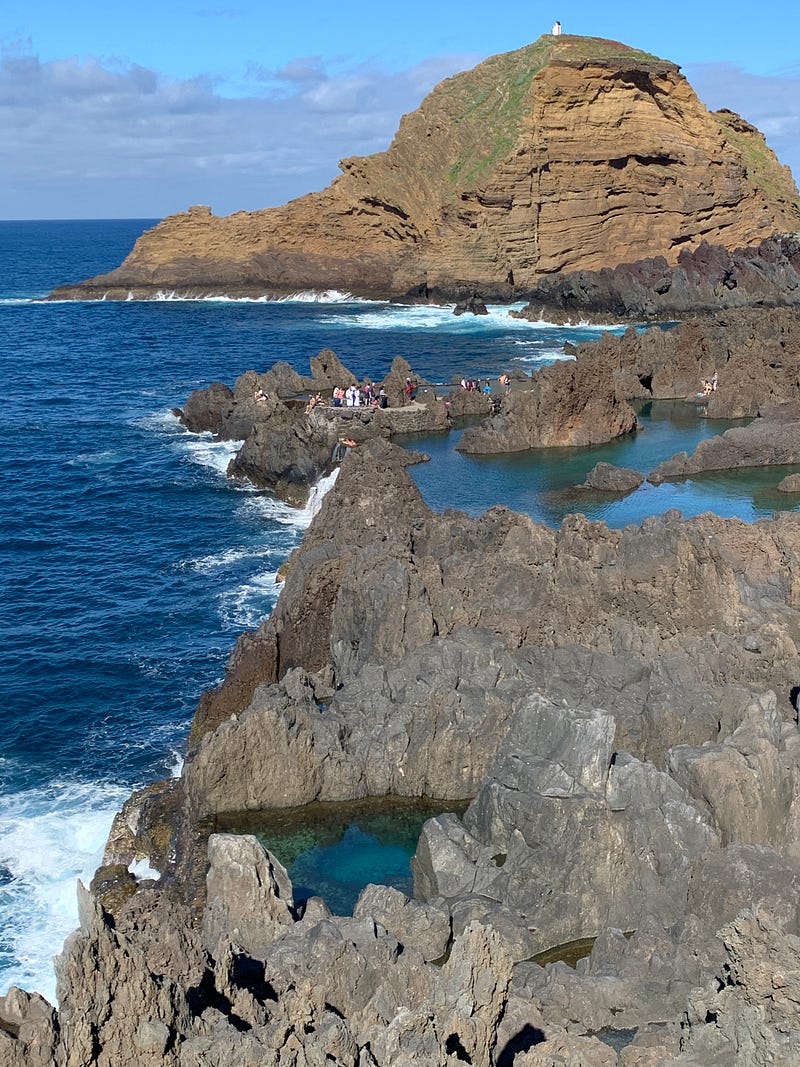
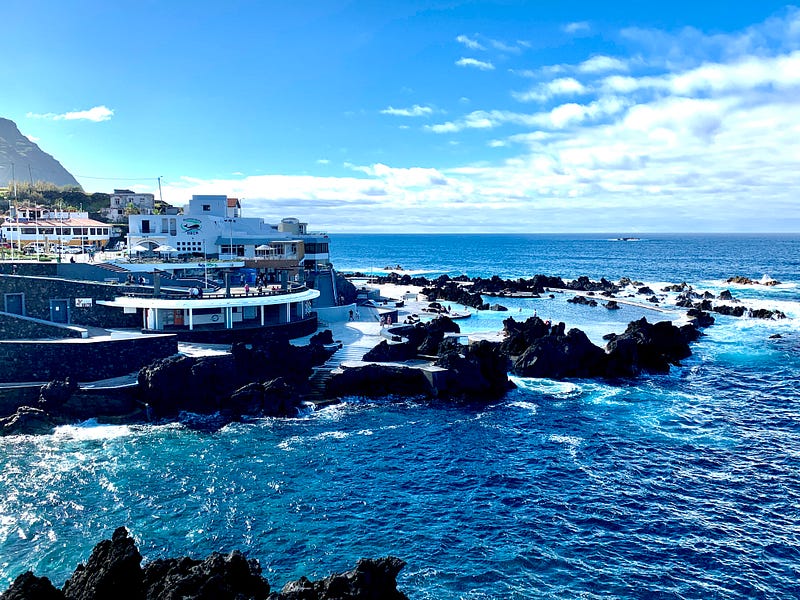
Tired after a long day of flâmotoring, we headed for home up another winding road up the cliffs and south over the western side of the island. Returning to higher altitudes, we entered a dark forest of tall eucalyptus trees. G’day! Somehow without leaving Madeira, we ended up in Australia. Eucalyptus were brought to Portugal from Australia in the 18th century, and from there on to Madeira, where plantations were grown for their fast-growing wood. But “fast-growing” also means fast spreading, and the giant trees have taken over parts of Madeira’s forest, squeezing out native species. But for the moment, we didn’t think about that. We simply rolled down the windows and enjoyed the relaxing, eucalyptus oil fragrance that filled the late afternoon air.
Returning to Ponta do Pargo before sunset, we felt as if we had been across the galaxy and back—back to our little farming village, our lighthouse, and our cow. Home, such as it is, for we two mature flâneurs.
Want more Madeira? You can find all six of my Madeira stories at the top of this list: