

Made to be Monsters: ‘Darkman’
When the man inside begins to change.
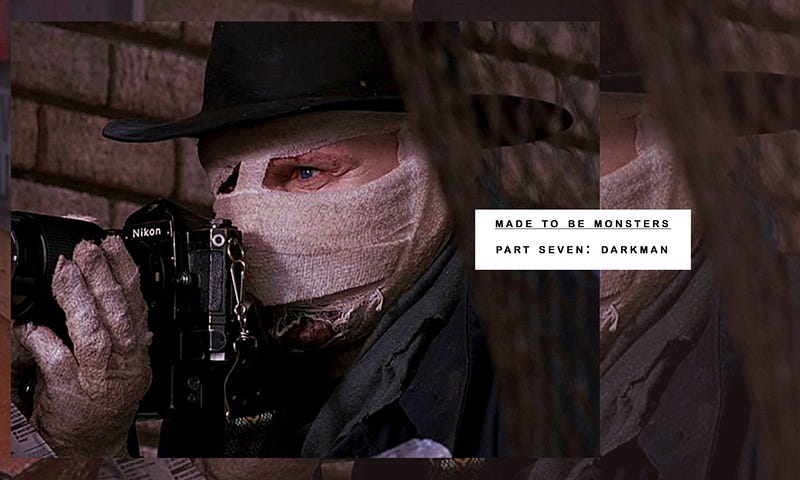
Welcome back to ‘Made To Be Monsters’, the series where I talk in-depth about my favorite films and why I think they’re secretly about the transsexual/queer experience. Remember: I am not trying to argue for the genuine, intended text of these films, and this is all in good fun.
You can find all previous and future entries into the series here!
Recently celebrating its 31st anniversary, Sam Raimi’s Darkman marks the second time the writer/director has been featured on this series! What can I say besides that this man has a finger to the pulse of Other’ed cinema, to the stories of societal outcasts and the journey of boy to Man. Although this film, released in 1990 to moderate financial and critical acclaim, has faded into the background for most superhero fans, I maintain that it is one of Raimi’s best, a true horror film within a comic book skin.
The story of Peyton Westlake (Liam Neeson), a scientist turned vigilante after being disfigured by a mobster, is a story of slow corruption, of a loss of identity resulting in further loss of humanity. It helped launch Liam Neeson into the American spotlight, as well as to prep Raimi for the Spider-Man trilogy twelve years later. And in the current landscape of Marvel and DC dominating the comic book film landscape, it’s a refreshing, darker take on the subgenre.
It is also, for the sake of this series, a film entirely concerned with the subject of identity, both literal/physical, and internal. A film that supposes an individual who is physically changed and must thus consider the question of what constitutes monstrosity in the eyes of the society, as well as in the eyes of the individual. A film that states that Darkman is “everyone and no one”, and solidifies its protagonist as another solid transsexual monster.
Darkman is an interesting departure from most of the films I’ve written about for ‘Made to be Monsters’. In most of these, I argue for why being perceived as monstrous is inaccurate or wrong in some fashion. But in the case of Peyton Westlake, we’re dealing with a character that is an actual, intentional monster. The character of Darkman is an intentional homage to the run of 1930’s horror figures by Universal, many of whom are tragic monsters themselves.
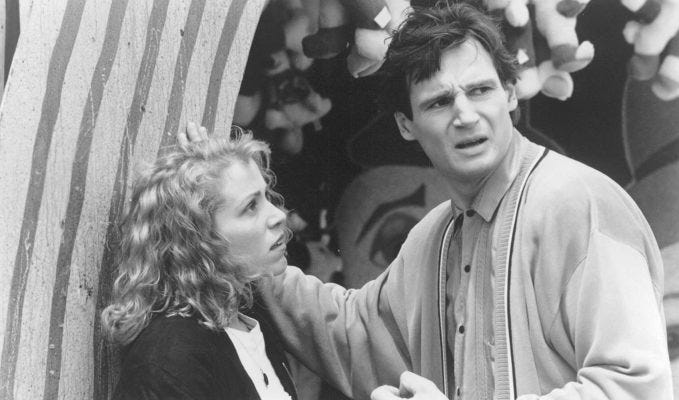
We start at the beginning, with a successful scientist and happy heterosexual Peyton Westlake. Peyton’s primary concern is the creation of synthetic skin for burn victims, and his inability to get it to last beyond 99 minutes. As the title may suggest, it turns out that the skin only remains stable in total darkness. This discovery comes right before Peyton is attacked, beaten half to death, and then blown up on top of it, resulting in his assumed death, much to the horror of his girlfriend, Julie (Frances McDormand).
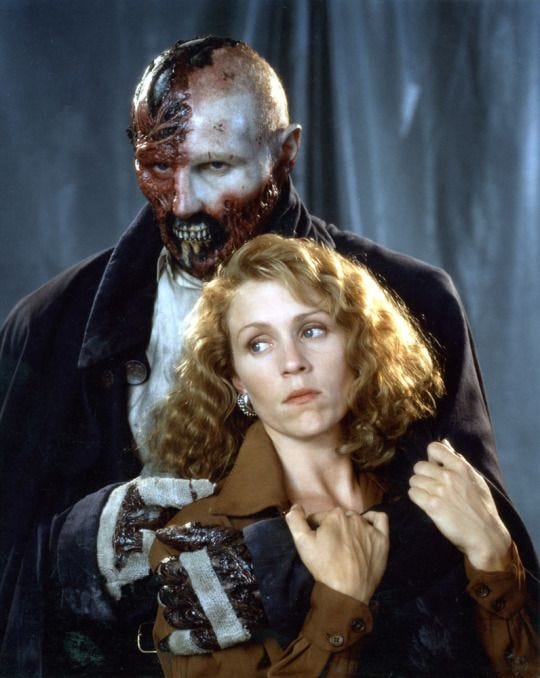
The early introduction of the skin sets up the “split” element that will be present throughout the rest of the film in regards to Peyton. By the end of the first act, he has been well disfigured and deformed. It is only through use of his synthetic skin that he is able to walk the streets with any semblance of normality, at least in the way that he knew it to be previously. But there is a catch: this skin can survive indefinitely in darkness, but daylight causes it to erode and break apart after 99 minutes.
This means that while Peyton has survived his attack, he no longer has the ability to live the normal life he once knew. Thus, consumed by the grief that comes with realizing he cannot return to his previous life until he truly perfects the synthetic skin, he turns his focus to vengeance. He tracks down the man responsible, Robert G. Durant (Lary Drake), and starts to pick off his henchmen one by one. That synthetic skin also functions as the perfect disguise, allowing Peyton to infiltrate Durant’s gang and avoid immediate identification. At the same time, he uses the synthetic skin as-is in order to reveal himself to Julie again, hoping to rekindle their relationship without revealing his deformation.
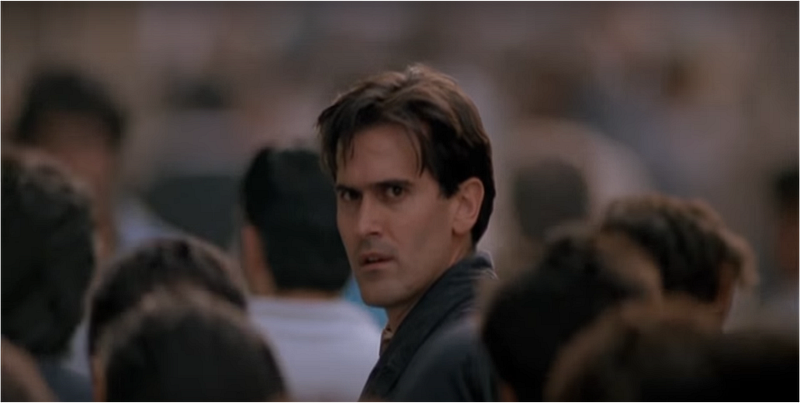
As one might expect, the two lives he attempts to lead do not stay separate for very long. Peyton’s synthetic skin very quickly fails in the daylight, which reveals his disfigurement to Julie; her reaction is mixed, genuine horror fighting with love for the man she had previously mourned the death of. And by the end of the film, despite witnessing Peyton murder the rest of his previous assailants, Julie is vocal about her persisting love for him. But Peyton, rightly or wrongly, comes to the realization that he is no longer the man she fell in love with. And he vanishes, once again using his synthetic skin to blend in with the faceless masses of the unnamed city, a man capable of hundreds of identities that are not his own.
First, let’s discuss that skin. The synthetic skin is used for two primary functions: to disguise Peyton so that he might take revenge, and to assume brief normality so that he might attempt to repair the life he was just starting to build with Julie. The skin therefore functions as a means of deception, both intentional and as a means of day-to-day survival. But the problem with the skin is its lack of permanence. Peyton cannot simply put on this skin and resume a completely normal life, because of its 99 minute lifespan in sunlight. He can only pretend he is “normal” for so long, before reality kicks back in and he must contend with the body he has.
And this loss of true face fundamentally changes everything about Peyton’s life. Although there are frequent conversations about how he is still “the same”, despite his disfigurement, it becomes clear to the audience that Peyton has changed significantly both in terms of personality and goals. Although he is far from having a choice in his initial disfigurement, he, I think, has an active choice in deciding his humanity has been immediately lost, and acting accordingly. As a result of the disfigurement, he suffers from heightened emotions, which in turn are also harder to control and which lead to outbursts of anger (much like the early results of HRT, actually) (and one of the funniest scenes ever committed to film).
The film briefly toys with the debate between vengeance as justified versus vengeance as an unhinged response, but ultimately that debate doesn’t hold much concern to the story. Peyton never sits back and considers his actions until the end, when all is already said and done. And by that point, he is different. He is violent and angry, despite his desires to stay “the same”. But there is no “same” for him to return to. The false skin will never be perfected, there will never be a way for Peyton to ignore what he has become in order to blend back into normal society.
“[If] I covered it, hid behind a mask, you could love me for who I was, inside. [But] as I worked on the mask, I found the man inside was changing. He became wrong, a monster. I can live with it now, but nobody else can.”
That’s not to say that by the end, Peyton is a bad person. Because he’s really not. He’s capable of doing horrible things, but usually only when provoked and for the sake of a sort of justice.
Peyton’s monstrosity is one of those sort-of kind-of things, where you have to weigh how he views himself, how his close associates/friends view him, and how the society at large views him. In the case of the first and last point, both view him as monstrous by virtue of appearance and existence alone. Peyton is unsure of his own humanity, viewing himself as barely living, hobbled together by science and his own desire for love. Julie (by virtue of being the only loved one left alive) is the only one who still sees Peyton as a man, not a monster.
The story of Darkman and of Peyton Westlake is one of violence, vengeance, and identity. There is no definable line where one begins and one ends; they inhabit one body despite a definitive difference in personalities. A body that was destroyed for a random and seemingly pointless reason, but one that Peyton was able to somewhat reconstruct.
It’s no longer the body he knew, but there is no doubt that it is his body. Darkman is one of many self-made men that have been covered in this series, a person forced into their situation of other-ness but who ultimately leans into their monstrosity as a way of returning the violence done onto them by society.
He is everyone, and no one!