
Macro Investors See Bitcoin’s Base Case As Hitting $500K at the 2025 Market Peak — It’s A Signal Worth Watching.
You’ll see why everyone is wrong about a bubble.

People hang off of dopamine-fueled price prediction buzzwords like crack addicts.
Like Warren Buffett famously said, “Forecasts may tell you a great deal about the forecaster — they tell you nothing about the future.”
He’s right, but where there’s significant uncertainty, people try to anchor themselves to an imaginary price target like some comfort blanket.
Bitcoin has skyrocketed more than 60% since the ETF frenzy kicked off a few months back.
It’s sparked a wave of comments from my readers about whether this will be a “buy the rumour, sell-the-news event”.
My honest answer is that I don’t know, and as Uncle Buffett explained, nor does anyone else.
I used to get tied up in guesswork or anticipating short-term price dynamics because I had this immovable and ‘make-believe’ entry price, like getting in under $30,000.
It means very little when you scan out a bit and if BTC goes to $500k, as predicted.
It spoke to my need for more patience and a longer-term mindset.
I’m now a buy-and-hold person. If you’re a day trader, more to you, but this isn’t the blog for you.
Over seven years of being in Crypto, I realised it pays to play the long game because it works like a jujitsu mindset hack that acts as a shield from all this short-term noise.
It’s something I could only do once I made the mental switch to thinking, “This is money I CAN afford to lose”.
When you see it as ‘house money’, this weird thing happens where you view those stomach-churning 30%+ drawdowns as an opportunity.
Once I started focusing on the structure of how I was applying myself and not trying to anticipate some imaginary end target, everything in the middle became noise.
What changed was when I used the business cycle as my framework and starting point, which helped remove the emotion and gave me the confidence to navigate the uncertainties.
I’m a regular guy, but I stole this strategy from Marco Investors, who use it to squeeze the juice out of an investment because the business cycle provides a predictable pattern of phases, from where we are now in expansion, peak, contraction, and trough. It’s guided me with more robust forward-looking indicators.
This stuff is simple, but Crypto Bros twist themselves into knots trying to sound like geniuses.
Since 2008, when “everything reset”, the business cycle has mirrored several other wild cash-loaded events.
And as a famous Marco investor once said, “When liquidity changes, everything changes”.
All the below impact liquidity and happen approximately every four years in sync.
People call it a “Macro secular trend,” which is a broad, long-lasting trend affecting the overall economy.
- Business cycle
- Liquidity Cycle (stimulus)
- Gov Debt Refinancing
- Election Cycle
- Bitcoin halving
Raoul Pal, who I often reference because he’s one of the few macro investors to put his neck on the line publicly, says — “I care about secular trends, secular cycles when you get them and capture them in the right point of the business cycle they become explosive.”
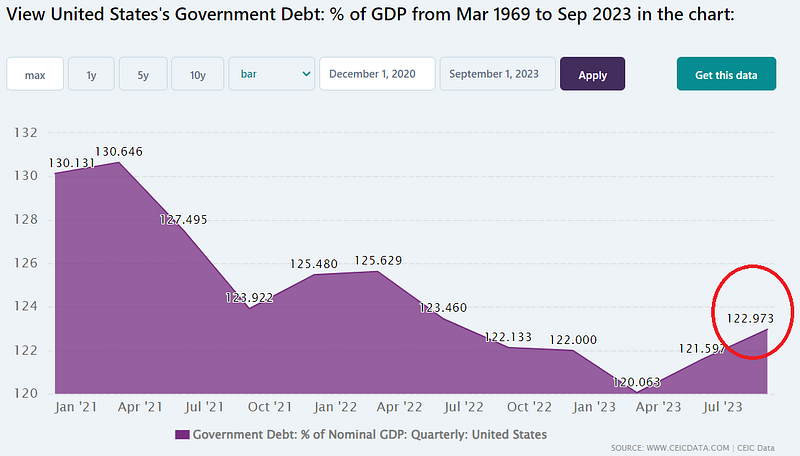
According to Pal, the global economic reset happened when all significant economies reached 100% debt to GDP.
In other words, the world’s economies borrowed more than they produced in output, and America is leading the race at 122.97% Debt to GDP.
The trend is down for now, but stimulus is set to return in 2024.
This constant band-aid of periodically printing money to maintain economic stability led us to the point of no return, where continuous liquidity is necessary to sustain the economy.
And with more money inflow, asset prices continue to increase optically while your money loses its purchasing power.
While the harmful long-term effect is the debasement of the currency, with ham sandwiches costing $29, increased liquidity has a stimulative impact on assets like Bitcoin.
As you can see on this chart, BTC is measured against the M2 money supply, the most basic measure of all money in circulation, and they mirror each other.
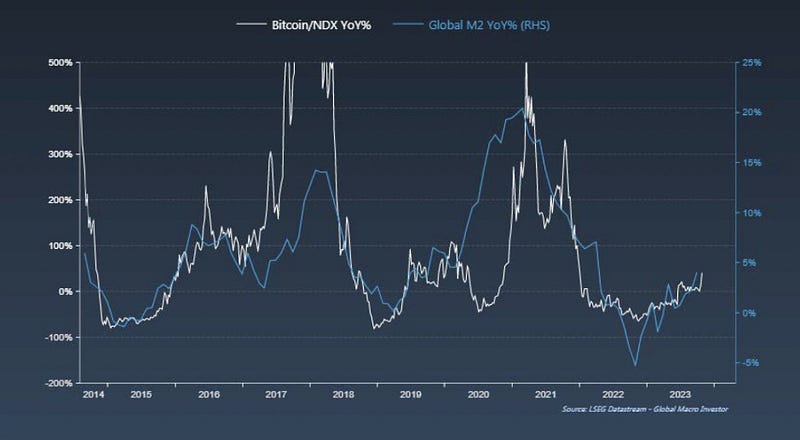
Pal expects a substantial rise in crypto asset prices, with Bitcoin reaching over $200,000 per coin after the halving around May and possibly up to a million dollars per coin by the end of 2025 or early 2026.
Raoul Pal — Source
“We think the business cycle peaks sometime at the end of 2025, and that would suggest a crazy sort of target that could get somewhere between half a million and a million dollars in Bitcoin.
Do I expect that? Probably not, but who the hell knows, right? These cycles can be crazy, and this one feels more like the 2016–17 cycle, and that cycle didn’t have a lot of Central Bank stimulus: well, not in the US, but central bank balance sheets were rising. We saw 20% growth in liquidity, and what happened was Crypto exploded.”
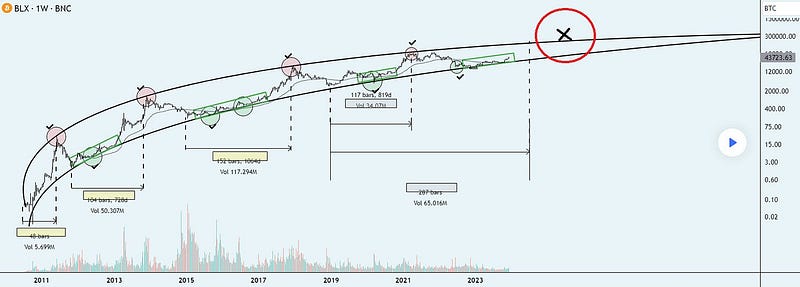
Pal says that if you zone out, you can see a perfect logarithmic chart and a smooth trend line, which shows a constant uptick, but many people have this “bubble and bust” view from the early internet days of 2000.
He says that because of liquidity, “It can’t happen”.
Raoul Pal — Source
“I don’t see any elements of a bubble — it’s just a normal trend that eats all other equity sectors alive. There is no point owning other stocks — every other bet is suboptimal to Crypto in this world where everything is correlated.”
All the log chart shows is the rate of change Bitcoin is making and the percentage increase after each leg up of the cycle, assuming that pattern continues.
So imagine the next leg up, where the X is marketed. That’s around a $600k BTC price.
Final Thoughts.
I don’t have a crystal ball.
But using these forward-looking indicators will give you an idea directionally.
Ironically, Cathie Woods Investment firm Ark Invest, who have applied for a Bitcoin ETF, have come up with the same base case.
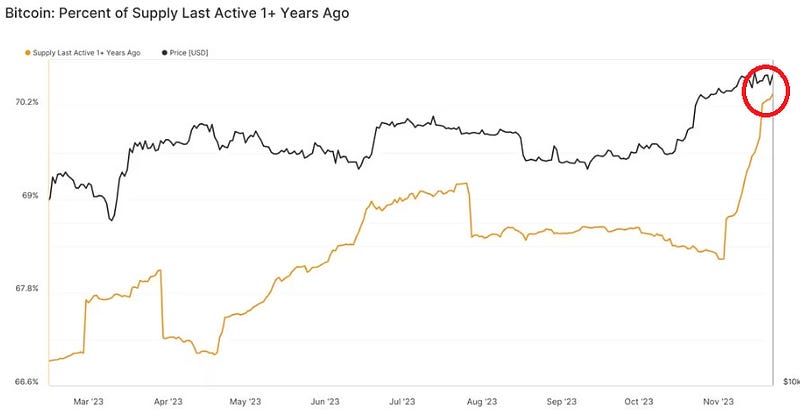
Over the next two years, we will be more digital, not less, with fewer people selling Bitcoin. Almost 71% of BTC has not moved for one year + which reduces the chances of it ever being sold.
People aren’t selling.
It creates a fascinating discussion about supply and demand dynamics and a potential cascade effect.
It’s not surprising that many see this as a significant opportunity.
Want to be notified whenever I publish a new article? Join 2,000+ people here. It’s free & you can unsubscribe at any time!
This article is for informational purposes only — it should not be considered financial, tax or legal advice. You can consult a financial professional before making any significant financial decisions.
Visit us at DataDrivenInvestor.com
Subscribe to DDIntel here.
Have a unique story to share? Submit to DDIntel here.
Join our creator ecosystem here.
DDIntel captures the more notable pieces from our main site and our popular DDI Medium publication. Check us out for more insightful work from our community.
DDI Official Telegram Channel: https://t.me/+tafUp6ecEys4YjQ1


