
Machine Learning for Kids — Decision Trees
In the world of machine learning decision trees are commonly used for classification (is it a dog or a cat?) and regression problems (how much should I sell this house for?)
As the name suggests a decision tree is used to make decisions, or at least help you make them. So you might be asking yourself, what sorts of decisions can these trees help me make?
- How much should I sell this house for?
- Should I play golf today?
- Does this patient need this operation?
The list can go on for miles, but hopefully you get the idea that the range of uses for this technique is almost limitless and is not restricted to a particular field.
So you want to go for a walk?
Please don’t go for a walk right now, stay and read the rest of this article and then go if the weather is nice.
What do you think about when you decide to go for a walk?
- Is it hot or cold outside?
- Is it raining?
- How windy is it?
Now, these are just a few factors that may influence your desire to go for a walk. There can be many others, but for now we shall keep to these three. The table below shows all the combinations for each factor and whether the person ultimately went for a walk.
By using a decision tree a computer would look at this and firstly check what the temperature is going to be. Is it hot or cold?
Let’s say it’s hot. Next, the computer would check to see if it’s raining. If it was then the chain would stop and say no to going for a walk. If it was not raining then it would respond with yes, since the information it has says that the person would go for a walk in those conditions even if it were windy.
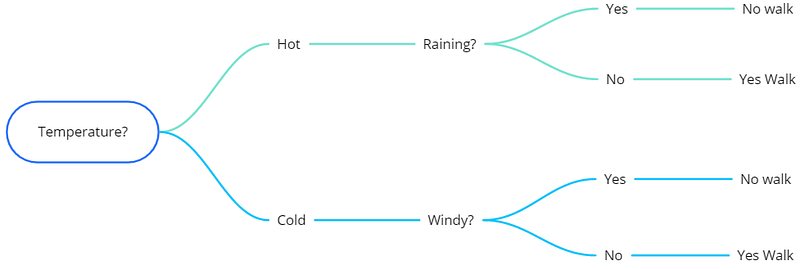
This is a very basic example of how a decision tree may be used to help make a decision based on past events or experiences. The number of factors a decision tree can handle is huge, and it is easy to see how the computer is making the end decision compared to other machine learning models.
The following video provides a great introduction to how decision trees are created and also has Python code that you can use to build your own tree if you want.
If you want more examples of decision trees and their uses, I recommend the following GitHub repository which has some wonderful examples showing a range of questions that have been raised.
Decision trees are one of the easier to understand machine learning models out there, and consequently make a wonderful starting block to introduce a child (or adult!) to the world of machine learning.
If you are looking for a more practical introduction to decision trees that also gets your child doing a bit of coding, then some wonderful tutorials using Scratch and Python can be found here:
The Machine Learning for Kids website provides a range of lesson plans for teachers and parents to help them teach their children the field of machine learning in a fun and engaging way.
I look forward to writing more on this and other topics soon and hope that you will get something out of it too.
If you would like to read more on teaching your children computer programming and data science then you can read some of my posts on this topic in the following links.
If you have enjoyed this article then please connect with me via LinkedIn or Twitter.


