avatarMax Deutsch

Free AI web copilot to create summaries, insights and extended knowledge, download it at here

1309

Abstract

I will need to especially cheat if I want to cut my solve time by a factor of three.)</p><p id="9739"><i>Cheating</i> takes two forms: 1. Checking and 2. Revealing.</p><figure id="5a7f"><img src="https://cdn-images-1.readmedium.com/v2/resize:fit:800/1*8FBHwwnaVMvoTaKn16YtCQ.png"><figcaption></figcaption></figure><p id="a2ee">Since I solve on the New York Times website, I’m given the options to “check” the puzzle, which validates or invalidates the currently filled in squares, or to “reveal” a particular square, which fills in the correct answer.</p><p id="809e">By using these <i>cheats</i>, I can maintain my momentum when I get stuck.</p><p id="68c9">The problem is… if I use these cheats too liberally, my brain won’t be engaged enough to learn anything, and if I use these cheats too sparingly, each puzzle will take too long. I need to find the perfect balance.</p><p id="ec2d">Today, I experimented with this balance, and was able to cut my solve time to around 20 minutes on average, using a <i>cheat</i> on 27% of the squares (the red triangle means I “revealed”, and the black triangle means I “checked” and the previous guess was incorrect).</p><figure id="0924"><img src="https://cdn-images-1.readmedium.com/v2/resize:fit:800/1*P8nMhxBKB7hW2JsGavJ9Og.png"><figcaption></figcaption></figure><

Options

p id="e55f">This 10-minute reduction is already a promising start, but I still need to cut a lot more time.</p><p id="2aa0">To be honest, I don’t want to cut more time: The fun part about solving a puzzle is the hopeless struggle. Without the struggle, the puzzle loses all of its appeal. The struggle is really the entire point.</p><p id="b35c">But, of course, right now, I’m not trying to optimize for enjoyment (although, it definitely helps as a motivator). Instead, I need to optimize for pattern recognition, which lives in the sweet spot between no struggle and all struggle.</p><p id="29d7">I’m not sure how I know where this sweet spot is. After all, it’s hard to say whether my failure to identify patterns is because of my liberal use of cheats, or because I haven’t seen enough puzzles, or because there just aren’t obviously-learnable patterns. But, I’ll have to do my best.</p><p id="e733">This is going to be an interesting balancing act.</p><p id="0425" type="7">Read the next post. Read the previous post.</p><h2 id="2238">Max Deutsch is an obsessive learner, product builder, guinea pig for Month to Master, and founder at Openmind.</h2><h2 id="1e64">If you want to follow along with Max’s year-long accelerated learning project, make sure to follow this Medium account.</h2></article></body>

M2M Day 245: How to tastefully cheat

This post is part of Month to Master, a 12-month accelerated learning project. For July, my goal is to solve a Saturday New York Times crossword puzzle in one sitting without any aid.

As I explained yesterday, the first part of my training plan isn’t too sophisticated: I’m just going to try to work through as many Saturday crossword puzzles as possible in the next week.

Hopefully, through this high-volume exposure, I’ll begin to identify my inefficiencies, gaps in knowledge, etc., and then be able to use this data to more systematically approach my training.

Ideally, I would work through 52 puzzles this week (i.e. a year’s worth of Saturdays). Of course, I only have about an hour per day, so, in order to hit this 52-puzzle target in this next week, I would need to reduce my puzzle “solve” time down to around 9 minutes.

Currently, it takes me about 30–35 minutes.

To close this gap, I’ll need to strategically cheat my way through the puzzles. (For the record, I already need to cheat, even to solve the puzzles in 30 minutes, but I will need to especially cheat if I want to cut my solve time by a factor of three.)

Cheating takes two forms: 1. Checking and 2. Revealing.
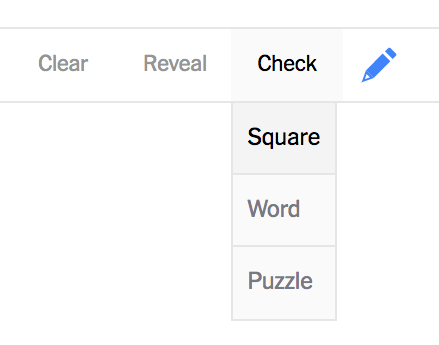
Since I solve on the New York Times website, I’m given the options to “check” the puzzle, which validates or invalidates the currently filled in squares, or to “reveal” a particular square, which fills in the correct answer.

By using these cheats, I can maintain my momentum when I get stuck.

The problem is… if I use these cheats too liberally, my brain won’t be engaged enough to learn anything, and if I use these cheats too sparingly, each puzzle will take too long. I need to find the perfect balance.

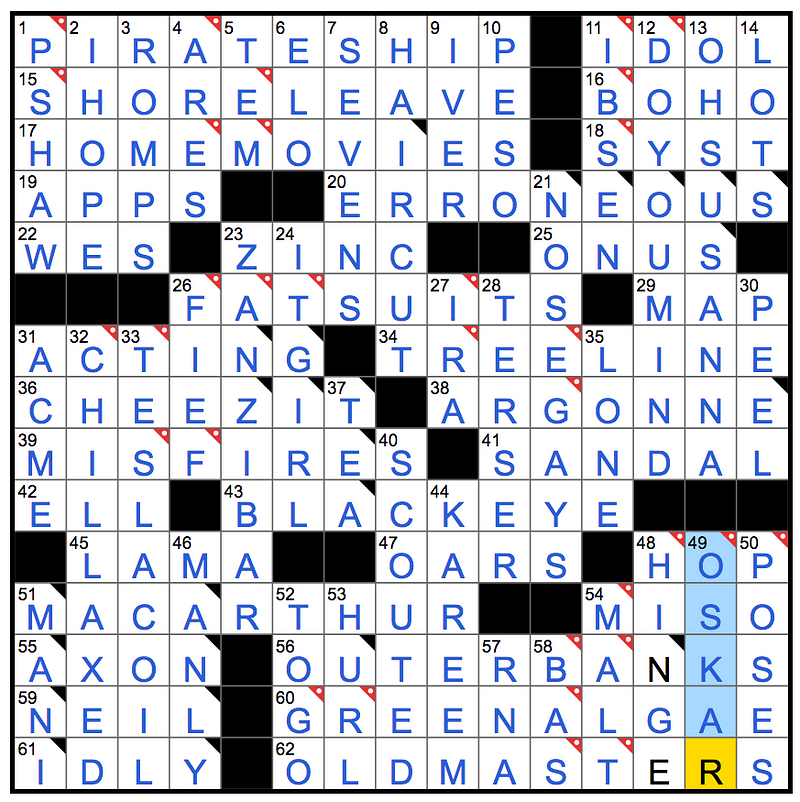
Today, I experimented with this balance, and was able to cut my solve time to around 20 minutes on average, using a cheat on 27% of the squares (the red triangle means I “revealed”, and the black triangle means I “checked” and the previous guess was incorrect).
This 10-minute reduction is already a promising start, but I still need to cut a lot more time.

To be honest, I don’t want to cut more time: The fun part about solving a puzzle is the hopeless struggle. Without the struggle, the puzzle loses all of its appeal. The struggle is really the entire point.

But, of course, right now, I’m not trying to optimize for enjoyment (although, it definitely helps as a motivator). Instead, I need to optimize for pattern recognition, which lives in the sweet spot between no struggle and all struggle.

I’m not sure how I know where this sweet spot is. After all, it’s hard to say whether my failure to identify patterns is because of my liberal use of cheats, or because I haven’t seen enough puzzles, or because there just aren’t obviously-learnable patterns. But, I’ll have to do my best.

This is going to be an interesting balancing act.

Read the next post. Read the previous post.

Max Deutsch is an obsessive learner, product builder, guinea pig for Month to Master, and founder at Openmind.

If you want to follow along with Max’s year-long accelerated learning project, make sure to follow this Medium account.

Learning
Life
Language
Brain
Life Hacking
Recommended from ReadMedium