avatarJose Luis Ontanon Nunez

Summary

Ludwig van Beethoven, a renowned composer who likely struggled with dyslexia, left an indelible mark on music history with iconic works like "Moonlight Sonata" and "Symphony №9 in D minor," despite facing personal challenges such as hearing loss and a difficult upbringing.

Abstract

Beethoven, born around December 16, 1770, was a musical prodigy who, despite a harsh musical education under his father, rose to prominence in Vienna as a pianist and composer. His innovative compositions, including "Moonlight Sonata," "Symphony №5 in C minor," and "Für Elise," were created even as he grappled with progressive hearing loss beginning at age 26. Beethoven's legacy is cemented by his masterpieces such as the "Hammerklavier" and "Choral"

100 Dyslexics in 150 Words or Less, Ludwig van Beethoven

Born approximately 16/12/1770, Beethoven’s father taught him beating him for each mistake. Gave his first concert at seven,

He moved to Vienna to continue studying. His reputation as a pianist grew and began mastering the counterpoint technique.
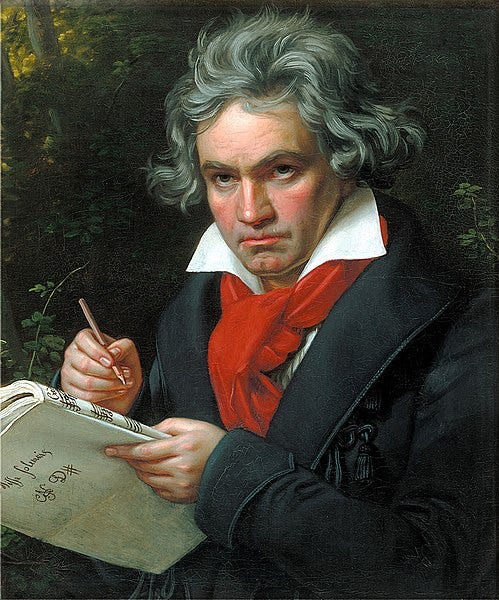
Wikimedia Commons Public Domain

Beethoven started losing hearing at 26, but composed many concertos, like Moonlight Sonata, Symphony №5 in C minor, Bagatelle in A minor, ‘Für Elise’, Piano Sonata №29 ‘Hammerklavier’, Symphony №9, ‘Choral’, and Fidelio his only opera.

All critics considered him one of the greatest composers of all time.

Beethoven died on 03/26/1827 of hepatitic cirrhosis.

Beethoven struggled with sums and spelling his entire life, biographers hypothesize he may have had dyslexia.

“Music comes to me more readily than words.”

— Ludwig van Beethoven

Illumination
Dyslexia
Success
Writing
Music
Recommended from ReadMedium