
LSD vs. Magic Mushrooms: Is There a Difference?
The main differences — and similarities — between the experiences
Clouds and plants appeared to breathe all around me. The ground changed colors as I danced to the background music. The figures and faces of my friends appeared to sharpen as if they were cartoon characters.
I was definitely on acid.
An overwhelming feeling of love and gratitude for the simplest of things, like the lilypads in the water or the plants on my porch. Things around me appeared as if they were almost holographic. The various shapes and obscure patterns on my ceiling looked like they were morphing and dancing.
I was definitely on shrooms.
The Fear Factor
I was 16, young, and impressionable when I first heard about LSD and magic mushrooms.
It was psychology class. We were watching a documentary intended to scare us out of ever using drugs. The drugs in question? Marijuana, cocaine, MDMA, LSD, and shrooms, of course.
That was the last time psychedelics crossed my mind before I tried them out for myself when I was 24. Yep, even despite the documentary’s plea for me not to.
My first “trip” was on the 4th of July with some of my closest friends. After a few booze-filled days, one of my friends offered an alternative: a tab of acid. I wasted no time in putting the tiny tab under my tongue and waiting for it to work its magic. And oh, it really did work its magic.
All I thought about for weeks was that trip and the amazing insights and visuals I saw. I was completely in awe of how powerful of an experience it was.
Just a few months later, I had my first psilocybin trip. It was late in the evening on a Friday night and I was home alone. While this experience was extremely different for me, it was just as powerful and insightful.
This Is Your Brain on Psychedelics
Each specific psychedelic experience varies. But the way that psychedelics affect our brains remains consistent across the board.
Increasing evidence shows that psychedelics can change the way the neurons in our brain connect with each other. In this regard, LSD and shrooms both influence the activity of serotonin in the brain.
Neurotransmitters are chemical messengers that transmit a signal from a neuron. Serotonin is a neurotransmitter used by the nervous system to carry messages between brain cells and muscles cells. See the connection yet?
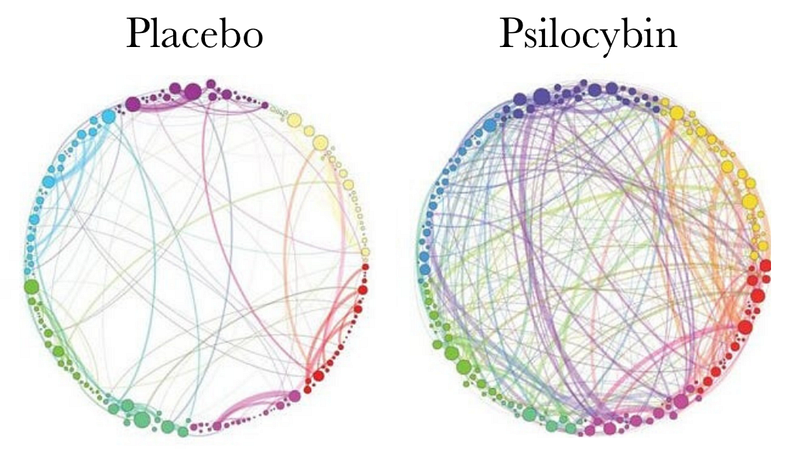
LSD and shrooms fire up these receptors in a seemingly chaotic way, disrupting the brain’s “autopilot” function. In layman’s terms, these substances allow neurons to work through connections that normally wouldn’t occur.
As we can infer from this graphic, the brain becomes more flexible, expansive, and creative on psychedelics. It’s easier to come to realizations and associations we normally wouldn’t and can unravel completely new ways of thinking about the world — and ourselves.
LSD vs. Psilocybin: The Differences

While the two psychedelics have similar baselines, certain experiences differ. Here are some specific examples of how the experiences may vary:
- LSD can last anywhere from 8–16 hours; shrooms usually last 4–6 hours
- LSD visuals are fractal and symmetrical; shrooms tend to be liquidy, holographic, or dancing
- LSD tends to feel fun and energizing; shrooms feel more introspective and reflective
The biggest difference between the two substances is your amount of self-control with where the psychedelic trip will go. As noted in the photo above, LSD is like you’re driving the car whereas shrooms feel like you’re in the backseat of a taxi cab.
Meaning…when you take a tab of acid, you feel more in control of how your trip proceeds. With shrooms, it’s unpredictable and completely reliant on how you’re really feeling at the time of consumption. I can 100% confirm that comparison.
Despite the varying experiences, the other main difference between the substances is that LSD is synthetic, while shrooms are 100% natural. In laymen’s terms, the only risk you run with shrooms is getting a bad batch with less psilocybin in it. With LSD, you run the risk of taking something fake.
P.S. — this can be avoided with the help of a test kit.
Anyways, LSD was discovered by Albert Hoffman in 1938. It’s a clear, odorless, and tasteless drug made from lysergic acid, which is found on a fungus that typically grows on grains. On the other hand, there are an estimated 200+ species of psychedelic mushrooms that can be found between the U.S., Mexico, and South America. Shrooms are a polyphyletic — an informal group of fungi that contain psilocybin, which turns into psilocin upon ingestion.
LSD vs. Psilocybin: The Similarities
A 2019 study found that LSD and psilocybin mushrooms produced the most similar effects of all psychedelic drugs surveyed. Participants were posed with 76 different questions about their experiences, and researchers found no significant differences between reports of LSD and psilocybin trips.
The similarities reported included:
- Distorted perceptions of time
- Hallucinations
- Visual fluidity (seeing stationary objects move/melt)
- Altered sense of smell, taste, and/or touch
- Feelings of unity with others and the surrounding world/heightened levels of “spirituality”
- Refreshed perspective on life or problems
And in the event of a “bad trip”, both substances can incite severe paranoia, anxiety, elevated heart rate, fear, and more. But that’s not what we’re talking about right now.
As aforementioned, one of the main differences is that LSD is man-made while shrooms are all-natural. But…both come from fungus, right?
Right! So, while LSD is synthetic, it mimics the biological activity of the fungus it was derived from, which ultimately makes its structure similar to psilocybin.
Key Takeaways
At the end of the day, LSD and shrooms can vastly differ — from the lessons learned during the trip to the visuals to the way they get in your hands.
But, one dominant similarity between the two is that their therapeutic amounts are skyrocketing. Research has consistently shown that both psilocybin and LSD are capable of delivering lasting anxiety-reducing, antidepressant, and anti-addictive effects.
Not everyone should dip their toes into the psychedelic pool. If you or a family member have a history of severe mental health problems or chronic heart conditions, the use of psychedelics is not suggested.
As always, please do ample research for yourself before taking psychedelics. While they’re not known to be addictive like other drugs, both invoke intense, mind-altering, and sometimes exhausting experiences like nothing else.
But they’re totally worth it.


