
Fiction
Loyalty
A story of an odd-sized casket
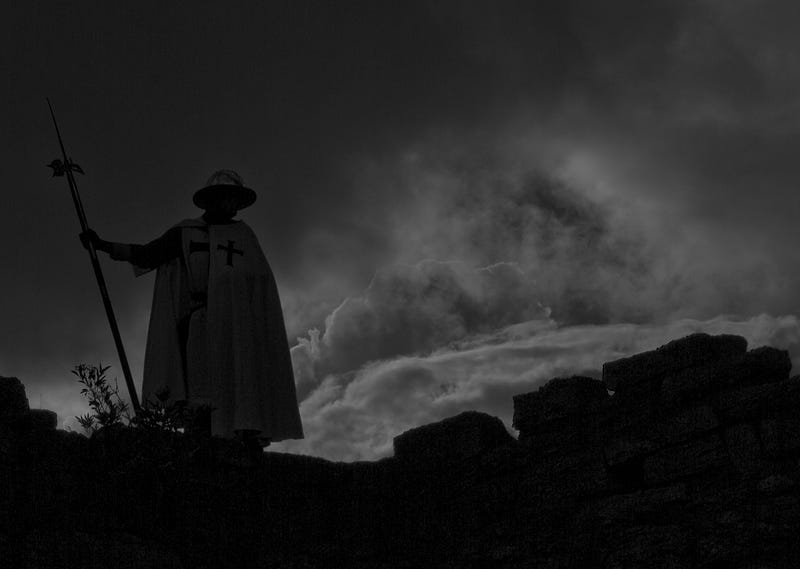
This story was my entry to the Owl Canyon Press Hackathon #4 (2020). Winning stories can be found here; although my story was not selected, I still think it is worth sharing. The first and last paragraphs were provided by the contest. The challenge was to write eighteen paragraphs to fill in the middle (for 20 paragraphs total), each with no less than fifty words.
It was an odd-sized casket, too small for a man, too big for a child. A flag was draped over it, a smallish one. It was carried by four men in uniform, though it was hard to tell for sure from a distance what uniform it was, or even if they were all men. There wasn’t room for the usual six pallbearers due to the small size of the casket since it would have made for a comical service to have all six jammed together, shoulder-to-shoulder, crowding around an under-sized coffin. So the extra pallbearers were in the ranks of many others in uniform standing beside a small open grave. The officiant wore a robe instead of a uniform and must have said something because there was a long silence, then a burst of laughter.
Laughter, at a time like this? I thought, watching the procession through narrowed eyes. It would seem as though some of the soldiers were not taking the occasion seriously, and such defiance of solemnity could not be tolerated. No, it would not do at all. Were His Majesty to hear them, the loyal men and women of His Majesty’s Army, gadding about on such an occasion — well, the outcome would be disastrous to us all. His anger would be immeasurable. What had the officiant said? I walked closer to the procession, and asked quietly of the Major General, whose thick moustache hid a thin, scar-like mouth incapable of laughter. He looked at me askance and said, without humour, “All dogs go to heaven.”
What a joke to make on such a day as this! With His Majesty’s beloved companion not yet cold in the ground, the victim of a heinous crime. The poisoner, still unidentified, might even be here, standing among His Majesty’s trusted Generals, hiding in uniform, or in dark mourning clothes. Women in veils ringed the procession of uniforms, some daubing their eyes with black handkerchiefs, others standing in groups of two or three, whispering behind paper fans. One standing alone caught my eye; behind the thick black veil, veined with silver thread, not even the suggestion of a face could be made out. Man or woman, the figure stood straight-backed, as though apprehensive, and distinctly apart from a small group of weeping mourners. Could this be the perpetrator? I wondered, raising my hood. Obscured by its shadow, I weaved my way through the throng of gathered bodies as the casket, oddly shaped though it may be, was lowered gracefully into the waiting grave.
For His Majesty not to be here was an affront to tradition, and to his own sensibilities, but I had insisted that he watch the funeral from afar. The Royal Gardens, glorious and fragrant in full spring bloom, were bordered on three sides by the palace walls. On one of the many overlooking balconies, mezzanines, and terraces — even I knew not which — His Majesty would be sitting, surrounded by full guard, with a pair of looking glasses for watching the burial. He had insisted that his best friend and livelong companion be buried among the Family, with a plinth and expertly carved statuette to mark his place among the honoured dead. His Majesty would do an unveiling of the effigy in good time, when it was safe to once again walk among his people, but for now the plinth stood empty over the welcoming mouth of the grave. I had seen to it myself that a skilled artiste had been commissioned to carve the tribute; it was coming along nicely, and His Majesty would be pleased to see the lion-like mane of His Royal Companion so lovingly immortalized.
The casket touched the bottom of the grave just as I reached the veiled stranger at the edge of the crowd. A woman cried out; bells were rung across the city; murmured prayers could be heard; the officiant began the official hymn; the six pallbearers — two emerging from the ranks — were handed their weapons and, aiming high, fired one last tribute to the fallen Companion. Birds streamed into the air at the sound. And still the stranger stood straight and still as death itself. Even the veil held still in the spring breeze, as though unmoved by nature’s breath. Such a stillness, a coldness, was unnatural under the bright, warm sun. I lowered my hood and stood to face this adversary, who I instinctively knew was out of place here.
“Show your face,” I demanded, one hand disappearing under my cloak to rest on the butt of my weapon. Those near us, on the edge of the procession, were startled by my voice. I spoke loudly, clearly, and with all the authority my position granted me. “I order you under the authority of His Majesty.”
The stranger was unmoved by my firm declaration, though space was immediately made around us as civilians backed away, fearing crossfire should an altercation occur. Weapons were drawn by the guardsmen and women in attendance. A messenger was sent scuttling back to the palace. The Major General appeared at my shoulder. The officiant continued the hymn, though few were listening now. A shiver ran through me. I straightened my own shoulders, determined not to show any fear. Perhaps this person had poisoned the dog; perhaps he had intended to poison His Majesty. If either were true, an execution was in order. I demanded again, trying for the same level of firmness, but instead almost hissing, “I said, show your face!”
And so, he did. Lifting the veil (oh, how had I not recognized it! His mother’s!), the stranger revealed a familiar young face, unmarked by hunger, illness, or poverty. The hands emerging from the ends of his generous sleeves were pale, uncalloused, and manicured, having not seen a day of work in the fields. His deep brown eyes, usually so warm, were now made cold with the touch of grief. His full mouth was curved into a wordless frown that, in absence of sound, spoke volumes. Disappointment radiated from him. I fell to my knees. What a mistake I had made!
“Oh, Your Majesty!” I cried, devastated at having forced him to reveal himself. How could I not have expected His Majesty to flout my orders — my recommendation, pardon — that he keep far from the funeral procession? His own lifelong companion’s interment could not, of course, go unobserved by His Majesty, despite the danger I perceived in his presence at the gravesite. The young ruler could not help but be present, disguised for his own safety, at the moment the casket was lowered into the ground. How stupid I had been! How quick to act, to draw attention to his quiet, dignified presence! “Forgive me,” I wept, shedding tears unabashed. I was disgraceful. I did not deserve forgiveness for this transgression.
His Majesty held up a hand to quiet the murmurs of the crowd who, shocked at seeing his face, had begun to chatter like nervous monkeys. He was so rarely seen in public, they seemed not to know what to do. A woman curtsied. Another fell to her knees and bent heard head as if in prayer, almost genuflecting. I alone looked to his eyes; I, one of his most trusted advisors, had betrayed his position, and made His Majesty vulnerable. I was to blame for this spectacle: I had created it.
“Do not be afraid,” His Majesty said, voice confident and deep beyond his years. “I am not afraid. I stand before you all, on this solemn occasion, for I could not bear to be alone on this day.” His voice, his countenance, his very posture demanded attention and respect. Hats were removed, eyes were lowered. He spoke evenly, taking a step forward and extending his slim, clean hand. “Stand, my friend. Stand beside me as we say goodbye to the most faithful of companions. No human being could be so loyal, so loving, as a dog raised from pup. I pity those who have never had a dog by their side as I have had. The joy of training him, of seeing his bravery in the face of adversary, of knowing his complete and utter devotion. Are any of you so devoted to me? Can I trust any man or woman to be as he was? As faithful? As steadfast?”
I took the soft hand and stood, feeling ashamed as I met His Majesty’s eyes. “I shall try, Your Majesty, to honour you as your dog has honoured you.” I clasped my hands in front of myself and lowered my gaze. “I fear no man capable of being so faithful a companion, but I shall try. I swear by it, Your Majesty.”
His Majesty inclined his head in the barest nod to acknowledge my pledge. Then, as though floating an inch above the ground, he glided to the graveside, in full view of all in attendance. “I was told it was unsafe to be here, among my own people!” he boomed, and any still murmuring fell silent. “An attempt was made on my life — ” Someone in the crowd gasped. “And took that of my most trusted advisor.” I felt the sting of that phrase, as though I had been slapped. The dog, of course, had ranked above me; but to hear it so plainly stated hurt in a way I had not expected. “This dog — as many are fond of reminding me — gave his life in service to me. Who among you would do the same? Who among you will swear your life to me?” He met my gaze again, this time over the grave where his best friend in all the world would eternally rest. To make such a show of strength as this moment of vulnerability was strategically brilliant; his father, buried only yard away, would have been proud. His grandfather, and his father before him, all would have knelt for this man, barely more than a boy, who commanded such presence.
“I will,” I declared, kneeling. I bowed my head and took my weapon from my side. I placed it on the freshly turned earth beneath our feet and laid my hands beside it. Another voice, wavering slightly, said, “I will,” and did the same. Another, and then another: men and women, soldiers and civilians, went to their knees in a show of deference and faith in their ruler. It would have been beautiful to behold, had I looked up, but I dared not. I felt and heard the movement of bodies to the ground, the thud of their knees, the rasps and whispers of their voices. For surely no member of His Majesty’s Army, and no one in attendance here, could resist this call for fealty. All fell silent as a cool breeze swept over the Royal Gardens. A chill ran down my spine, as if in warning.
“Major?” His Majesty asked. “Will you wear your life to my service?” I raised my eyes and saw the Major General, still on his feet in front of me. All others had knelt. Kneel, damn it, I thought. Do your duty. He unholstered his weapon to lay it before him — or so I thought. In slow motion, he raised it. In slow motion, hundreds of hands reached for their own weapons, lying useless in the dirt. I didn’t bother with mine: I lunged awkwardly from my kneel toward the Major General, my body on autopilot. I had not trained for this; I had been taught how to attack in the conference hall, the courtroom — not the battlefield. I was a man of investigation, of argument, not of violence. But what good is an advisor without good impulses? I was only a second too late.
He fired a shot. Birds sprung up from the bushes and trees, darkening the sky. A strangled cry fell from my mouth as I impacted the Major General’s knee — too late to knock him off balance and skew the shot. His Majesty dropped, first to his knees and then forward, pitching into the grave of his best friend and most loyal companion. Dozens of bodies descended upon the general, tearing at his clothes and flesh, battering his body with cries of anguish.
I was close enough to the traitor to hear his last words, before they were drowned out by his own whimpers and the screeches of a wronged public. He said, “He was weak!” and “It was only a dog!” and “A child cannot rule us!” I wept as I crawled to the graveside and saw the officiant and two soldiers pull His Majesty’s lifeless body from the casket. I was told later that the Major had shot true: there could have been no saving him, even with the swiftest and most competent care.
“Let him be!” I cried, as they pulled him from the body of the one being who had never betrayed him: that dog. Barely older than a boy, His Majesty had held the devotion of a nation, but none more so than that dog. None were as loyal, not even me. In my weakness and short-sightedness, I had exposed him. I had caused this. I alone was to blame. “Let him be,” I whimpered, “Let them be together.”
In the end, it was decided that the boy and his dog should spend their eternal rest together. To avoid the new regime — whatever that may be — desecrating the bodies, or some other horror, it was decided that they should be buried quickly and without much ceremony. Woodworkers were hired in a hurry to build a casket sized for two: one man, one dog. The gravediggers, so recently engaged, were rehired to expand the dog’s place and make room for His Majesty. His father’s funeral had taken weeks to plan, the body kept on ice while His Majesty — then really only a boy — had been prepared for the role, with that dog by his side. As they had ruled, so shall the rest: side by side.
The grave wasn’t ready until sunset, so the whole event was rushed and disorganized, except for the very last part. The grave was a massive affair, more of a crater than a grave, and it took until dark to roll the casket down to the bottom. If any prayers were said, they couldn’t be heard over the dull thudding of the clods raining down on the casket far below. It was an odd sized casket, too big for a man, too small for a dream, but just right for a dynasty.
Support the author:
If you’re enjoying my content, consider showing your support by buying me a coffee. If you sign up using my referral link to get unlimited access to all of Medium, I receive a small commission.
To see more of my work, follow me on Medium or check out my personal nonfiction, nonfiction journalism and longform fiction. I do not monetize poetry or flash fiction. My novels are temporarily out of print; find out why in my article, “The Dreamspinner Press Controversy.” You can also find me on Twitter or like my public Facebook page.


