
Lowlights of the Palace on Wheels
The Bhikari Experience
As promised, this article gives you the lowlights of traveling on the luxury train, Palace on Wheels (POW). If you haven’t already done so, you can read about the highlights first.
The two main lowlights of the experience are Poverty and Corruption. Both concepts are not new to people living in developing countries with a high density of population and a huge gap between the rich and poor.
Sidenote: My sub-heading for the highlights was “The Maharani Experience.” Maharani means Queen. The sub-heading for this essay is “The Bhikari Experience.” Bhikari means beggar.
The people and their stories
I end up chatting with people and understanding more about their livelihood and lifestyles. To me, the best part about traveling is learning about people, and their stories either have a tale to tell or a lesson to teach.
CRam was a 25-year-old man who earned his living polishing shoes and repairing sandals for passengers on the POW. He didn’t have fixed prices for his services but relied on what the generous tourists gave him by way of tips. I would see him on the platforms of each of the POW stops (Jaipur, Chittaurgarh, Udaipur, Jaisalmer, and Jodhpur).
CRam collected the shoes of the POW passengers in the morning and returned them by the time the train was ready to depart from the station in the evening. All the saloon captains and staff on the train had his mobile phone number and were able to reach him when a passenger needed his shoe-polishing services. It’s only logical to assume (at least I did) that he worked for POW and traveled on the train. After all, he was there at every station.
It was not until we reached the penultimate stop on the trip (i.e., Jodhpur) and the last stop in Rajasthan, that I struck a full-fledged conversation with CRam about his plans for the future. He said that he was already married, but had no kids.
To my utter dismay, I learned that he did not have the luxury of traveling with the staff on POW. Instead, he took the local train that ran on the parallel tracks and caught up with the POW at every station. He has been doing this since he was 8-years old, hence the familiarity with the staff on the train.
This was his livelihood for eight months of the year when the train was in operation. When asked what he did during the off-season, he said he gets by with some work in his village. CRam wanted my mobile number and when I asked what he would do with it, he said he would contact me during his off-months.
He said if people like me gave him Rs. 15,000 — Rs. 20,000 (~$200–270), it would help “poor people” like him get by during the off-months. I couldn’t help but tell him he needed to think of a better plan that was far more sustainable than relying on donations from the generous passengers.
Meet Vicki
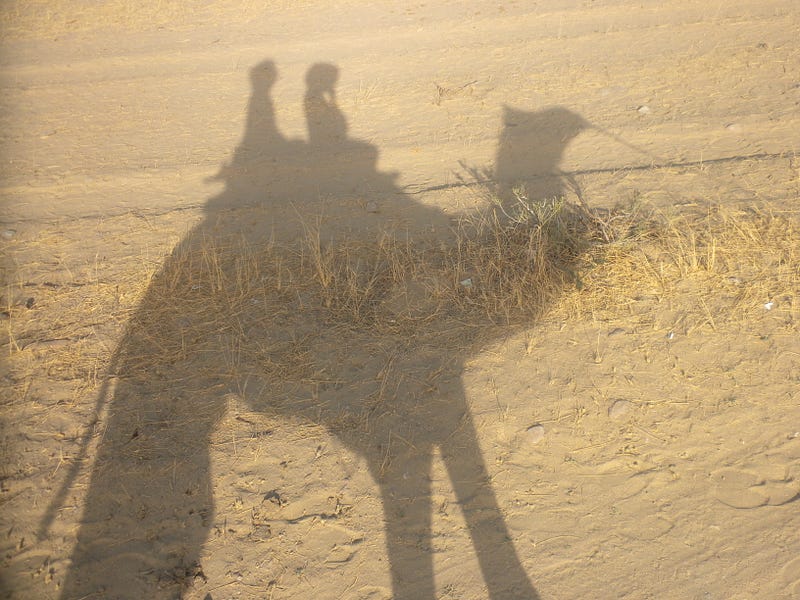
Vicki (a.k.a Vikram) was an enterprising young male, also in his early twenties. I met Vicki in the Thar desert during our 30-min camel ride. He spoke fluent English, with an exaggerated American accent. He earned his living selling ice-cold King Fisher beers to tourists riding the camel. He was one among 3–4 other young lads who would run after the tourists on their camel ride. You are thinking, how could this be a lucrative business?
Let me tell you. If you took a beer that cost about Rs. 100 and sold it for Rs. 400 to foreign tourists, you would make a profit too. By this point, I was just amazed at the number of jobs this POW train had generated.
Yet again, I engaged in a conversation with Vicki (who was running behind us) asking him about his future plans. He said his goal in life (immediate future goal, I guess) was to get married. When asked what came next, he said to have a “good child.” As simple as that! However, when my friend asked him what he planned to do, he said he was saving up money to buy his own camel one day.
On a different note, I don’t know how much it costs to ride a camel, as our ride was included in our tour; but riders were advised to tip the camel man no more than Rs. 100. At the end of the ride, we gave our camel man double the suggested tip (i.e., Rs. 200)for his services and he was not happy.
Meet Mr. D
Then there was Mr. D, a saloon captain aboard the POW. A very courteous, middle-aged man who took very good care of passengers in his saloon. He was responsible for one of the coaches, coordinated activities, and kept the rooms clean with help from his assistant. Throughout the trip, he reassured us that our valuables would be safe under his watch and that he was a very honest person.
He was very timely in meeting every single request of the passengers, made breakfast, and carried shopping bags. Surely, not an easy job but he did it all. He was a resident of one of the cities we visited in Rajasthan and got to visit his family for a few hours when the train stopped at that station.
He travels 8 weeks at a stretch, living aboard the POW, and doing his job. After all the passengers settled their respective bills on the train, Mr. D comes up to one cabin saying they still needed to pay for 7 beers that were not included in the main invoice, and that these beers needed to be paid by cash. If our friend Vicki was selling a bottle of beer for Rs. 400 in the desert, the beer cost Rs. 430 on the POW + tax.
Being that it was the last day, the passengers truly did not have enough Indian currency to pay for these beers but were confused as it to how these beers were excluded from the main bill that was settled using a credit card.
It wasn’t until I was called to help with this situation, more so of the possible communication barrier, that I realized that Mr. D was doing exactly what Vicki was doing in the desert. The only difference was that Mr. D was “biting the hand that was feeding him.” In my opinion, Vicki scored better on the integrity scale and just came ahead being called “enterprising.”
Poverty and Corruption
In my highlights of POW, I wrote that the passengers on this train are typically shielded from poverty. But if one looked closely it would be visible.
What struck me about CRam and Vicki was not just their need to earn a simple living but how their thinking was so simple. They were only able to think about the here and now. Their future goals included marriage and kids. There was no sustainable financial plan for the future. They were content living life one day at a time.
Mr. D, on the other hand, compromised on his integrity to make that extra buck. I was appalled to see the corruption on board the POW. I am certain that Mr. D is not alone in doing what he does and there are many others who do this on a larger scale on the POW, and in India.
I sat with an uneasy feeling for weeks after the trip. I contemplated writing to the Government of India and the Tourism Board of Rajasthan, the two operating bodies of the POW, about the corruption. Then again, I didn’t want to cost these folks the only livelihood that they had by ratting on them.
Again, poverty and corruption are not things that most people would notice. But I did — maybe because of my need to connect with and understand people better or maybe because I am an Indian hoping to see people do better for themselves and for society.
Can you relate to the stories of poverty and corruption in other places you’ve visited?
I’d love to read your thoughts in the comments section. If you’d like to join medium to read my work and that of other writers, you can do so using the referral link.


