
Urban Living
Low-Cost Housing Chains People to Cars
A look at the intersection of walkability and affordability

While recently sitting at a café in Sausalito enjoying the bay breeze on a warm afternoon, it occurred to me the busboy clearing the next table must have had a long commute. The houses that nestle into the hillside with views of San Francisco and the East Bay are well out of my league as are the sailboats in the harbor. The nearest community with any affordable housing would be San Rafael and as for low-income housing, I doubt I could find a place within an hour of where I was sipping an iced latte.
Pre-Covid, my commute was 15 minutes by car and I had taken public transportation once. The bus trip took an hour and only got me within a mile and a half of my office. Public transportation in San Diego, like most U.S. cities, has a few corridors where light rail and express busses take the burden off major commutes but quickly becomes useless once departing the main arteries.

I am fortunate to live near two grocery stores, a large pharmacy, a half dozen cafes, and several very good restaurants. The area is rated at 92% walkability as scored by walkscore.com. Since I moved here, the local business district and many homes and apartment buildings have been upgraded increasing to prices of real estate. This is good news for me, but what about the workers? They are just as much a part of the community and the area would be even better if the shopkeeper or barista lived down the street. A friendly exchange at the counter would be more relevant and meaningful for both of us. Instead, I limit topics to more general subjects.
Those who work low-wage jobs in walkable neighborhoods are forced to own and maintain a car or endure long commutes on public transportation. This affects more than the busboy I saw. The list of jobs paying less than $15/hour includes sales clerks, food service workers (front and back of house), healthcare workers, and anyone cleaning anything.

The Affordability Lie
Nearly every article I read about affordable, walkable areas in U.S. cities identifies less chic areas. This is fine for upper-middle-class professionals looking to reduce the stress of driving to every service needed, however, it ignores the needs of those same services for staff who can easily get to work. Many low-wage workers hold down two jobs to make ends meet and travel time is uncompensated.
The argument that not owning a car will compensate for the higher rent is flawed. It overlooks the cost difference between owning a car, $797/month on average, and the “walkable premium” which easily exceeds that amount. According to Redfin, a 1 point rise in Walk Score adds about 1 percent to the price of a home and thus rents as well. Some transportation costs will still need to be accounted for whether it’s a bus pass or an Uber ride. The assumption that a lot of jobs in an area make living in that area possible does not work for service workers. Rents for walkable areas with lots of restaurants are notoriously high.
Looking at affordability using city-wide averages rather than calculating on a per neighborhood basis can also lead to the wrong conclusion since walkability is, by definition, a radius that can be walked. I live in the very walkable Normal Heights, not the city of San Diego.
The Intersection
Areas of low and high-income housing typically have lower walkability. Affluent neighborhoods are intentionally distant from noise and often have lot sizes that make going to a market require starting up the Tesla or Range Rover. Poor neighborhoods are simply skipped by grocery chains and other services as not being profitable or even risky to be in.
Charting the intersection of rents and walkability scores for San Diego neighborhoods shows the best areas are going for over $2,000/month, while acceptable areas have rents above $1,500/month. This is out of reach for anyone making less than $36K annually.
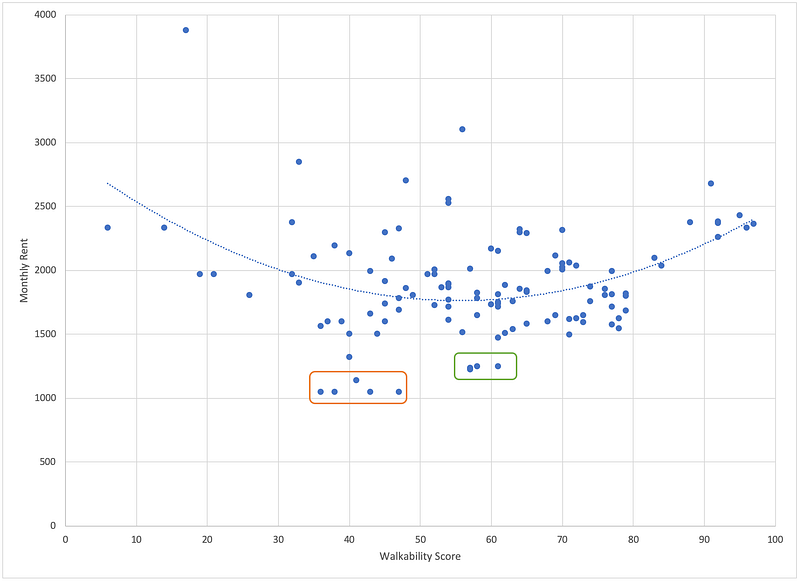
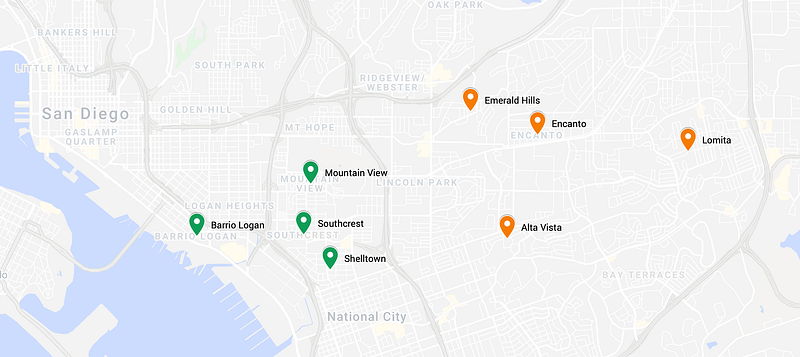
The sweet spot for a walkable area with low rent is in the area south of downtown San Diego where rents average $1,250. Most guidelines will use 30% of income for housing but let’s be real and use a higher estimate of 50%. This means the green box in the chart will require an hourly rate of $16.87, a bridge too far at the $14/hour California minimum wage.
Mapping the data shows the rent increase also provides cooler locations closer to the bay. Barrio Logan is within walking distance of downtown and the Gaslamp Quarter, however, because of proximity with the shipyards there are air quality issues.
Every major city in America has this problem where workers are priced out of areas where service sector employment exists.
All workers need the option to live where their job is. It is better for the worker, better for the patron, and better for the planet.
Inclusive Planning
Cities are working on creating walkable neighborhoods and even developers are getting into the game though mainly to benefit from increased property values. We need to ensure these efforts are inclusive of lower-income areas and not just the upper-middle-class neighborhoods.
Improved Transportation
Enhancements to neighborhoods take years and sometimes decades even if included in the city master plan. Public transportation improvements can provide some near-term relief by stretching access to walkable areas.
Inclusive Development
The creation of affordable housing in semi-affluent areas is a good interim measure but is not always possible as land values and low housing stock puts pressure on developers to turn a profit without governmental subsidies. Rent control is a third-rail I won’t touch.
Wage Increases
Increasing low wages is the single fastest solution for allowing low-wage workers access to housing in walkable areas. As illustrated, an increase to $17/hour can lead to access in areas with better walkability, resulting in a win/win for everyone. The Fight for 15 movement is pushing this idea and now it’s time to push the fight even farther. In California, we should say the Fight for 17.
Sources
“Average Rent in San Diego & Rent Prices by Neighborhood — RENTCafé.” RENTCafé, www.rentcafe.com/average-rent-market-trends/us/ca/san-diego. Accessed 14 July 2021.
“Get Your Walk Score.” Walk Score, www.walkscore.com. Accessed 15 July 2021.
Indeed Editorial Team. “10 Jobs That Pay Minimum Wage or More.” Indeed Career Guide, 23 Feb. 2021, www.indeed.com/career-advice/finding-a-job/jobs-that-pay-minimum-wage.
“Server Salary in San Diego, CA.” Indeed, www.indeed.com/career/server/salaries/San-Diego--CA. Accessed 15 July 2021.
Showley, Roger. “San Diego: Not Made for Walking — The.” San Diego Union-Tribune, 5 Sept. 2016, www.sandiegouniontribune.com/business/growth-development/sdut-walkability-ranking-walkscore-2013apr04-htmlstory.html.


